The Illusion of Failure
A recent evaluation of local and cloud-based Large Language Models (LLMs) presented a dire picture. The initial scoreboard, a seemingly authoritative summary of test runs, reported catastrophic failure rates. Local llama3.2 showed 5 out of 6 evaluations as malformed, while Anthropic Sonnet fared even worse, with all 6 evaluations flagged as malformed. At first glance, the conclusion was clear: both model engines had failed spectacularly. This summary, however, was a mirage, a product of subtle but critical bugs within the evaluation harness itself, not the LLMs.
The raw data, when examined closely, told a different story. The single word 'malformed' was a smokescreen, obscuring three distinct underlying issues. One failure was not a model error at all, but an exhaustion of API credits, preventing a request from ever reaching the Anthropic Sonnet model. Another apparent malformation was traced to a local model response corrupted by terminal control bytes, a leak through the capture path of a Command Line Interface (CLI) tool. The third issue, affecting the Sonnet response, was a valid JSON structure that the scoreboard's parser failed to recognize, leading to a false positive.
Unmasking the Capture Layer Bugs
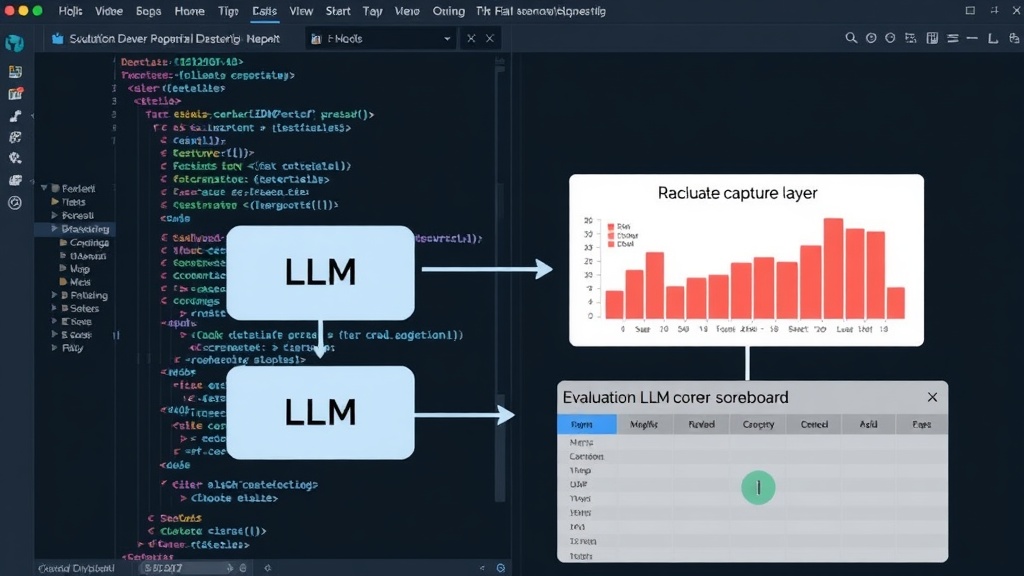
The core of the problem lay not in the LLM inference, but in the intermediary layers responsible for capturing and processing the requests and responses. These capture layers acted as gatekeepers, and in this case, faulty ones. The terminal control bytes, for instance, are special sequences of characters that control cursor movement, text formatting, and other display functions on a terminal. When these bytes were inadvertently included in the LLM's output and then passed through the capture mechanism, they corrupted the raw response data. This corrupted data was then presented to the evaluation harness as 'malformed' output, even though the LLM itself might have generated a perfectly valid response initially.
Similarly, the misinterpretation of valid JSON highlights a common pitfall in data parsing. A valid JSON structure, when passed through a capture layer that perhaps adds extraneous characters or fails to properly delimit the JSON object, could be rendered unparsable by the evaluation script. The scoreboard, relying on a simple parsing check, would then incorrectly flag the entire evaluation as a failure. This is akin to a librarian rejecting a perfectly good book because a single page was dog-eared – the content is sound, but the presentation has an artifact.
Sentry's Role in Diagnosis
This is where application monitoring and error tracking tools like Sentry become invaluable. Instead of just seeing a summary score, developers and engineers can use Sentry to drill down into the granular details of each request and response. Sentry captures exceptions, logs, and performance metrics across the application stack. In this scenario, Sentry could have been configured to monitor the capture layer processes. When terminal control bytes corrupted a response, Sentry would log this as an unusual data anomaly or a specific parsing error within the capture module, distinct from an LLM generation failure.
When a valid JSON response was misinterpreted, Sentry could potentially flag the response content itself, showing the raw, uncorrupted JSON. It could also log errors related to the parsing logic within the evaluation harness, pinpointing the exact line of code or module failing to handle the data correctly. By providing detailed breadcrumbs – the sequence of events leading up to an error – Sentry allows engineers to trace issues back to their root cause. In this case, it would have revealed that the 'malformed' status was a symptom of a capture layer bug, not a fundamental flaw in the LLM's output.
The Third Integrity Seam
The resolution of the two capture-layer bugs exposed a third, more fundamental integrity issue: the scoreboard's design itself. The initial reliance on a simple 'malformed' flag, without deeper inspection capabilities, meant the scoreboard was brittle. It could not differentiate between genuine model failures, data corruption during transit or capture, or parsing errors within the evaluation framework. This revealed a deficiency in the overall integrity monitoring of the evaluation pipeline. A robust system should not just report failures, but categorize them, providing actionable insights into where the breakdown occurred.
The lesson here is critical for anyone building or evaluating LLM systems. The infrastructure surrounding the models – the data capture, the request handling, the response parsing, and the aggregation of results – is as complex and prone to failure as the models themselves. A failure in these surrounding systems can easily be misattributed, leading to wasted effort in debugging non-existent LLM problems.
Moving Forward: Robust Evaluation
To prevent similar illusions of failure, developers must implement comprehensive monitoring and logging at every stage of the evaluation process. This includes:
- Capture Layer Monitoring: Ensure that data integrity is maintained as requests and responses pass through capture mechanisms. Log any anomalies or corruption events.
- Response Parsing Validation: Implement rigorous validation for all expected data formats, such as JSON, and log specific parsing errors.
- Error Categorization: Design evaluation frameworks that categorize failures. Differentiate between LLM generation errors, data corruption, infrastructure issues (like API limits), and parsing failures.
- End-to-End Observability: Utilize tools like Sentry to provide detailed traces and context for every evaluation run, allowing quick identification of the failure point.
By adopting these practices, teams can move beyond superficial scoreboards and gain genuine visibility into the performance and reliability of their LLM deployments. The goal is not just to know if an evaluation failed, but precisely why and where, enabling targeted fixes and more trustworthy results.