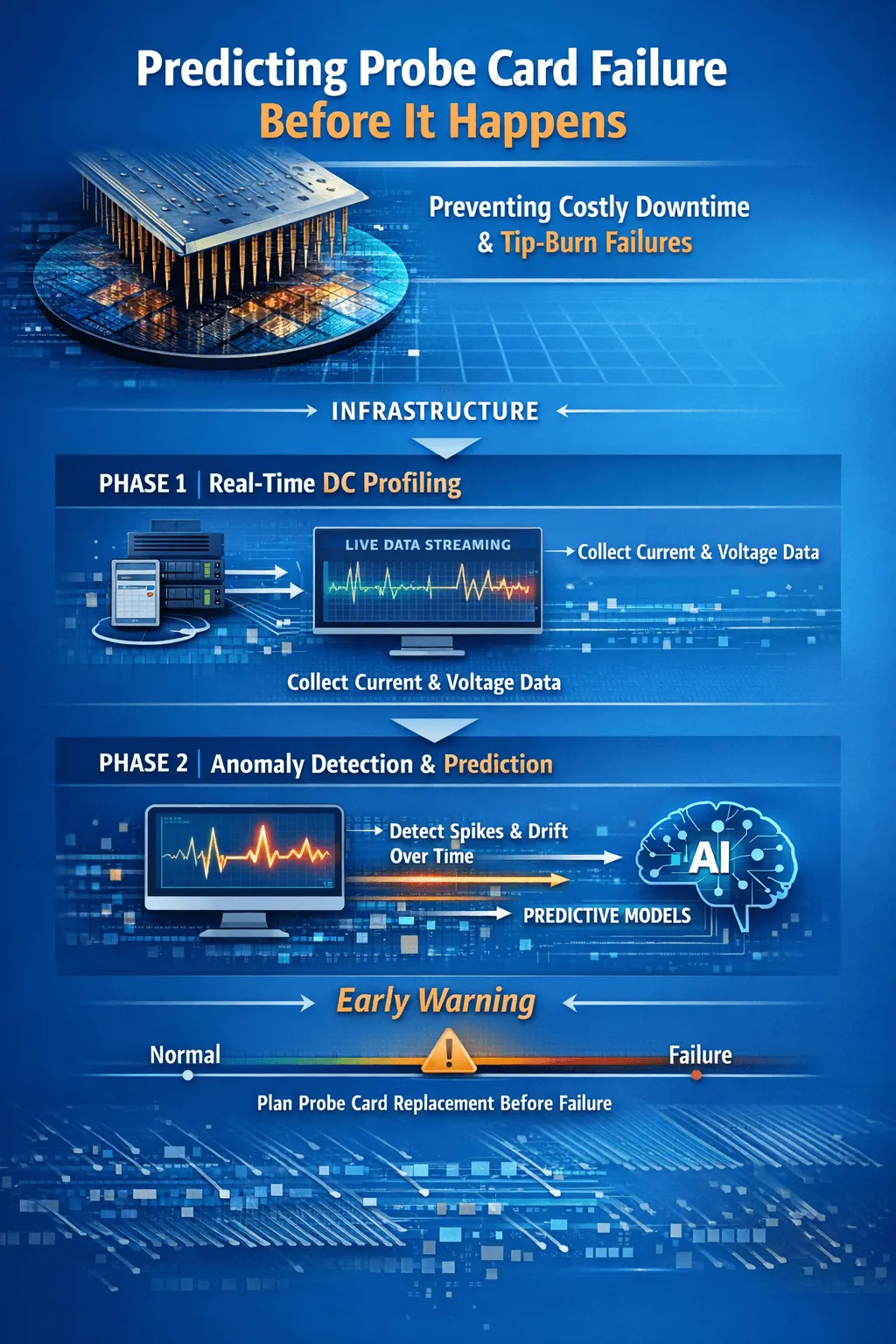
The Shift from Reactive to Predictive in Wafer Testing
The semiconductor industry operates at the bleeding edge of precision and efficiency. Every nanosecond of downtime, every fraction of a yield percentage point, translates into significant financial implications. Traditionally, maintaining the complex ecosystem of wafer test environments has been a largely reactive process. When a probe card, the critical interface between the wafer and the test equipment, showed signs of degradation or failure, it was replaced. This reactive approach, while functional, inherently led to unplanned downtime, potential yield loss due to unaddressed subtle issues, and a constant struggle to keep operations stable.
However, a paradigm shift is underway. The integration of real-time data analytics, specifically through DC profiling, is enabling a move towards predictive planning for probe cards. This isn't merely about fixing what's broken; it's about understanding the subtle health indicators of probe cards before they manifest as problems. By continuously monitoring the electrical characteristics of each probe tip during testing, manufacturers can build a comprehensive intelligence profile for every probe card in operation. This intelligence allows for proactive maintenance, optimization, and ultimately, a more robust and efficient wafer test process.
DC profiling, in this context, involves analyzing the direct current behavior of individual probe tips as they make contact with the wafer. This includes measuring parameters like contact resistance, current leakage, and voltage drop. These metrics, when tracked over time and across different test sites, provide an incredibly granular view of probe card health. A subtle increase in contact resistance on a specific probe, for instance, might not be enough to cause an immediate test failure, but it could be an early warning sign of wear or contamination. Without continuous, intelligent monitoring, such indicators would be missed until they escalate into significant issues.
Unlocking Probe Card Intelligence with DC Profiling Analytics
The core innovation lies in transforming raw DC profiling data into actionable intelligence. Instead of relying on periodic, manual checks or waiting for failures, systems can now analyze these electrical signatures in real-time. This continuous stream of data is fed into sophisticated analytics engines that can identify deviations from normal operating parameters. These engines are trained on historical data, learning what constitutes healthy probe behavior and what signals impending issues. This machine learning-driven approach allows for the identification of trends that are invisible to the human eye or traditional testing methods.
Consider the analogy of a car's diagnostic system. Instead of waiting for a warning light to illuminate, modern car diagnostics monitor engine performance, tire pressure, and fluid levels continuously. Alerts are triggered for subtle anomalies, allowing for a mechanic to address a potential problem, like a slow coolant leak, before it leads to catastrophic engine failure. DC profiling analytics for probe cards function similarly, acting as an early warning system for the complex machinery of semiconductor testing. The system can flag specific probes or even entire probe cards that are exhibiting abnormal electrical behavior. This allows for targeted interventions.
The benefits are multifaceted. Firstly, it drastically reduces unplanned downtime. By predicting when a probe card is likely to fail or degrade to a point where it impacts yield, maintenance can be scheduled during planned downtimes. This predictability is invaluable for production planning and resource allocation. Secondly, it directly protects yield. Early detection of probe issues prevents faulty tests from being run, thereby avoiding the misclassification of good dies as bad or vice-versa. This ensures that only high-quality wafers proceed through the manufacturing process. Thirdly, it improves operational stability. Consistent probe card performance leads to more reliable test results, reducing the variability that can plague wafer fabrication facilities.
The Transition to Predictive Planning
The transition from reactive replacement to predictive planning represents a significant leap in operational maturity for semiconductor manufacturers. It moves the focus from firefighting to strategic management of test assets. This predictive capability allows for a more nuanced approach to probe card management. Instead of a binary 'good' or 'bad' state, probe cards can be assigned a 'health score' or a 'remaining useful life' estimate based on their performance trends. This enables a tiered maintenance strategy.
For instance, a probe card showing minor, stable deviations might be scheduled for routine cleaning or recalibration during the next planned maintenance window. A card exhibiting more significant, accelerating degradation might be flagged for immediate replacement, but with ample notice to procure a new one and schedule the swap without disrupting the production line. This level of foresight allows for optimized inventory management of spare probe cards and efficient scheduling of engineering resources.
Furthermore, the data generated by DC profiling analytics can feed back into the design and manufacturing of new probe cards. By understanding which probe geometries, materials, or manufacturing processes are leading to faster degradation or specific failure modes, engineers can refine future designs. This creates a continuous improvement loop, pushing the boundaries of probe card longevity and reliability. The intelligence gathered isn't just for maintenance; it's a vital input for R&D, driving innovation in test hardware itself. The surprising detail here is not the sophistication of the analytics, but how long it has taken for such granular, real-time monitoring to become a standard practice in an industry that relies so heavily on precise measurement.
Broader Implications for Wafer Test Environments
The adoption of real-time DC profiling analytics for probe cards has broader implications for the entire wafer test environment. It contributes to a more robust and reliable semiconductor supply chain by ensuring the integrity of the testing process, which is a critical gate before devices are packaged and shipped. As chip complexity increases and feature sizes shrink, the demands on test equipment, including probe cards, become more extreme. Predictive maintenance is no longer a luxury; it is a necessity for maintaining competitive throughput and quality standards.
The operational stability gained from this predictive approach can also lead to significant cost savings. Reduced downtime directly translates to higher equipment utilization rates. Improved yield means less waste of expensive silicon wafers and fewer re-runs. The ability to optimize maintenance schedules reduces labor costs associated with emergency repairs and allows engineers to focus on more strategic improvements rather than constant troubleshooting. Ultimately, unlocking probe card intelligence with real-time data empowers manufacturers to operate with greater efficiency, higher quality, and enhanced predictability in a highly demanding industry.