The Core Distinction: What's the Difference?
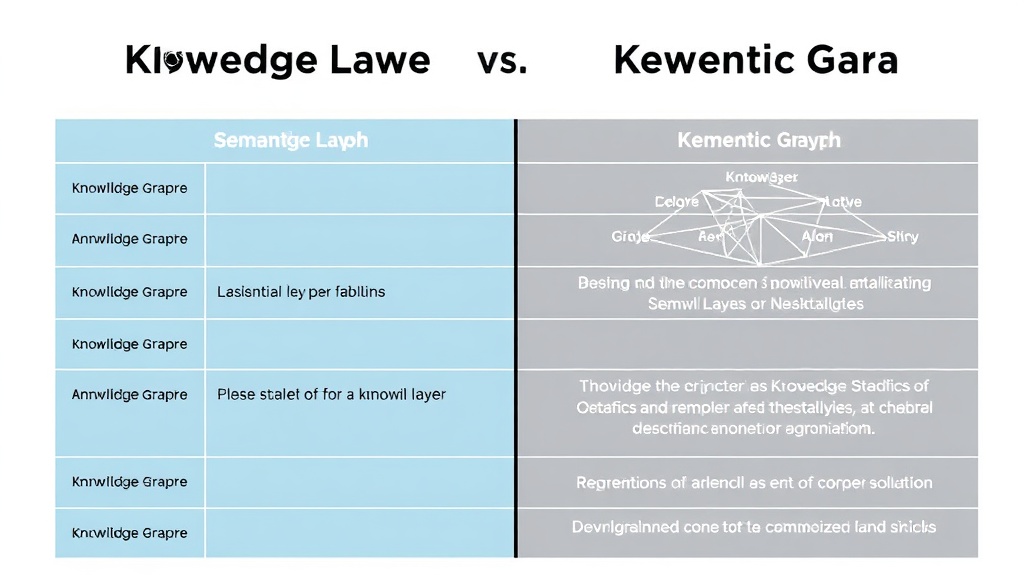
The ongoing debate between proponents of semantic layers and knowledge graphs often feels like two ships passing in the night. Each approach tackles a crucial aspect of making data understandable and usable for AI, but they address fundamentally different problems. A knowledge graph excels at modeling how entities relate to each other, mapping the connections and potential causal chains within your data. Think of it as a highly detailed map of your business landscape, showing not just where things are, but how they connect. A semantic layer, on the other hand, focuses on proving what a number means. It defines metrics, their grain, permissible filters, and the governance rules around them. This is less about the abstract relationships and more about the concrete, quantifiable business logic. You likely need both to build a robust AI data foundation.
The honest division of labor highlights these differences starkly. Knowledge graphs are strong at traversal, inference, and understanding causality – answering questions like "How is X connected to Y?" They model entities and their relationships. Their typical failure mode is ontology drift, where the model of reality subtly changes without anyone noticing. Semantic layers, conversely, are strong at aggregation, definition, and governance. They answer questions like "What is X, exactly, for this person?" by defining metrics, grain, and filters. They struggle with anything not explicitly modeled as a metric and typically fail when a question falls outside the defined metric set.
Knowledge Graphs: Mapping the Relationships
Knowledge graphs are built around entities and the relationships between them. These entities can be anything: customers, products, orders, employees, locations, concepts, or even abstract ideas. Relationships define how these entities interact: a customer *places* an order, a product *is part of* an order, an employee *manages* a team. This structure allows for powerful traversal and inference. An AI agent can navigate the graph to understand complex connections, discover hidden patterns, and even infer causality. For example, by traversing the graph, an AI might identify that a specific marketing campaign (entity) led to an increase in orders (entity) for a particular product (entity) within a certain demographic (entity).
The strength of knowledge graphs lies in their ability to represent complex, interconnected data that doesn't easily fit into traditional relational databases. They are particularly useful for use cases like recommendation engines, fraud detection, supply chain optimization, and complex query answering where understanding the context and connections is paramount. A key challenge with knowledge graphs is maintaining the accuracy and relevance of their ontologies over time. As business operations evolve, the model of reality represented by the graph can drift, leading to incorrect inferences if not actively managed.
Semantic Layers: Defining the Business Logic
A semantic layer acts as an abstraction over raw data, translating technical data structures into business-friendly terms. It defines what metrics mean, how they are calculated, the context (grain) in which they are valid, and the rules for filtering and aggregation. For instance, a semantic layer would define "Total Revenue" not just as a sum of a column, but as the sum of `order_total` for `order_status` = 'completed' within a specific time frame and for a particular business unit. This ensures consistency and accuracy when business users or AI systems query data.
The primary function of a semantic layer is to provide a single source of truth for business definitions, ensuring that everyone, including AI models, is speaking the same data language. It simplifies data access by hiding the complexity of the underlying data sources and provides robust governance, preventing common data quality issues. Its weakness lies in its focus on predefined metrics. If an AI needs to answer a question that requires a calculation or relationship not explicitly defined in the semantic layer, it will fail. This is the typical failure mode: a valid business question that falls outside the pre-modeled metric set.
Why You Likely Need Both
The argument isn't about which is superior, but about their complementary roles. A knowledge graph provides the contextual understanding of how different pieces of data relate. A semantic layer provides the precise, governed definitions of the metrics derived from that data. Consider an AI agent tasked with understanding customer churn. The knowledge graph can identify that a customer experiencing frequent support issues (entity A) who also purchased a specific product (entity B) is at higher risk. However, to quantify that risk, the AI needs the semantic layer to accurately calculate the customer's lifetime value, their engagement score, and the average resolution time for their support tickets.
Without a knowledge graph, the AI might struggle to connect disparate pieces of information, missing critical contextual clues. Without a semantic layer, the AI might misinterpret what