
The Problem of Metric Definition Chaos
Imagine asking your data team, "What was Q1 revenue?" The analyst might query your orders table with a simple sum of amounts. The data engineer, however, might refine that by adding a condition to exclude cancelled orders. Finance, meanwhile, might subtract refunds and trial conversions. Suddenly, three valid queries yield three different numbers, all purporting to answer the same question. This isn't a matter of anyone being wrong; it's a fundamental challenge in how metrics are defined and consumed across an organization.
Multiply this single example across every key performance indicator (KPI), every business unit, and every reporting tool. The result is a fragmented, inconsistent, and often untrustworthy view of business performance. This problem escalates as more teams and more tools interact with the data warehouse, each potentially interpreting core business logic differently. This ambiguity leads to wasted time, incorrect decisions, and a lack of confidence in the data itself.
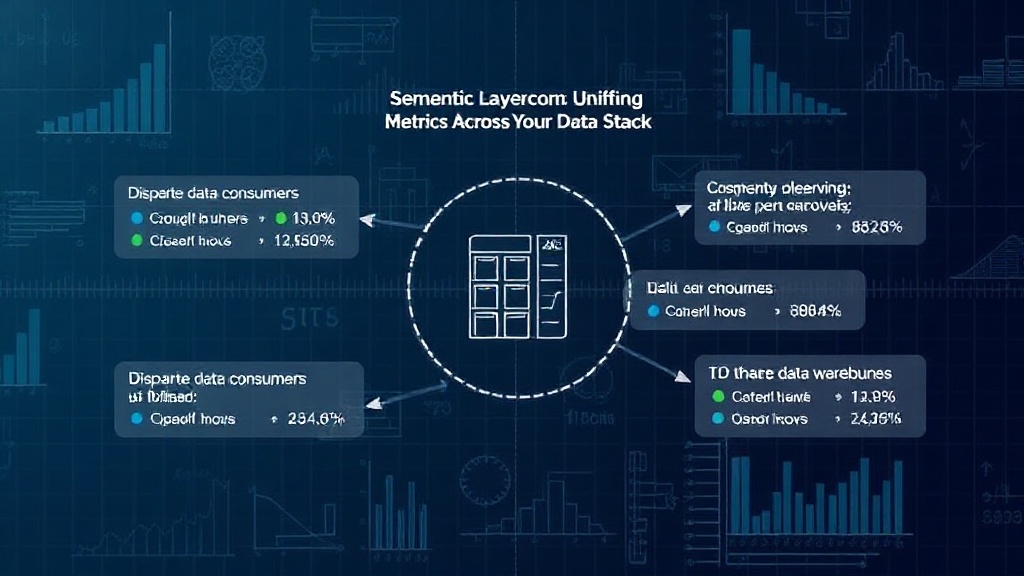
What Exactly Is a Semantic Layer?
A semantic layer acts as a crucial metadata abstraction between your raw data sources, typically a data warehouse, and the diverse array of tools and users that consume that data. Its primary function is to define business logic and metrics in a single, authoritative location. Think of it less like a database and more like a very organized friend who happens to remember precisely how to calculate every important business figure, and ensures everyone asks them the same way.
Instead of each analyst or tool independently writing SQL or transformation logic to define metrics like "revenue," "customer lifetime value," or "churn rate," these definitions are codified once within the semantic layer. This layer then serves these standardized definitions to downstream applications, including business intelligence (BI) tools, dashboards, data science notebooks, and ad-hoc query interfaces.
This approach ensures that when a report from Tool A and a dashboard from Tool B both display "Q1 Revenue," they are, in fact, calculating it using the exact same underlying business rules. This consistency is paramount for reliable decision-making and fostering trust in data-driven insights.
Key Components and Functionality
At its core, a semantic layer comprises a set of metadata that translates the technical structure of a data warehouse into familiar business terms. This translation typically involves:
- Metric Definitions: Clearly defining how key business metrics are calculated, including any necessary filters, aggregations, and transformations. For example, defining "Active Users" might involve specifying a time window and exclusion criteria for bot traffic.
- Dimensional Modeling: Organizing data around business concepts (dimensions) such as customers, products, dates, and locations, and relating them to factual measures (facts) like sales amounts or quantities. This makes querying more intuitive, allowing users to slice and dice data by dimensions without needing to understand complex table joins.
- Business Logic Encapsulation: Embedding business rules, such as currency conversions, tax calculations, or specific accounting principles, directly into the layer. This ensures that these rules are applied consistently across all data consumption points.
- Data Governance and Security: Often, semantic layers include features for managing access control, ensuring that users only see the data and metrics they are authorized to access. This can also include lineage tracking and data quality checks.
The output of a semantic layer is a unified, consistent view of the data that simplifies analysis and reporting. It abstracts away the complexity of the underlying data warehouse schema, allowing business users to focus on insights rather than data manipulation.
Benefits for Data Engineers and Analysts
The adoption of a semantic layer brings significant advantages:
- Reduced Redundancy: Eliminates the need for multiple teams to reinvent metric definitions, saving engineering and analyst time.
- Improved Data Quality and Consistency: Ensures that everyone in the organization is working with the same, accurate numbers, leading to more reliable insights and decisions.
- Faster Time to Insight: Analysts can query data more efficiently using familiar business terms, accelerating the process of generating reports and uncovering trends.
- Enhanced Data Governance: Centralized definition of metrics and business logic simplifies the enforcement of data policies and security standards.
- Simplified Tooling: BI tools and other applications can connect to a single source of truth for metric definitions, reducing integration complexity.
For data engineers, a semantic layer means less time spent troubleshooting inconsistent reports caused by differing metric interpretations. They can focus on optimizing data pipelines and ensuring data quality at the source, knowing that the business logic applied downstream will be standardized.
Challenges and Considerations
While powerful, implementing a semantic layer is not without its challenges. The initial setup requires careful planning and collaboration between data engineering, analytics, and business stakeholders to accurately capture and codify business definitions. The semantic layer itself needs to be maintained and updated as business requirements evolve, which can become a bottleneck if not managed effectively.
Furthermore, choosing the right semantic layer technology is critical. Options range from open-source solutions and features within existing BI platforms to dedicated semantic layer products. Each has its own trade-offs in terms of flexibility, scalability, ease of use, and cost. A poorly implemented or maintained semantic layer can become a new source of frustration rather than a solution.
The Semantic Layer in the Broader Data Ecosystem
The rise of the semantic layer is a natural evolution in the data stack, driven by the increasing complexity and scale of modern data environments. As organizations move beyond simple reporting to more sophisticated analytics, AI, and machine learning initiatives, the need for a consistent, governed, and easily accessible understanding of data becomes paramount. It bridges the gap between the technical world of data warehousing and the business world's need for understandable, actionable insights.
What remains to be seen is how well semantic layers will integrate with emerging data architectures like data mesh, where data ownership is decentralized. Ensuring semantic consistency across independently managed data products presents a new frontier for this technology.
Conclusion
A semantic layer is an indispensable component for any organization serious about leveraging its data effectively. By centralizing metric definitions and business logic, it eliminates ambiguity, ensures consistency, and empowers both technical and business users with a reliable understanding of organizational performance. It transforms the data warehouse from a raw repository into a source of trusted, actionable business intelligence.