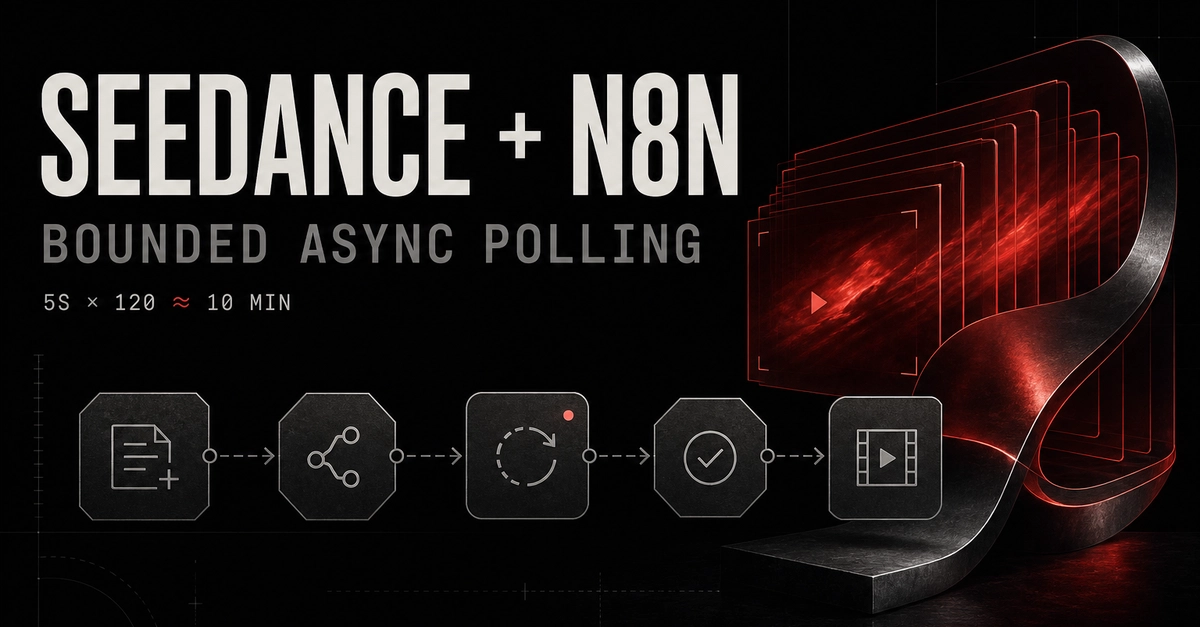
The Challenge of Asynchronous Video APIs
Video generation APIs, by their nature, are asynchronous. Submitting a request doesn't yield a finished MP4 file. Instead, it returns a task identifier. This ID is crucial for tracking the job through the provider's queue, processing, and eventual completion or failure. This fundamental difference transforms a simple automation task into a complex workflow problem.
A production-ready workflow for such APIs must go beyond basic polling. It needs to handle several critical aspects to be robust:
- Exactly-once submission: Ensure the video generation request is sent only one time, preventing duplicate jobs and wasted resources.
- State preservation: Reliably store and pass the
task_idand any loop configuration settings from one node in the workflow to the next. - Intelligent waiting: Implement a deliberate delay between status checks to avoid overwhelming the API and to respect rate limits.
- Immediate termination: Halt the polling process as soon as the job reports success or failure, conserving resources and providing timely feedback.
- Polling limits: Enforce a maximum number of polling attempts to prevent infinite loops and manage execution time.
- Observable timeouts: Clearly indicate when a job has timed out due to exceeding the polling budget.
This is where the combination of Seedance and n8n becomes invaluable. Seedance provides the core logic for managing these asynchronous operations, while n8n offers a visual, node-based interface for building and orchestrating complex workflows.
Introducing Seedance for Bounded Polling
Seedance is a Python library designed to address the specific challenges of polling asynchronous tasks. It abstracts away the complexities of managing state, retry logic, and timeout conditions. For automation builders using n8n, Seedance can be integrated as a custom node or a Python script within an existing workflow. The library enforces a predefined polling budget, ensuring that the workflow doesn't get stuck indefinitely waiting for a response.
Key features of Seedance include:
- Configurable polling intervals: Set initial delays and subsequent backoff strategies (e.g., exponential backoff) to manage polling frequency.
- Maximum polling attempts: Define a hard limit on how many times the workflow will check the status of a task.
- Success and failure conditions: Specify what constitutes a successful completion and what indicates a failure, allowing the workflow to branch accordingly.
- Result aggregation: Collect the final status and any associated data upon completion or timeout.
By encapsulating these robust polling mechanisms, Seedance simplifies the development of reliable workflows that interact with asynchronous APIs.
Leveraging n8n for Workflow Orchestration
n8n is a powerful open-source workflow automation tool. Its node-based interface allows users to visually connect different services and logic blocks to create complex automated processes. For developers and automation builders, n8n significantly lowers the barrier to entry for creating sophisticated integrations.
Integrating Seedance into n8n can be achieved in several ways:
- Custom Node: Developing a dedicated n8n node that wraps Seedance functionality. This provides a seamless user experience within the n8n canvas.
- Code Node: Utilizing n8n's built-in Code node to execute Python scripts that leverage the Seedance library. This offers flexibility for those comfortable with Python.
The workflow would typically start with a node that submits the initial request to the video generation API, obtaining the task_id. This task_id, along with the API endpoint and polling configuration, would then be passed to the Seedance integration (either the custom node or the Code node). Seedance would manage the polling loop, checking the API status periodically. Once Seedance determines the task is complete (success or failure) or has timed out, it returns the final status to the n8n workflow, allowing subsequent nodes to handle the outcome, such as downloading the video, logging an error, or triggering further actions.
Building the Bounded Async Polling Workflow
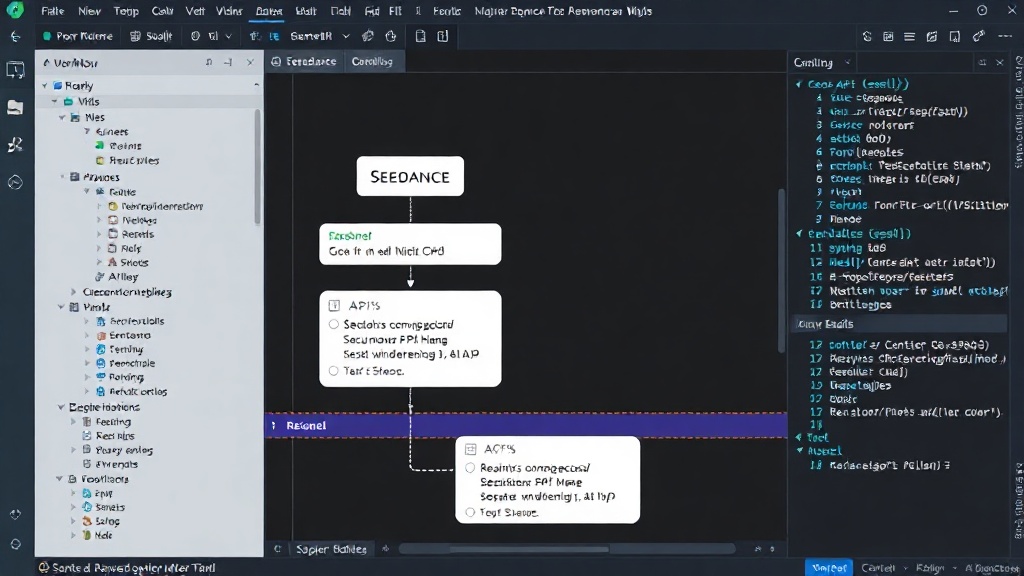
The core of this integration lies in defining the parameters for Seedance within the n8n environment. When submitting the initial video generation request, the workflow must capture not only the task_id but also the specific configuration needed for polling. This includes the URL for status checks, the expected success/failure indicators, and the polling budget (maximum attempts and intervals).
Consider a typical workflow:
- API Submit Node: This node makes the initial POST request to the video generation service. It extracts the
task_idfrom the response. - Seedance Polling Node (or Code Node): This node receives the
task_idand other necessary parameters. It initializes Seedance with the polling configuration. Seedance then takes over, repeatedly calling the status endpoint until a terminal state is reached or the polling budget is exhausted. - Result Handling Node(s): Based on the output from the Seedance node (e.g., 'success', 'failure', 'timeout'), different branches of the workflow can be triggered. A 'success' might lead to a download node, while 'failure' or 'timeout' could trigger notification nodes or error logging.
The surprising detail here is not the complexity of the video APIs themselves, but how a relatively simple Python library like Seedance can abstract away the intricate state management required for robust asynchronous operations. It transforms a potentially fragile polling mechanism into a predictable, bounded process. What this means for automation builders is a significant reduction in the effort required to integrate with services that don't provide immediate responses.
Implications for Automation Builders
This integration empowers developers and automation builders to create more reliable and resilient workflows. Previously, handling asynchronous tasks often required custom scripting or complex state management logic within the automation tool itself. Seedance, when coupled with n8n's visual interface, provides a structured and observable way to manage these operations.
For instance, a marketing team could automate the creation and delivery of personalized video content. They submit a request for a batch of videos, and the n8n workflow, powered by Seedance, manages the waiting and retrieval process. Once all videos are ready, the workflow automatically distributes them. This level of automation was previously difficult to achieve without significant development overhead.
The use of a bounded polling mechanism is critical. It prevents workflows from consuming resources indefinitely. If a video generation job hangs or fails on the provider's end, the workflow will eventually time out gracefully, allowing for manual intervention or alternative actions. This predictability is essential for production systems.