The gut-wrenching moment of realizing you just committed sensitive credentials to a public repository is a fear shared by developers worldwide. Even a quick `git push` can expose API keys, database passwords, or configuration secrets. Once leaked, these credentials must be rotated immediately, a process that can be time-consuming and disruptive. Malicious actors and automated scrapers can detect these leaks within seconds, making swift prevention paramount.
To address this critical vulnerability at the source, Mahdy Yarmonfared developed Secret-Scrub. This Node.js command-line interface (CLI) tool acts as a pre-commit hook, scanning code for secrets *before* they enter your Git history. It boasts zero external dependencies, ensuring easy integration into any Node.js project, and offers a one-click installer for Git pre-commit hooks. Its core innovation lies in its dual-layer detection engine, combining traditional regex matching with Shannon entropy analysis for more robust secret identification.
Dual-Layer Detection Engine
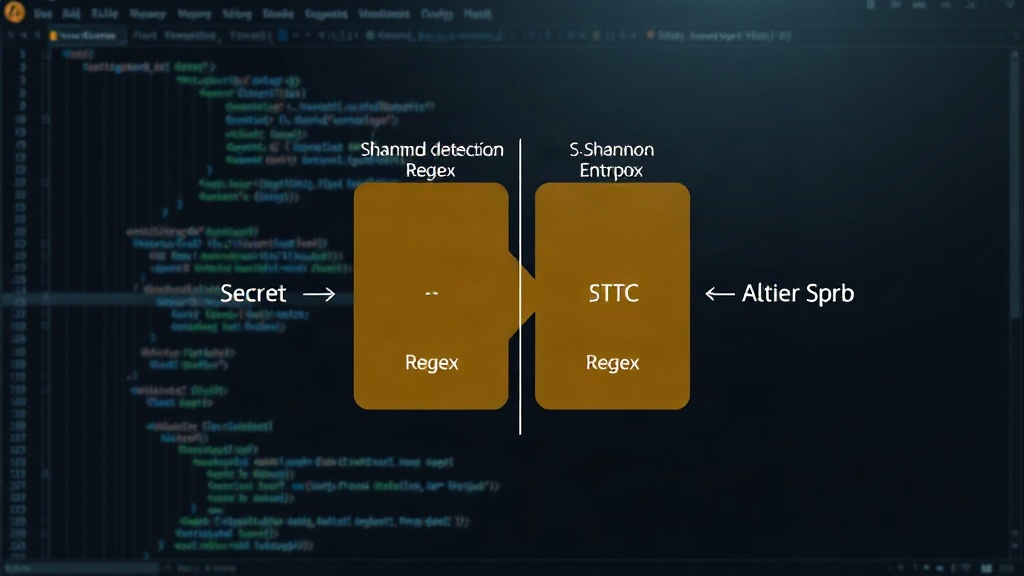
Relying solely on regular expressions for secret scanning is insufficient. Vendor-specific formats evolve, and secrets don't always conform to predictable patterns or prefixes. Secret-Scrub's architecture tackles this by employing a two-pronged approach:
The first layer uses a curated set of regular expressions to identify commonly known secret formats. This includes patterns for API keys, private keys, passwords, and other sensitive information that adheres to established structures. However, this layer alone is prone to false positives and can miss novel or obfuscated secrets.
The second, more sophisticated layer leverages Shannon entropy analysis. Shannon entropy is a measure of the randomness or unpredictteness in a string of data. Highly random strings are less likely to be naturally occurring code or text and more likely to be generated secrets like API keys or encryption salts. By calculating the entropy of potential secret candidates, Secret-Scrub can flag strings that exhibit characteristics of generated secrets, even if they don't match a predefined regex pattern. This combination significantly reduces false negatives and increases the accuracy of secret detection.
Zero-Dependency and Pre-Commit Integration
A key design principle behind Secret-Scrub is its zero-dependency nature. This is crucial for a pre-commit hook, as it means developers don't need to install a complex runtime environment or a multitude of packages just to run the scanner. A clean, dependency-free tool is easier to install, maintain, and ensures consistency across different development environments. This approach prevents potential conflicts with existing project dependencies.
The tool's integration with Git pre-commit hooks is designed for maximum developer convenience. A pre-commit hook is a script that Git executes before it finalizes a commit. By placing Secret-Scrub within this workflow, it automatically scans staged files for secrets. If any secrets are detected, the commit is blocked, providing immediate feedback to the developer. This ensures that no secrets are accidentally committed.
The one-click installer simplifies the setup process, abstracting away the manual configuration often required for Git hooks. Developers can quickly enable Secret-Scrub without needing deep knowledge of Git's hook system, making it accessible to a broader range of users.
Performance and Use Cases
Secret-Scrub is engineered for speed. The zero-dependency architecture and efficient scanning algorithms ensure that the pre-commit hook runs quickly, without significantly slowing down the developer's workflow. This is essential for a tool that is executed on every commit.
The primary use case is preventing the accidental leakage of secrets into version control systems, especially public repositories like GitHub. This protects against unauthorized access to cloud resources, databases, and internal systems.
Beyond public repositories, Secret-Scrub is valuable for private codebases as well. While internal breaches might be less common than public leaks, maintaining strict control over sensitive credentials is a fundamental security best practice. It can also serve as an educational tool, highlighting to developers the importance of credential management and secure coding practices.
The tool's design also implies a broader philosophy of developer-centric security tools. By building lightweight, zero-dependency utilities that integrate seamlessly into existing workflows, developers are more likely to adopt and benefit from them. This contrasts with more cumbersome, enterprise-focused security solutions that can be difficult to implement and manage.
The Shannon Entropy Advantage
The inclusion of Shannon entropy analysis is what sets Secret-Scrub apart from many basic regex-based scanners. Consider a string like `a1b2c3d4e5f6`. A simple regex might not catch this as a secret. However, its entropy value would be relatively high, indicating a lack of predictable patterns and a higher probability of it being a generated key or token. Conversely, a string like `abcdefg` has low entropy and is unlikely to be a secret.
By combining these two methods, Secret-Scrub achieves a more nuanced detection capability. It can catch secrets that are not yet widely known or that deviate from standard formats, while also avoiding excessive false positives that plague purely heuristic approaches. This makes it a more reliable gatekeeper for code integrity.
What remains to be seen is how effectively this dual-layer approach scales against increasingly sophisticated obfuscation techniques. As attackers develop new ways to hide secrets, scanners like Secret-Scrub will need to continuously adapt their entropy thresholds and regex patterns. Nevertheless, for the immediate threat of accidental commits, it provides a strong, accessible defense.