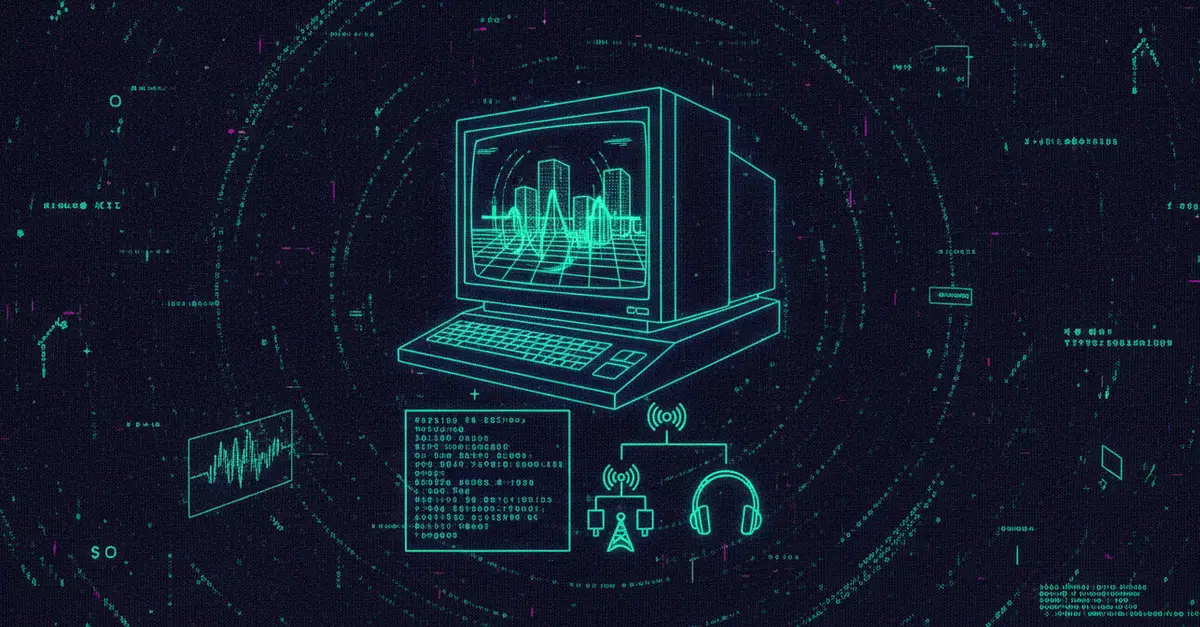
The Unseen Digital Frontier: Sub-GHz Spectrum
Modern security engineers operate with a significant blind spot. Their focus is typically confined to the well-defined digital realm, meticulously auditing TLS 1.3 handshakes, tuning eBPF probes, and enforcing Kubernetes network policies. They treat the Ethernet cable and the 802.11 Wi-Fi frame as the absolute boundaries of the digital universe. This perspective, while crucial for wired and wireless network security, leaves a vast, parallel digital landscape entirely unobserved.
This overlooked domain exists in the airwaves, just outside our windows. It's a chaotic, largely unencrypted wild west of real-time data transmission. Devices like smart meters broadcasting household power consumption, drive-thru headsets leaking audio, municipal traffic sensors relaying congestion data, fire alarms, medical pagers, logistics trackers, and even simple garage door openers are all transmitting raw, unauthenticated data. These devices do not rely on Wi-Fi or IP addresses. They operate in the sub-gigahertz (Sub-GHz) spectrum, and their transmissions are often completely exposed.
This is where Software-Defined Radio (SDR) emerges as a critical tool. SDR allows security professionals to move beyond the traditional OSI model's upper layers and peer into this lower-level, physical layer communication. It transforms the way we can audit and secure the increasingly connected world, offering a lens into devices and protocols previously invisible to standard network security practices.
Why Sub-GHz Matters for Security
The implications of this unmonitored spectrum are profound. Many Internet of Things (IoT) devices, industrial control systems (ICS), and critical infrastructure components utilize Sub-GHz frequencies for their communication. These frequencies are attractive for their longer range and better penetration through obstacles compared to higher frequencies like 2.4 GHz or 5 GHz used by Wi-Fi. However, this often comes at the cost of robust security measures.
Consider a smart meter. It might be broadcasting granular data about your electricity usage. If this data is unencrypted and unauthenticated, an attacker could potentially infer when you are home or away, track your habits, or even disrupt the data flow to the utility company. Similarly, a logistics tracker on a valuable shipment, if transmitting its location unencrypted, could be a beacon for theft. The audio leakage from drive-thru headsets is a direct privacy violation, easily intercepted by anyone with the right equipment within range.
The lack of encryption and authentication in many Sub-GHz devices means that data can be eavesdropped on, modified, or replayed. This vulnerability extends to critical systems. For instance, some older or simpler industrial sensors might communicate vital operational data over Sub-GHz links. Intercepting or manipulating this data could have significant consequences for manufacturing processes, utility operations, or even public safety systems.
SDR: The New Wireshark for the Airwaves
Wireshark is the de facto standard for analyzing network traffic at the packet level. It allows deep inspection of protocols running over Ethernet or Wi-Fi. SDR offers a similar capability, but for the radio frequency (RF) spectrum. Instead of capturing digital packets, an SDR device captures raw radio waves. Specialized software then decodes these captured signals into meaningful data, much like Wireshark decodes network packets.
The process typically involves:
- Hardware: A Software-Defined Radio receiver, such as an RTL-SDR dongle, HackRF, or LimeSDR, capable of tuning into the desired Sub-GHz frequencies. An appropriate antenna is also essential.
- Software: Tools like GQRX, SDR#, Universal Radio Hacker (URH), or even custom Python scripts using libraries like `SoapySDR` or `pyrtlsdr` are used to capture and analyze the radio signals.
- Analysis: Once signals are captured, the software attempts to demodulate and decode them. This can involve identifying modulation schemes (e.g., FSK, OOK, ASK), data rates, and the underlying communication protocol.
This capability is analogous to Wireshark's ability to dissect TCP/IP packets. Where Wireshark shows you the payload of an HTTP request, SDR analysis can reveal the raw data being sent by a garage door opener or a wireless temperature sensor. The complexity lies in identifying the signal, its encoding, and its protocol. Unlike well-documented standards like HTTP or TCP, many Sub-GHz devices use proprietary or obscure protocols.
Bridging the Gap: From Digital to RF Security
The adoption of SDR by security professionals signifies a crucial evolution in security auditing. It acknowledges that the attack surface extends beyond the logical network into the physical RF environment. For organizations with a significant number of IoT devices, smart building technology, or critical infrastructure components, understanding the security posture of Sub-GHz communications is no longer optional.
This shift requires new skill sets and tools. Security teams need to become familiar with RF principles, antenna theory, and the nuances of radio signal analysis. They must learn to identify common Sub-GHz protocols used in various industries, from LoRa and Sigfox for long-range IoT to simpler proprietary protocols for remote controls and sensors.
The challenge is not just in detection but in proactive defense. Once a vulnerability is identified—such as an unencrypted data stream or a weak authentication mechanism—teams need to implement countermeasures. This could involve recommending or mandating devices that use more secure protocols, implementing RF jamming or detection systems in sensitive areas, or developing custom firmware for devices that allows for encrypted communication.
An Unanswered Question: The Scalability of RF Auditing
While SDR provides powerful capabilities for individual device analysis, a significant question remains: how can organizations effectively scale these RF security audits across thousands or even millions of deployed devices? Manually analyzing each signal type is time-consuming and requires deep expertise. Developing automated systems capable of identifying and analyzing a vast array of unknown Sub-GHz protocols presents a formidable technical challenge. The current state of SDR tools is akin to early packet analysis tools – powerful but requiring significant manual effort and specialized knowledge. The path forward likely involves AI and machine learning to assist in protocol identification and vulnerability detection in the RF spectrum, but this is still largely an nascent field.
The Future of Connected Device Security
As the world becomes increasingly connected, the security of all communication channels must be considered. SDR is not just a niche tool for radio enthusiasts; it is becoming an indispensable part of the modern security engineer's toolkit. It allows us to see what was previously invisible, to audit the raw signals that underpin so much of our modern infrastructure, and to close the security gaps that exist in the chaotic, unencrypted expanse of the Sub-GHz spectrum. Ignoring this domain is akin to securing your front door while leaving all your windows wide open.