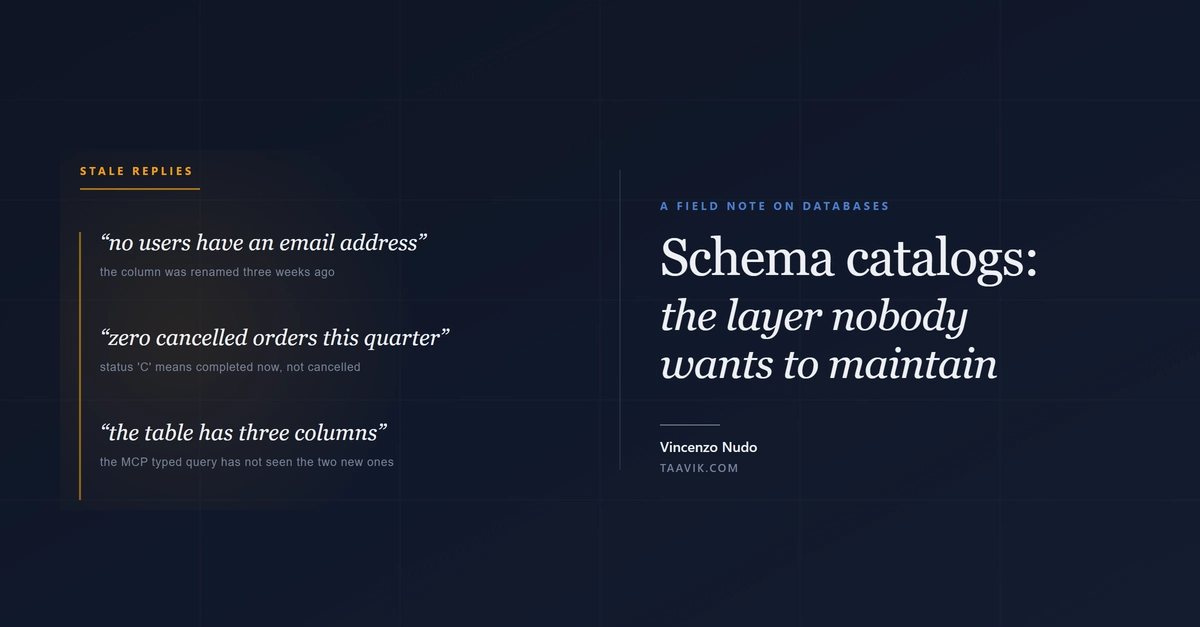
The Unseen Foundation of AI Data Assistants
AI assistants designed to interact with databases face a fundamental challenge: understanding the structure of the data they are querying. This understanding is encapsulated in a schema catalog. Think of it less like a database itself and more like an exceptionally detailed, constantly updated map of a city, showing not just streets and buildings but also their types, relationships, and even the purpose of individual rooms. This map is crucial for an AI assistant to generate accurate queries, whether the underlying database is PostgreSQL, MySQL, SQL Server, or Redshift. It details table names, column names, data types, primary and foreign keys, and enough relational context to enable the AI to construct a valid SQL query. The schema catalog resides between the database and the AI, a critical intermediary that must remain synchronized with a data source in constant flux.
The problem is that this layer, while essential, is rarely glamorous. It's often built hastily, typically over a single weekend when the immediate need for an AI assistant arises. The initial implementation might work seamlessly for the first few tables. However, the complexity and maintenance burden escalate rapidly, usually within weeks. The issues that emerge are diverse and idiosyncratic to each database and its evolving schema.
Connection vs. Knowledge Layers
A crucial distinction to make early on is between the connection layer and the knowledge layer. The connection layer handles the mechanics of how the AI assistant establishes communication with the database. This involves authentication, network protocols, and ensuring the assistant can physically reach the data store. It’s the plumbing. The knowledge layer, on the other hand, is what the assistant knows about the database’s shape – its schema. This is the intelligence that allows it to interpret requests and translate them into actionable queries. While the connection layer receives significant attention, the knowledge layer is frequently the source of persistent, low-level engineering friction. It’s the difference between knowing how to open a door and knowing what’s inside the rooms behind it.
The Maintenance Nightmare
The core of the problem lies in the dynamic nature of most databases. Schemas are not static entities. They evolve as business requirements change, data models are refactored, and new features are introduced. Each alteration to the database schema – a new table, a renamed column, a changed data type, a modified relationship – invalidates the existing knowledge layer. Without a robust, automated process for updating the schema catalog, manual intervention becomes necessary. This is where the maintenance nightmare begins.
Teams often find themselves in a reactive cycle: the AI assistant starts producing incorrect results, prompting an investigation that leads back to an outdated schema catalog. The process of updating this catalog is often tedious and error-prone. It requires developers or data engineers to manually inspect the database, compare it against the catalog, and make the necessary corrections. This is time-consuming work that detracts from more strategic initiatives. Furthermore, the problems are rarely uniform. One week, the issue might be a missing foreign key that prevents a join. The next, it could be an incorrectly inferred data type leading to query errors. Each discrepancy requires a unique troubleshooting approach.
Why This Layer is So Difficult
Several factors contribute to the difficulty in maintaining schema catalogs:
- Lack of Automation: Many organizations build their schema catalogs manually or with ad-hoc scripts. These solutions quickly become brittle as the database schema grows and changes. True automation requires sophisticated introspection capabilities that can detect schema drift in real-time or near real-time.
- Schema Drift: As mentioned, databases evolve. Without a continuous integration/continuous deployment (CI/CD) pipeline for schema changes that automatically updates the catalog, drift is inevitable. This is akin to having a map of a city that only gets updated when a major construction project is completed, leaving you unaware of minor road closures or new one-way streets.
- Complexity of Relationships: Modern databases often feature intricate relationships between tables. Accurately capturing and representing these relationships, especially for complex joins or subqueries, is challenging. An AI assistant needs more than just a list of tables and columns; it needs to understand the semantic meaning and functional dependencies within the data.
- Onboarding Time: The initial setup is deceptively simple. Teams often underestimate the ongoing effort required. The