The Problem with Editing LLM-Generated HTML
Large language models (LLMs) can generate complete HTML documents with remarkable speed. This capability opens new avenues for content creation and automation. However, the process of refining these generated documents often reverts to manual source code editing, which is cumbersome for tasks like proofreading, rearranging content, or making minor editorial adjustments. Traditional HTML editing tools are built for developers, not for the nuances of content refinement. This disconnect creates a bottleneck when trying to iterate on AI-generated content.
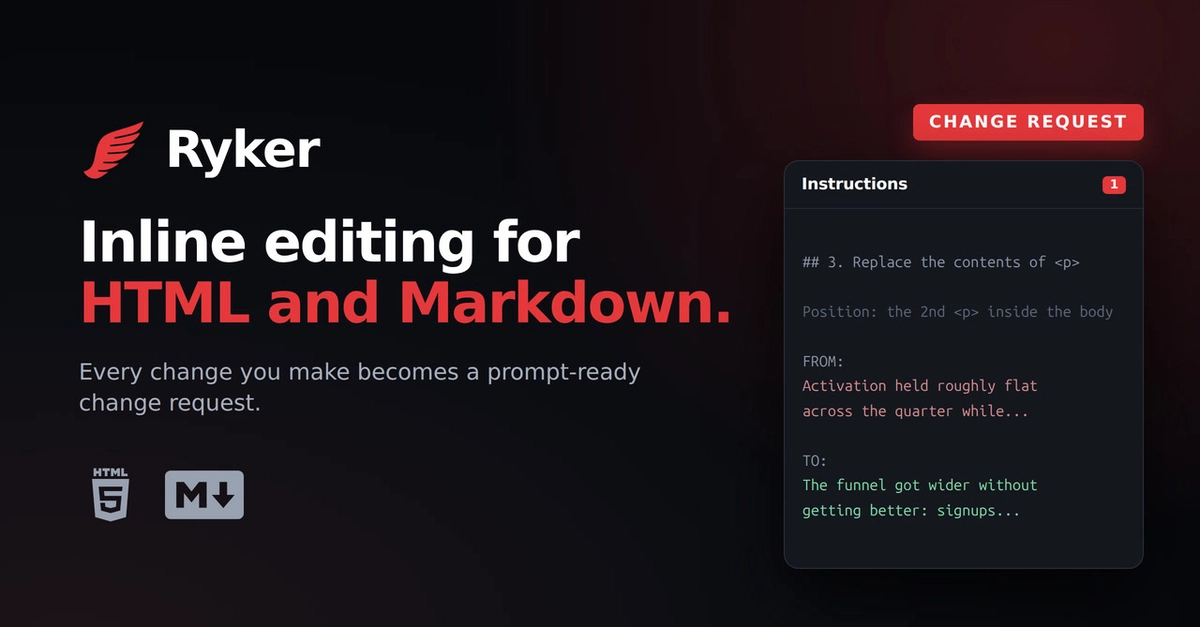
Ryker, a new Chrome extension, aims to bridge this gap. It provides a visual, in-browser editing experience for both HTML and Markdown files. More importantly, it transforms the edits made into a structured format that AI agents can readily consume and act upon. This feature is designed to streamline the workflow between AI content generation and human refinement, allowing for quicker iteration cycles.
How Ryker Works: Visual Editing Meets Agent Integration
The core functionality of Ryker revolves around a simple yet powerful concept: make edits visually, and have the tool record those changes programmatically. When a user edits an HTML or Markdown document within their browser using Ryker, the extension tracks every modification. Instead of just saving the altered file, Ryker compiles these changes into a series of machine-readable requests. These requests are essentially instructions detailing what was changed, where, and how.
Think of it less like a traditional word processor and more like a meticulous assistant who takes notes on every single tweak you make to a document. When you instruct this assistant to "move this paragraph up," they don't just move it; they write down "Paragraph X, originally at position Y, has been moved to position Z." This detailed log is what Ryker generates.

Once the user has finished making all their visual edits and proofreading, they can export this log of changes. This export is formatted specifically to be understood by AI agents. The implication is that a human can perform the high-level content refinement and layout adjustments, and then hand off the precise instructions to an AI agent to implement these changes, perhaps in a larger codebase or a more complex content management system. This creates a closed loop where AI generates content, humans refine it visually, and AI agents then implement the refinements.
The Agent-Ready Change Export
The standout feature of Ryker is its ability to export edits as "agent-ready change requests." This means the output is not just a diff or a patch file, but a structured set of instructions designed for programmatic interpretation. This format is crucial for integrating human feedback directly into automated workflows. For instance, if an LLM generates a blog post that needs minor reordering of sections or adjustments to headings, a human can visually make these changes in Ryker. The extension then generates a request like: "Change H2 heading 'Introduction' to H3," or "Move section 'Key Findings' before section 'Methodology'."
This capability is particularly valuable in scenarios where LLMs are used to generate large volumes of content, such as product descriptions, documentation, or even draft articles. The manual process of editing these outputs can be time-consuming. By converting visual edits into agent-ready commands, Ryker allows for rapid iteration and deployment of refined content. It effectively democratizes the editing of AI-generated HTML, making it accessible to users who may not be deeply technical but need to manage and polish AI-produced text.
Workflow Implications and Future Potential
The workflow enabled by Ryker has significant implications for content creation pipelines. Developers and content managers can leverage LLMs for initial drafts and then use Ryker for the crucial human touch. The exported change requests can be fed into automated systems that update websites, databases, or other content repositories. This reduces the need for manual copy-pasting or intricate code merging.
Consider a scenario where an LLM generates a dozen product pages. Instead of a developer manually checking each page for consistency and making small edits, a content editor could use Ryker to visually adjust headings, add or remove bullet points, and tweak paragraph order across all pages. Ryker would then generate a unified set of instructions that could be applied automatically to update all the generated pages. This dramatically accelerates the time-to-market for AI-generated content.
What remains to be seen is how robust Ryker's change request format will be when dealing with complex DOM manipulations or highly dynamic content. The current focus appears to be on static or semi-static HTML and Markdown. However, the underlying architecture suggests potential for expansion into more intricate editing scenarios. The success of this approach hinges on the clarity and universality of the "agent-ready" format it employs. If this format becomes a de facto standard for human-to-agent change communication, Ryker could become an indispensable tool in the AI-assisted content creation ecosystem.