
RxJS in Angular: Mastering Real-World Patterns
You've journeyed through the fundamentals of RxJS in Angular, from Observables and core operators like map and filter to more complex constructs like Subjects, switchMap, and error handling. This final chapter distills that knowledge into the practical, everyday patterns that define robust Angular applications. It's about moving from theory to production-ready code, understanding not just *what* operators do, but *how* and *when* to apply them effectively, and crucially, what common pitfalls to sidestep.
Pattern 1: The State Service Pattern (Mini State Management)
In the intricate landscape of large Angular applications, state management often emerges as a primary challenge. While NgRx provides a comprehensive solution, it's not always necessary. For many scenarios, a well-structured service leveraging BehaviorSubject offers a lightweight yet powerful approach to managing shared state. This pattern simplifies data flow and makes state accessible across different components without the overhead of a full-blown state management library.
Implementing the State Service
The core of this pattern is a service that encapsulates the state and exposes it via a BehaviorSubject. Components can then subscribe to this subject to receive state updates. The service itself manages the state mutations, ensuring a single source of truth.
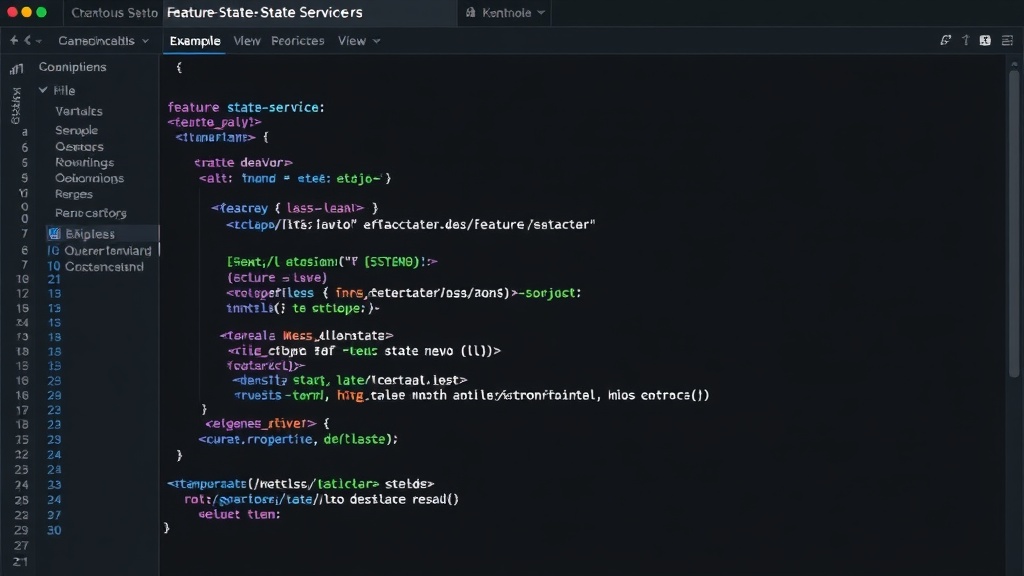
Consider a FeatureStateService. It holds a BehaviorSubject, initialized with a default state. Public methods in the service allow components to query the current state (e.g., via an observable derived from the subject) and to update it. This encapsulation prevents direct manipulation of the state from components, enforcing a controlled update mechanism. When a component needs to access the state, it injects the service and subscribes to the observable. Updates are pushed to all subscribers automatically.
Pattern 2: Handling Asynchronous Operations in Forms
Forms are a ubiquitous part of web applications, and handling asynchronous operations within them—such as validating user input against a server API—is a common requirement. RxJS provides elegant solutions for this, particularly when combined with Angular's reactive forms.
Debouncing User Input for API Calls
A frequent use case is validating a username or email address as the user types. Making an API call on every keystroke is inefficient and can overload your backend. The debounceTime operator is crucial here. It waits for a specified period of silence in user input before emitting the latest value. This ensures that an API call is only made after the user has paused typing, significantly reducing the number of requests.
Following debounceTime, you'll typically use distinctUntilChanged to prevent redundant API calls if the value hasn't actually changed (e.g., the user types 'a', then backspaces, then types 'a' again). Then, switchMap comes into play. When the debounced value is emitted, switchMap subscribes to the inner observable (the API call). If a new value arrives from the source observable before the inner observable completes, switchMap unsubscribes from the previous inner observable and subscribes to the new one. This is vital for forms: if a user rapidly changes input, you only care about the validation result for the *latest* input, not intermediate ones.
Pattern 3: Error Handling Strategies
Uncaught errors can bring an application to a halt. Robust error handling is not an afterthought; it's a fundamental aspect of building reliable applications. RxJS offers operators to manage errors gracefully within an observable stream.
The catchError Operator
The catchError operator is your primary tool for intercepting errors. When an error occurs in the source observable, catchError allows you to handle it. You can return a new observable (e.g., a default value, an empty observable, or trigger a retry mechanism), re-throw the error, or transform it into a more user-friendly format. This prevents the error from propagating further up the stream and terminating the observable chain.
A common strategy is to catch an error, log it to a service, and then return an observable that emits a default value or an empty observable. This allows the application to continue running, perhaps displaying a user-friendly error message. For example, when fetching data from an API, if the request fails, catchError can return an observable emitting an empty array instead of crashing the component.
catchError is particularly useful when dealing with multiple asynchronous operations. If one operation fails, you can isolate the failure and decide how to proceed without affecting other parts of the application that might be running in parallel or sequentially.
Best Practices and Pitfalls to Avoid
Beyond specific patterns, several best practices ensure your RxJS usage remains clean and efficient:
- Unsubscribe Properly: Always unsubscribe from observables when a component is destroyed to prevent memory leaks. The
asyncpipe handles this automatically for template subscriptions. For manual subscriptions, use techniques liketakeUntilwith a subject that emits on destroy, or store subscriptions in an array and unsubscribe inngOnDestroy. - Avoid Nested Subscriptions: While possible, deeply nested subscriptions (a
subscribeinside anothersubscribe) often indicate a missed opportunity to use higher-order mapping operators likeswitchMap,mergeMap, orconcatMap. These operators are designed to handle one observable emitting another observable. - Use
tapfor Side Effects Only: Thetapoperator is for performing actions that don't affect the stream's data, such as logging or triggering analytics events. Avoid using it for transforming data; that's the job of operators likemap. - Understand Operator Order: The order of operators in a
pipematters significantly.mapbeforefilterwill transform data before filtering, whilefilterbeforemapwill filter the original data before transformation. - Choose the Right Higher-Order Mapping Operator:
switchMap: Cancels previous inner observables when a new outer value arrives. Ideal for scenarios where only the latest result matters (e.g., typeahead search, cancelling pending HTTP requests).mergeMap: Runs inner observables concurrently. Useful when you need all results, regardless of order or completion time (e.g., making multiple independent API calls).concatMap: Runs inner observables sequentially, one after another. Use when order is critical and you must wait for each operation to complete before starting the next (e.g., sequential file uploads).
- Be Mindful of Hot vs. Cold Observables: Understand when an observable is