The Harvest-Now, Decrypt-Later Threat
The migration to post-quantum cryptography (PQC) is not a distant theoretical concern; it's a present danger. For projects like Anyhide, where data is inherently persistent and potentially long-lived, the threat of 'harvest-now, decrypt-later' is particularly acute. Adversaries can capture today's encrypted communications and store them, waiting for the day when mature quantum computers can break current encryption standards. This reality forced the Anyhide project to confront the PQC migration head-on, rather than deferring it.
Many projects are understandably hesitant. The landscape of pure-Rust PQC libraries is still nascent. Audits are incomplete, and the practical implications, such as increased wire sizes for certain algorithms like ML-KEM-768 (now a NIST standard FIPS 203), present significant engineering challenges. The common approach is to wait for greater maturity, more robust tooling, and clearer industry consensus. However, the Anyhide team recognized that waiting carries its own substantial risk – the risk of rendering current data vulnerable to future quantum decryption.
Choosing the Hybrid Path in Rust
The decision was made to implement a hybrid encryption scheme. This approach combines traditional, well-understood symmetric encryption (like AES) with a new, quantum-resistant asymmetric algorithm. The rationale is that even if the quantum-resistant component is eventually weakened or proven flawed, the underlying symmetric encryption still provides a layer of security. Conversely, if the asymmetric component proves robust, it guards against future quantum threats. This layered strategy offers a pragmatic balance between immediate security needs and future-proofing against unknown quantum capabilities.
Implementing this hybrid strategy in Rust presented several specific technical hurdles. The core challenge involved integrating the new PQC libraries seamlessly with existing cryptographic primitives. This required careful management of cryptographic contexts, key generation, and the serialization/deserialization of hybrid ciphertexts. The growth in message size due to PQC key encapsulation mechanisms (KEMs) needed to be accommodated without breaking existing data formats or significantly degrading performance for real-time applications.

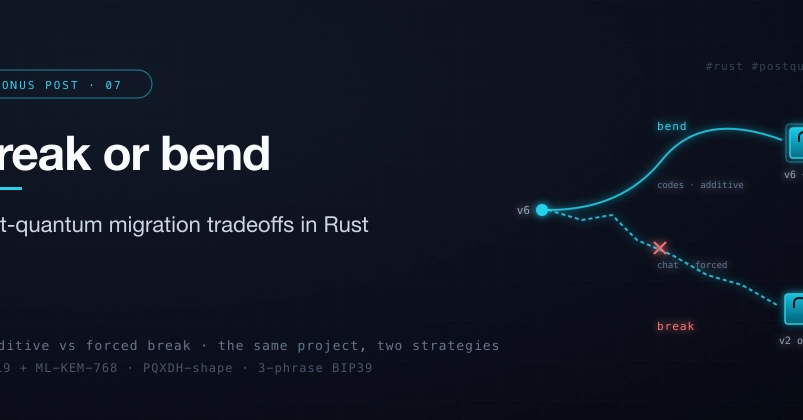
Tradeoffs in Migration: Breaking vs. Bending
The migration process forced a critical examination of tradeoffs. Should the project 'break' existing compatibility to adopt new standards cleanly, or 'bend' existing structures to accommodate new features while maintaining backward compatibility?
For Anyhide, the decision leaned towards 'bending' where possible, but accepting some 'breaks' were necessary. The v0.14 release represented a significant shift. It necessitated changes to the wire format for encrypted messages. This means that messages encrypted with v0.14 and later are not directly compatible with older versions. This is a 'break' from strict backward compatibility. However, the internal implementation of encryption and decryption was designed to 'bend' the existing cryptographic architecture to incorporate the hybrid PQC elements. This involved creating new abstractions and traits that could represent both traditional and hybrid encryption schemes, allowing the core application logic to remain largely unchanged.
One of the key considerations was the choice of PQC algorithms. NIST standardized ML-KEM-768, a key encapsulation mechanism, as FIPS 203. This provides a standardized baseline. However, the Rust ecosystem for these algorithms is still evolving. Libraries like pqcrypto-kem offer implementations, but their stability, performance characteristics, and audit status require careful evaluation. The Anyhide team had to assess whether to use these bleeding-edge libraries directly or to build wrappers and additional validation layers. The choice impacts development velocity, security guarantees, and the long-term maintainability of the cryptographic stack.
The Developer Experience and Ecosystem
The developer experience in Rust for PQC is a significant factor. While Rust's strong type system and memory safety features are ideal for cryptographic software, the PQC libraries themselves are still maturing. This means developers might encounter less comprehensive documentation, fewer examples, and potentially more frequent API changes compared to established cryptographic libraries. The integration process requires a deep understanding of both Rust's concurrency primitives and the intricacies of the chosen PQC algorithms.
Furthermore, the broader Rust ecosystem plays a role. The availability of audited, high-quality cryptographic libraries is crucial. Projects like the RustCrypto group provide a strong foundation for many standard cryptographic primitives. However, the PQC space is newer. Developers must actively seek out and vet PQC implementations, which adds a significant burden. The decision to migrate early, as Anyhide did, means contributing to the maturation of this ecosystem through practical application and feedback.
Future Implications and the Road Ahead
The Anyhide migration is a case study for other projects grappling with the PQC transition. It demonstrates that an early, pragmatic approach is feasible, even with an evolving ecosystem. The hybrid model offers a robust path, mitigating immediate risks while preparing for future threats. The tradeoffs are real: increased complexity, potential compatibility breaks, and the burden of vetting new cryptographic primitives. However, for data with long-term security requirements, the 'harvest-now, decrypt-later' threat makes proactive migration a necessity rather than an option.
The journey is far from over. As PQC standards evolve and Rust libraries mature, further refinements and updates will be necessary. This will likely involve moving towards more standardized, potentially more efficient PQC algorithms as they gain wider adoption and undergo rigorous public scrutiny. The experience gained from this migration will be invaluable in navigating those future transitions. It underscores a critical point: the security of data today depends on anticipating the threats of tomorrow, even when those threats are powered by technologies not yet fully realized.