Unlocking Polars' Potential with Rust
The Polars DataFrame library is celebrated for its speed and memory efficiency, largely due to its Rust backend. However, complex or domain-specific data operations often require custom logic that goes beyond Polars' built-in functions. Historically, extending Polars meant writing Python code that would be translated and executed by Polars, which could introduce performance bottlenecks. The introduction of Rust expression plugins fundamentally changes this paradigm, allowing developers to write custom logic directly in Rust and integrate it seamlessly into Polars workflows.
This new capability is akin to giving a high-performance race car a custom-tuned engine. Instead of relying solely on the manufacturer's standard parts, you can now bolt in precisely engineered components for specific tracks or conditions. For data scientists and engineers, this means the ability to craft highly optimized kernels for operations that are unique to their industry or problem set, without sacrificing the performance gains Polars is known for.
The core idea is to leverage Rust's strengths: its speed, memory safety guarantees, and powerful metaprogramming features. By writing custom expressions in Rust, developers can bypass the Python interpreter overhead entirely for these critical computations. This is particularly impactful for tasks involving intricate numerical calculations, specialized string manipulations, or custom aggregations that are performance-sensitive.
How Rust Expression Plugins Work
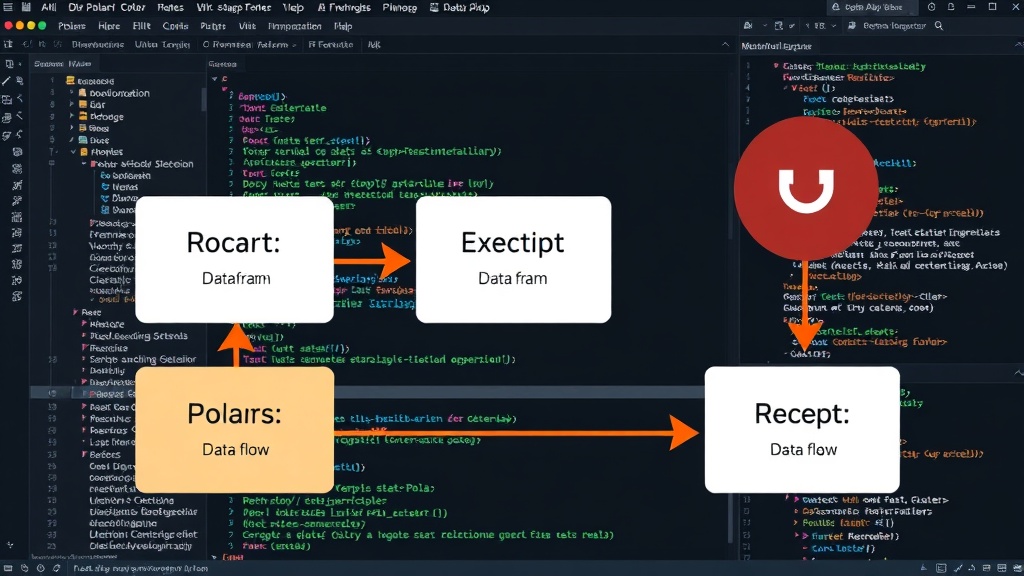
The mechanism involves defining a Rust struct that implements specific traits provided by the Polars API. These structs represent the custom expression. When this expression is used within a Polars DataFrame operation (e.g., a `select` or `with_column` call), Polars serializes the necessary data chunks to Rust, executes the custom logic using the compiled Rust code, and then deserializes the results back into a Polars Series. This process is designed to be efficient, minimizing the overhead of inter-process communication or serialization where possible.
Consider a scenario where you need to perform a highly specialized statistical calculation that isn't available in standard libraries. Traditionally, you might implement this in Python, potentially leading to slow execution. With Rust plugins, you implement the core logic in Rust, compile it, and then call it from your Python (or Rust) Polars script. Polars handles the data marshalling, ensuring that your high-performance Rust code runs directly on the data chunks.
The plugin system is designed to be flexible. Developers can define expressions that operate on single columns, multiple columns, or even window functions. The ability to express complex dependencies between operations within the Rust code itself, and have Polars optimize their execution, is a significant advantage.
Key Benefits and Use Cases
The primary benefit is performance. For computationally intensive custom operations, Rust plugins can offer orders of magnitude speed improvements over Python UDFs (User Defined Functions). This translates to faster data processing pipelines, reduced cloud computing costs, and the ability to tackle larger datasets.
Beyond raw speed, Rust plugins enable:
- Domain-Specific Logic: Implement specialized financial calculations, bioinformatics algorithms, or custom geospatial operations that are not generic enough for core Polars but critical for specific industries.
- Complex String Processing: For tasks involving intricate pattern matching, custom tokenization, or specialized text transformations that are too slow in Python.
- Custom Aggregations and Transformations: Define novel ways to aggregate data or transform Series that go beyond standard `sum`, `mean`, or `apply`.
- Integration with Existing Rust Libraries: If you already have performance-critical codebases in Rust, you can now integrate them directly into your Polars data pipelines without costly rewrites or inefficient bridging.
Getting Started with Rust Plugins
The process involves setting up a Rust project, defining your custom expression struct, and using the `polars-core` and `polars-arrow` crates. You'll need to implement methods that define the expression's behavior, its inputs, and its output type. The Polars documentation provides examples and templates to guide developers through this process.
A typical workflow might look like this:
- Define the Rust Struct: Create a Rust struct that will represent your custom expression.
- Implement Traits: Implement the necessary Polars traits, such as `PolarsExpression` and potentially others related to evaluation and type checking.
- Compile the Rust Code: Build your Rust project into a shared library (e.g., `.so` on Linux, `.dylib` on macOS, `.dll` on Windows).
- Load and Use in Polars: In your Python script, use Polars' mechanisms to load the shared library and then reference your custom expression by name.
The development experience is designed to be as smooth as possible, with clear error messages and robust type checking to catch issues early. However, it does require familiarity with Rust programming concepts and build tooling.
The Road Ahead and Unanswered Questions
While this feature is powerful, it raises questions about maintainability and discoverability. As more custom plugins are developed, managing a growing library of specialized Rust code could become complex. Furthermore, how will the broader community contribute and standardize common custom operations? Will we see a marketplace or registry for popular Rust plugins? The potential for performance gains is immense, but the operational overhead of managing these custom extensions will be a key factor in their widespread adoption.
The ability to write Rust plugins for Polars is a significant step forward for users who need to push the boundaries of data processing performance. It democratizes high-performance computing within the DataFrame ecosystem, allowing developers to tailor data manipulation to their exact needs.