The Friction of Traditional Data Stores for AI
For decades, backend engineering has operated within two primary paradigms: relational databases (SQL) for structured, tabular data, and document stores (NoSQL/JSON) for flexible, unstructured information. While effective for many applications, these traditional approaches introduce significant architectural friction when building for modern AI agents. AI agents do not naturally think in terms of rows, columns, or complex foreign key joins. Similarly, parsing heavily nested, arbitrary JSON text blobs is an inefficient overhead for their operational needs. Agents are fundamentally designed to work with state, context, and entities, and they perform optimally when data mirrors the object structures they manipulate within their runtime environments.
This is precisely the problem Sayan Mohsin aimed to solve with thingd. The goal was to create a memory engine that combined the raw speed of a local relational database with the inherent flexibility of an object-first paradigm. By building natively in Rust, Mohsin sought to bypass the typical performance bottlenecks associated with Object-Relational Mappers (ORMs) and create a more direct, efficient data interaction layer for AI systems.
Designing an Object-Shaped Memory Engine
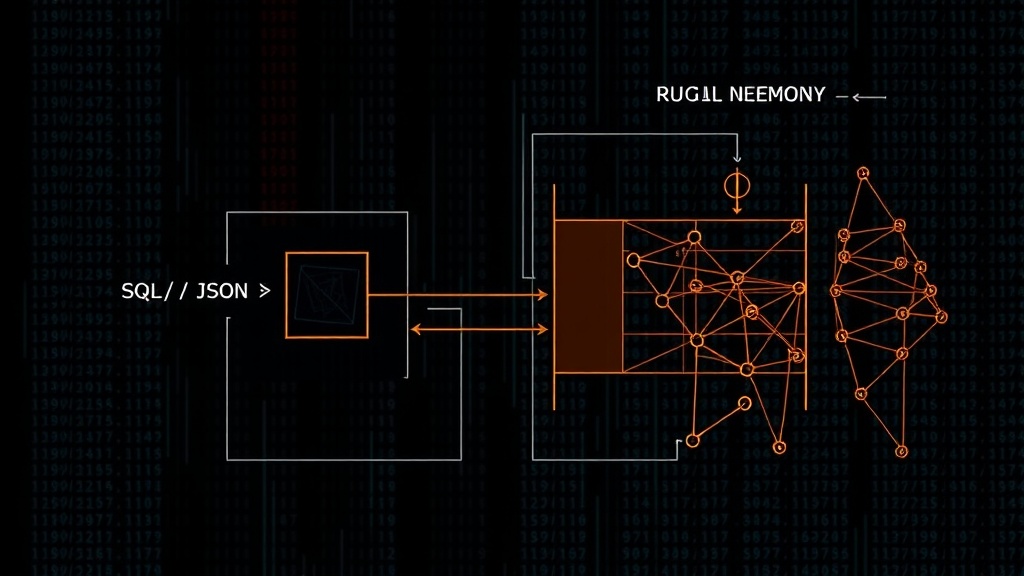
The core challenge in designing such an engine lies in how data is represented and accessed. Traditional databases, whether SQL or NoSQL, impose a translation layer. With SQL, object properties must be mapped to table columns, requiring complex joins and data transformations. With NoSQL and JSON, while more flexible, the data is still fundamentally text-based. Agents must parse this text, deserialize it into runtime objects, and then re-serialize it when storing changes. This constant serialization/deserialization cycle is computationally expensive and introduces latency, directly impacting the responsiveness and efficiency of AI agents.
Thingd's approach, as detailed in the design, focuses on what Mohsin terms "object-shaped memory." This means the data store's internal representation and access patterns directly align with the in-memory object structures used by the application. In Rust, this translates to leveraging the language's powerful type system and memory management capabilities. Instead of mapping objects to tables or documents, the engine treats objects as first-class citizens. When an object is stored, its structure is preserved in a format that can be retrieved and manipulated directly, without intermediate parsing or conversion steps.
The engine achieves this by using a custom data structure that mimics the object graph. This structure is optimized for fast reads and writes, akin to an in-memory key-value store but with richer relational capabilities built directly into the object model. For instance, relationships between objects are not managed through foreign keys in separate tables but are represented as direct pointers or references within the object graph itself. This allows for efficient traversal and querying of related data, similar to how an object would navigate its own properties.
Performance and Rust's Role
Rust was a deliberate choice for this project. Its performance characteristics are comparable to C and C++, offering low-level control over memory and execution without a garbage collector. This is critical for an engine designed for speed and efficiency, especially in the context of AI agents that may need to process vast amounts of data rapidly. Furthermore, Rust's strong compile-time safety guarantees help prevent common memory-related bugs, which is crucial for a data store that must maintain integrity.
By building the memory engine in Rust, developers can achieve near-zero overhead when interacting with their data. Storing an object involves writing its serialized form directly to memory or a persistent backing store, and retrieving it involves reading that representation back into a runtime object. The engine handles the underlying persistence and indexing, but the interface remains object-centric. This eliminates the need for complex ORM layers that often introduce performance penalties and add significant complexity to the codebase. The engine is designed to be embedded directly within the application, acting as a high-performance, in-memory data store that understands the application's native object model.
Implications for AI Agent Development
The architectural shift proposed by thingd has profound implications for the future of AI agent development. By removing the friction associated with traditional data storage, developers can build more responsive, efficient, and capable AI agents. Instead of spending development cycles wrestling with data serialization and ORM configurations, teams can focus on the core intelligence and decision-making logic of their agents. This direct object manipulation paradigm makes it easier to manage complex states, maintain context over long interactions, and represent intricate relationships between entities.
Consider an AI agent tasked with managing a complex project. It needs to track tasks, dependencies, team members, deadlines, and resources. In a traditional SQL database, this would involve numerous tables and joins. In a JSON store, it might be a deeply nested, difficult-to-query structure. With an object-shaped memory engine, the agent can represent these as interconnected objects in memory, directly querying and updating them as its understanding of the project evolves. This allows for more nuanced reasoning and faster adaptation to changing project conditions.
The core innovation here is not just a new database but a new way of thinking about data for AI. It's about aligning the data layer with the computational model of AI agents, treating data as living objects rather than static records. This approach promises to unlock new levels of performance and sophistication in AI systems, moving beyond the limitations imposed by legacy data architectures. The question remains how widely this object-centric paradigm will be adopted and what new tools and frameworks will emerge to support it.