
Automated Program Synthesis: The Goal
Program synthesis, the automatic generation of programs from specifications, has long been a holy grail in computer science. The dream is to describe what a program should do, and have a tool write the code. While full-blown synthesis remains challenging, a significant step forward has been demonstrated by a researcher using the Rust programming language and the Z3 SMT solver to synthesize loop-free programs. This work tackles a specific, yet important, class of programs: those that can be expressed without iterative constructs.
The core idea is to leverage the power of SMT (Satisfiability Modulo Theories) solvers like Z3. These solvers are adept at determining the satisfiability of logical formulas, often involving arithmetic, bit-vectors, and other theories. By encoding program synthesis as a satisfiability problem, we can ask Z3 to find inputs that satisfy a desired output, effectively generating a program that maps inputs to outputs.
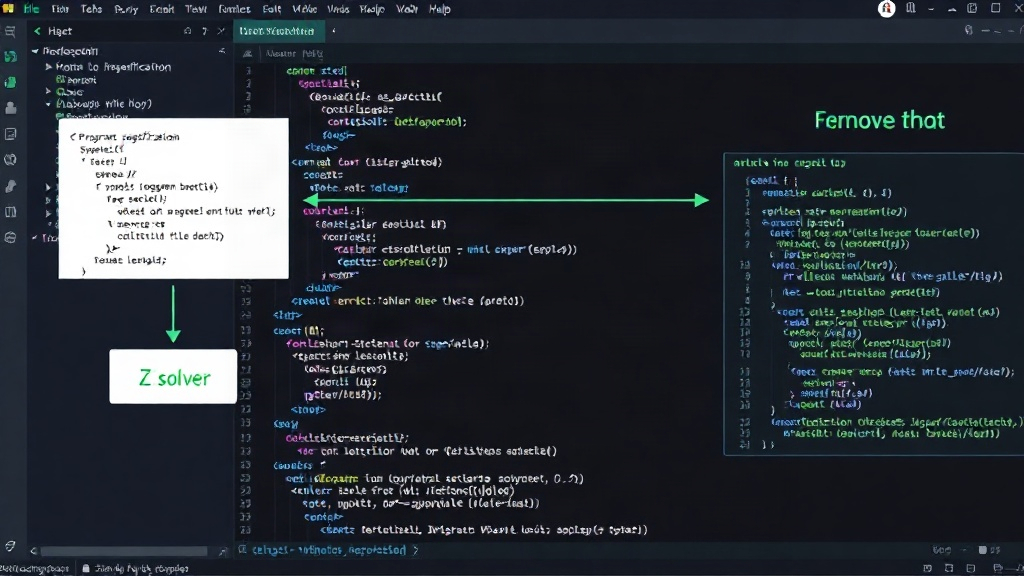
Encoding Programs for Z3
The process involves translating the desired program behavior into a formal representation that Z3 can understand. This typically means defining input and output types, and then constructing a logical formula that captures the input-output relationship. For loop-free programs, this relationship can often be expressed as a series of conditional statements and basic operations. The Z3 solver then attempts to find a concrete instantiation of these operations and conditions that fulfills the specification.
Consider a simple example: synthesizing a function that computes the absolute difference between two integers. The specification might be: given integers a and b, return abs(a - b). This can be translated into Z3 by asserting that for any input pair (a, b), the synthesized program's output out must satisfy (a - b >= 0 AND out == a - b) OR (a - b < 0 AND out == b - a). Z3, when asked to find a program satisfying this, can propose code that implements this logic.
Rust as the Implementation Target
The choice of Rust as the target language is significant. Rust offers strong guarantees around memory safety and concurrency, making it an attractive language for systems programming and applications where reliability is paramount. Synthesizing code directly into Rust means the generated programs benefit from these safety guarantees out-of-the-box.
The research explores how to represent program structures, like arithmetic operations, comparisons, and conditional branches, within Z3's logical framework. The solver then attempts to find concrete values for constants and select appropriate operations to construct a valid program. The synthesized code is then translated back into Rust source code. This direct generation into a high-level, safe language simplifies integration into existing Rust projects.
The Loop-Free Constraint
The constraint to loop-free programs is crucial for tractability. Synthesizing programs with arbitrary loops is significantly more complex, as it involves reasoning about program termination and potentially infinite states. Loop-free programs, often representable as straight-line code with conditional branches, fall within the capabilities of many SMT solvers. This allows for practical synthesis of certain types of utility functions, data transformations, and simple algorithms.
This limitation means the synthesized programs are not general-purpose. They are best suited for tasks where the control flow is inherently simple or can be statically determined. For developers, this approach is most valuable for generating boilerplate code, helper functions, or specific algorithmic components where the logic is well-defined and does not require complex iteration. It's less about replacing human-written complex algorithms and more about automating the creation of smaller, verifiable code segments.
Challenges and Future Directions
While promising, this approach faces several challenges. The expressiveness of the synthesized programs is limited by the loop-free constraint. Furthermore, the performance of the synthesis process itself can be a bottleneck, especially for more complex specifications. The size of the generated code can also become unwieldy as the complexity of the specification increases. The surprising detail here is not the complexity of Z3 itself, but how elegantly its core satisfiability checking can be repurposed for code generation. However, translating complex, real-world programming tasks into Z3 formulas requires significant expertise.
Future work could explore lifting the loop-free constraint by integrating techniques for loop synthesis or by using different verification tools. Expanding the set of supported operations and data structures would also increase the applicability of the technique. Nonetheless, this research provides a solid foundation for building more sophisticated program synthesis tools that can assist developers in writing correct and efficient code.