
Introducing Runloom: A New Paradigm for Python Concurrency
Python's Global Interpreter Lock (GIL) has long been a bottleneck for true multi-threaded concurrency. While asynchronous programming with `asyncio` offers a way to manage I/O-bound tasks efficiently, CPU-bound parallelism remains a challenge. Enter Runloom, a new open-source project aiming to bring the simplicity and power of Go-style coroutines to Python, specifically within a free-threaded environment. This means developers can now leverage multiple CPU cores for concurrent tasks in Python without resorting to multiprocessing, which often incurs significant overhead.
Runloom, presented on Hacker News as a "Show HN" by developer Roberts, is built on the premise that Go's `goroutine` model, which allows for millions of concurrent, lightweight functions to run, can be adapted for Python. Unlike traditional threads that are managed by the operating system and can be heavy, goroutines are managed by the Go runtime, enabling rapid creation and switching between them. Runloom aims to replicate this experience in Python, offering a way to write concurrent code that is easier to reason about than complex thread management or callback-heavy asynchronous patterns.
How Runloom Works: Lightweight Tasks and Scheduling
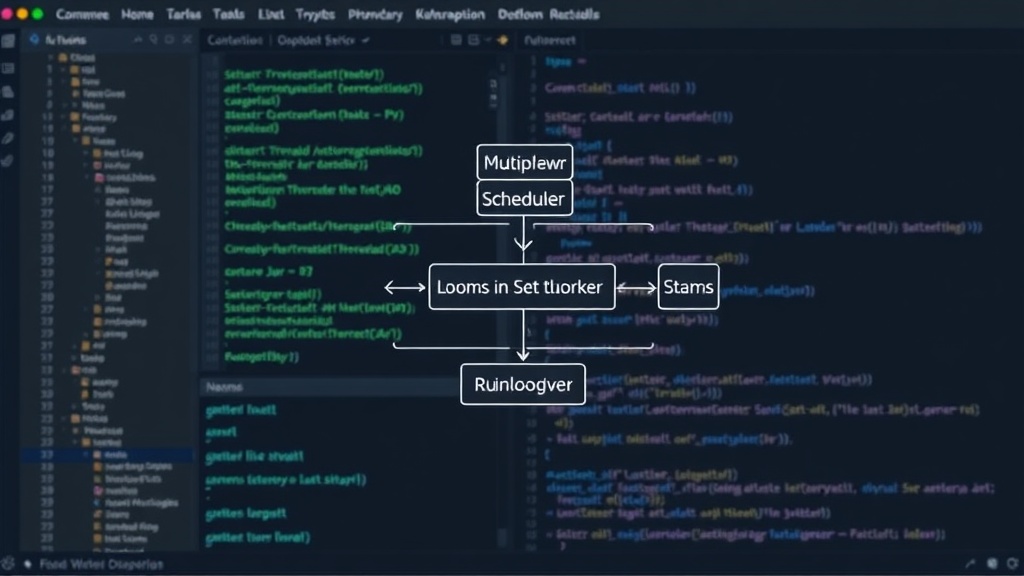
At its core, Runloom provides a mechanism to define and run lightweight concurrent tasks, analogous to Go's goroutines. These tasks, or "looms" as they are called in the library, are not actual OS threads. Instead, Runloom manages their execution using a scheduler that multiplexes these looms onto a pool of worker threads. This approach allows for a massive number of looms to be active concurrently, far exceeding what would be feasible with traditional OS threads, especially in I/O-bound scenarios.
The key innovation is Runloom's ability to operate in a free-threaded Python environment. This means it can bypass the GIL's limitations by utilizing multiple Python interpreters, each running on its own thread. When a loom needs to perform a CPU-intensive operation, the scheduler can offload it to a worker thread that is not subject to the GIL. For I/O-bound operations, the looms can yield control cooperatively, allowing other looms to run on the same thread without blocking. This is similar in spirit to `asyncio`, but the API and mental model are designed to feel more like Go's straightforward concurrency primitives.
The library provides simple constructs for creating new looms, sending messages between them (channels, akin to Go's channels), and synchronizing their execution. This offers a compelling alternative for developers who find Python's existing concurrency models either too complex or insufficient for their needs. The benefit is code that is easier to write, understand, and debug, while still achieving high levels of concurrency and parallelism.
The Go Analogy: Simplicity and Scale
Go's goroutines are a cornerstone of its popularity for building concurrent systems. They are incredibly cheap to create, with stacks that grow and shrink dynamically, allowing developers to spawn thousands or even millions of them. The runtime scheduler efficiently distributes these goroutines across available CPU cores. Runloom attempts to capture this elegance. Instead of managing thread pools, locks, and complex synchronization primitives manually, developers can think in terms of independent, communicating tasks.
Consider a web server. In a traditional Python threaded model, each incoming request might be handled by a thread. This quickly becomes resource-intensive as the number of requests grows. With `asyncio`, requests are handled by a single thread that rapidly switches between them. Runloom offers a middle ground: developers can write code that looks like sequential operations within a loom, but the library handles the underlying concurrency. A single web server process could potentially manage thousands of active looms, each representing a client connection, without overwhelming the system.
The communication mechanism is also a critical component. Go's channels provide a type-safe way for goroutines to communicate and synchronize. Runloom implements similar channel primitives, allowing looms to send and receive data safely. This avoids common pitfalls of shared-memory concurrency, such as race conditions, by encouraging message passing over direct memory access. This focus on communication patterns makes concurrent code more robust and easier to reason about.
Potential Impact and Unanswered Questions
The introduction of Runloom could significantly alter how Python developers approach concurrency, especially for applications that demand high throughput and efficient CPU utilization. For developers accustomed to Go's concurrency model, Runloom offers a familiar paradigm within the Python ecosystem. It could make Python a more viable choice for building highly concurrent services, data processing pipelines, and even certain types of game development where managing many concurrent entities is crucial.
However, the library is new, and several questions remain. How does Runloom's performance compare to native Go or to Python's existing solutions like `asyncio` and `multiprocessing` across various workloads? What is the memory overhead per loom compared to traditional threads? The stability and maturity of the scheduler are also critical factors for production use. Furthermore, the integration with existing Python libraries, especially those that are not thread-safe or rely heavily on the GIL, needs careful consideration. What happens to the vast ecosystem of C extensions that are inherently tied to the GIL's behavior? Adapting these to a free-threaded Python environment managed by Runloom could be a significant undertaking.
The success of Runloom will likely depend on its ability to provide a compelling balance between performance, ease of use, and compatibility with the broader Python ecosystem. If it can deliver on the promise of Go-style concurrency without introducing prohibitive complexity or performance penalties, it could become an indispensable tool for Python developers pushing the boundaries of concurrent programming.