Local AI Development: The Case for Offline Agents
Cloud-based Large Language Models (LLMs) are indispensable for production-grade AI applications. However, relying solely on cloud APIs during the development lifecycle introduces significant friction. Each API call incurs latency, adds to operational costs, and necessitates careful credential management. For developers iterating rapidly, this can slow down the feedback loop and increase expenses. The alternative? Running the LLM directly on your local machine, tightly integrated with your agent. This approach offers immediate response times, eliminates per-call charges during testing, and simplifies the development environment, allowing for focused experimentation.
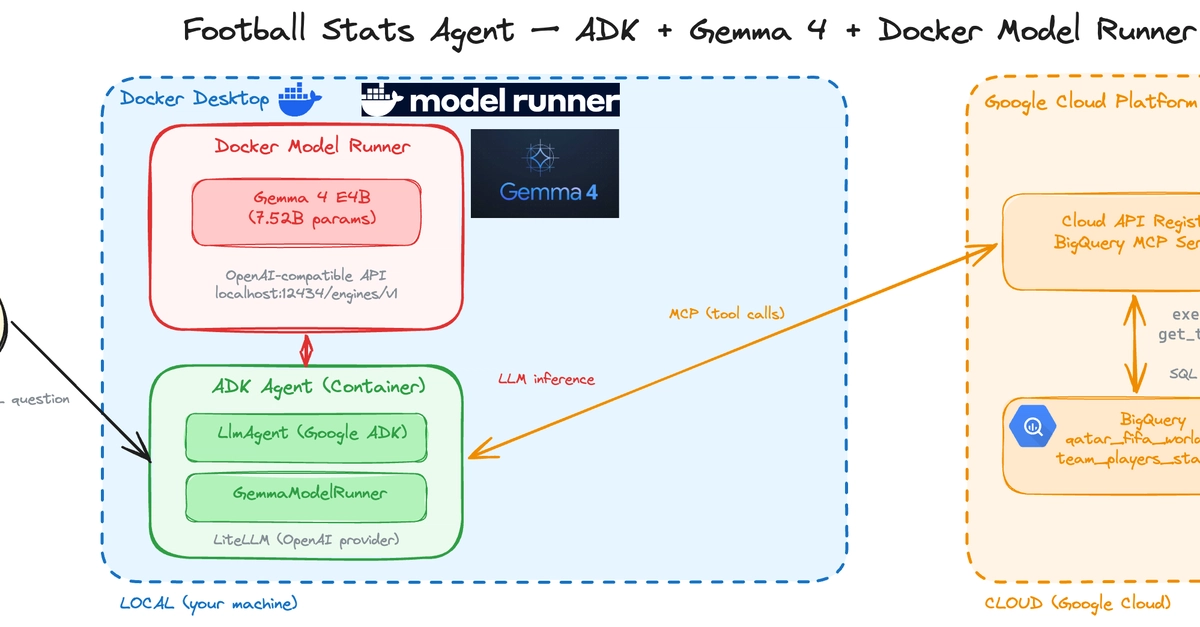
This article demonstrates how to transition from a cloud-centric AI agent setup to a local execution model. We build upon the foundation of a previously developed football statistics agent, which leveraged Google ADK (Agent Development Kit), BigQuery MCP via Cloud API Registry, and Gemini 2.5 Flash deployed on Cloud Run and Vertex AI Agent Engine. The goal here is to swap out the cloud-hosted Gemini model for Gemma 4, a powerful open model, running entirely within a Docker container on the local development machine.
Setting Up Gemma 4 Locally with Docker
The core of running Gemma 4 locally involves a containerized environment. Docker provides an isolated, reproducible setup that abstracts away system dependencies. The process typically involves pulling a pre-built Docker image containing Gemma 4 or building one from a Dockerfile. For this setup, we assume access to a Gemma 4 image that exposes an API endpoint compatible with standard LLM interfaces, such as OpenAI's API specification. This compatibility is crucial, as it allows tools and frameworks designed to interact with cloud LLMs to seamlessly connect to the local Gemma 4 instance.
The Docker image should be configured to run the Gemma 4 model and expose a network port. This port will serve as the communication channel for the AI agent. When the agent needs to generate text or perform a reasoning task, it sends a request to this local endpoint instead of a remote cloud service. The Docker container manages the model's inference, returning the results directly to the agent. This local inference engine acts as a drop-in replacement for cloud LLM APIs, provided the API contract is maintained.
Integrating Gemma 4 with Google ADK
Google ADK (Agent Development Kit) is designed to simplify the creation of sophisticated AI agents. It provides tools for defining agent behavior, managing tools, and orchestrating interactions between different components, including the LLM. To integrate the locally running Gemma 4 with ADK, the ADK's configuration must be updated to point to the local Dockerized model's endpoint. Instead of specifying a cloud LLM API endpoint and associated credentials, the configuration will reference the local Docker container's IP address and port.
The ADK typically allows for model configuration through environment variables or configuration files. For instance, if the Docker container exposes an OpenAI-compatible API at http://localhost:8000/v1, the ADK would be configured to use this URL. The ADK's internal mechanisms then handle the communication: sending prompts to Gemma 4, receiving responses, and processing them according to the agent's logic. This abstraction means that the core agent logic built with ADK remains largely unchanged, providing flexibility in choosing the underlying LLM and its deployment strategy.
The Football Statistics Agent in Action (Locally)
With Gemma 4 running in Docker and ADK configured to use this local model, the football statistics agent can now operate entirely offline. The agent's workflow remains the same: it receives a user query, identifies the necessary information (e.g., team statistics, match results), uses its tools (like BigQuery MCP for data retrieval) to fetch relevant data, and then passes this data along with the prompt to the LLM for synthesis and response generation. The key difference is that the LLM inference step now occurs on the local machine via the Docker container.
Consider a query like "What was the average number of goals scored by Manchester City in their last 5 home games?" The agent would first use its BigQuery tool to query the relevant database for this data. Once retrieved, the structured data (e.g., a list of goal counts) would be included in a prompt sent to the local Gemma 4 instance. Gemma 4 would then process this prompt and data to formulate a concise answer, such as "Manchester City averaged 2.8 goals per game in their last 5 home matches." The entire process, from query to answer, bypasses external API calls, offering a faster and more cost-effective development experience.
Benefits and Considerations
Running AI agents with local LLMs like Gemma 4 offers several compelling advantages. Cost Savings are immediate; development and testing become free of per-token charges. Reduced Latency means faster iteration cycles and a more responsive development environment. Enhanced Privacy and Security are also key benefits, as sensitive data and prompts do not leave the local machine. Furthermore, it enables development and testing in environments with intermittent or no internet connectivity.
However, there are considerations. Running powerful LLMs locally requires significant hardware resources, including a capable CPU, ample RAM, and often a powerful GPU for acceptable performance. The setup complexity, while mitigated by Docker, still involves managing containerized environments and model deployments. Performance may not match that of highly optimized cloud-based inference services, especially for very large models or complex query loads. The choice between local and cloud deployment ultimately depends on the specific development stage, hardware availability, and project requirements. For rapid prototyping and iterative development, the local approach shines.
What's Next for Local AI Development?
The trend towards local AI development, exemplified by running models like Gemma 4 via Docker, is likely to accelerate. As open-source models become more capable and hardware becomes more powerful, more developers will opt for offline inference during the build and test phases. This shift necessitates better tooling for managing local LLM deployments, optimizing inference performance on consumer hardware, and seamlessly integrating these local models into existing development workflows and agent frameworks like ADK.
The surprising detail here is not the capability of Gemma 4 itself, but how readily it can be integrated into existing agent frameworks with minimal code changes, provided a standardized API interface is exposed. This interoperability is key. As more powerful open models become available, the ability to swap them in and out of agent architectures without extensive refactoring will become a significant advantage for development teams. The question remains: how will cloud providers adapt their offerings as more sophisticated development shifts locally, and what new services will emerge to support this hybrid development paradigm?