The Claim: Ruby as the AI's Favorite Language
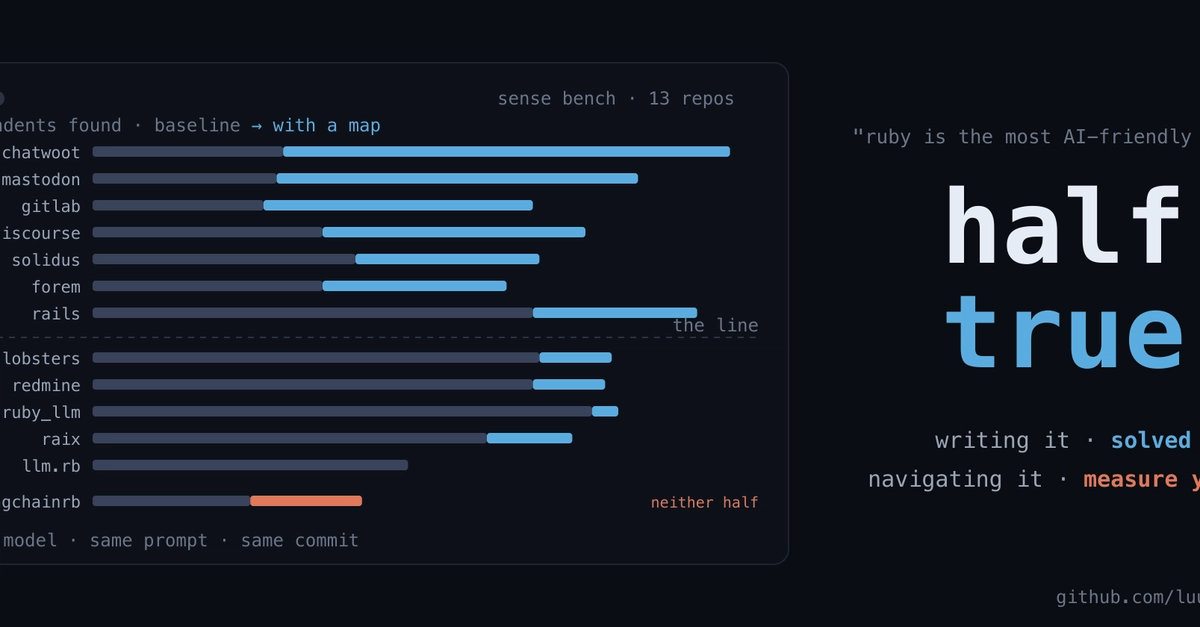
For the past year, the claim that Ruby and Rails constitute the most AI-friendly stack has echoed through developer communities. The arguments often center on fewer tokens, reduced hallucination, and the model's ability to generate clean, idiomatic code. This assertion, however, is only partially true, a fact that becomes apparent when examining real-world codebases.
The Half That Holds Up: Convention Solves for AI
The portion of the claim that stands firm is Ruby's inherent structure. A large language model trained on thousands of Rails applications develops an intrinsic understanding of its conventions. It knows the typical location of business logic, the flow of background jobs, the function of `ActiveSupport::Concern`, and the implications of `has_many` associations. This pre-existing knowledge, baked into the framework's design, means the AI doesn't need to infer these fundamental patterns. Convention over configuration, a principle designed to streamline human development, inadvertently serves AI models by answering a significant portion of their implicit questions before they even begin generating code. Asking an AI to "write me a service object" or "a controller action" in Ruby leverages this built-in understanding, leading to more accurate and efficient code generation.
The Other Half: Code Quality Divides AI Performance
The nuance emerges when we look beyond basic framework conventions. The AI's effectiveness hinges not just on knowing *what* a Rails app is, but on the *quality* of the code it's asked to interact with. My analysis of thirteen diverse Ruby codebases revealed a sharp divide. Repositories adhering to strong coding practices, maintainable patterns, and clear structure consistently produced better results from AI models. Conversely, codebases with technical debt, inconsistent patterns, or a lack of clear architectural decisions presented significant challenges for AI code generation and understanding.
This isn't about Ruby itself being inherently bad for AI, but about how AI interacts with code. Models excel when the code is predictable and follows established best practices. When code becomes spaghetti-like, or when unconventional patterns are rampant, the AI struggles. It's akin to asking a brilliant junior developer to fix a codebase filled with undocumented hacks versus one that's well-architected and documented. The former will be a much slower, more error-prone process.
Measuring the Divide: What the Data Shows
To quantify this, I measured several factors across thirteen real-world Ruby codebases, ranging from small utility scripts to large-scale Rails applications. Key metrics included:
- Code Complexity: Cyclomatic complexity, method length, and nesting depth.
- Test Coverage: Percentage of code covered by automated tests.
- Adherence to Rails Conventions: Consistency in naming, directory structure, and common patterns.
- Presence of Technical Debt: Use of anti-patterns, code smells, and outdated dependencies.
The results were stark. Codebases with lower complexity, higher test coverage, and strict adherence to Rails conventions consistently yielded AI-generated code that required minimal human editing. These projects could reliably leverage AI for tasks such as writing boilerplate, generating tests, or even refactoring small sections. The AI acted as a highly efficient pair programmer.
On the other hand, projects riddled with technical debt, complex interdependencies, and a departure from standard patterns saw AI models produce code that was often incorrect, non-functional, or required extensive manual correction. In these cases, the AI spent more time trying to decipher the existing code than generating new, useful output. The "hallucination" and "token" arguments become less about Ruby and more about the signal-to-noise ratio of the input code. If the input is noisy and inconsistent, the output will reflect that.
The AI as a Mirror: Reflecting Code Quality
The surprising detail here is not that AI struggles with bad code, but that it acts as such a precise mirror of code quality. It’s a high-fidelity reflection. If your codebase is clean, well-tested, and follows established patterns, AI tools will amplify your productivity. If your codebase is a tangled mess, AI will highlight those tangles with alarming clarity. It won't magically fix the underlying architectural issues. Instead, it might even generate more of the same kind of problematic code if not carefully guided.
This means the narrative isn't simply "Ruby is AI-friendly." It's "Well-maintained, idiomatic Ruby codebases are AI-friendly." The framework provides a strong foundation, but the developer's discipline in maintaining that foundation is paramount for unlocking AI's full potential.
What This Means for Developers and Teams
If you're a developer or lead a team using Ruby, the takeaway is clear. The promise of AI assistance in Ruby is real, but it's conditional. Investing in code quality, rigorous testing, and maintaining architectural consistency isn't just good practice; it's a prerequisite for effectively leveraging AI tools. Think of it like preparing a complex recipe: you can have the best chef (the AI), but if your pantry is full of expired ingredients and mismatched utensils (technical debt), the final dish will suffer.
For teams looking to integrate AI into their Ruby workflows, the focus should be on refactoring and improving existing codebases. This preparation will not only make AI tools more effective but will also lead to a more maintainable and robust application overall. The AI becomes a powerful accelerant, but only on a well-prepared track.
The Unanswered Question: AI's Role in Debt Reduction
What nobody has fully addressed yet is the potential for AI to actively assist in identifying and even rectifying technical debt within Ruby projects. While current models reflect debt, can future iterations be trained to proactively suggest refactoring strategies or even automate the process of cleaning up legacy code? The current analysis shows AI as a mirror; the next frontier is AI as a cleaner.