The Challenge: Structured Data from Raw Events
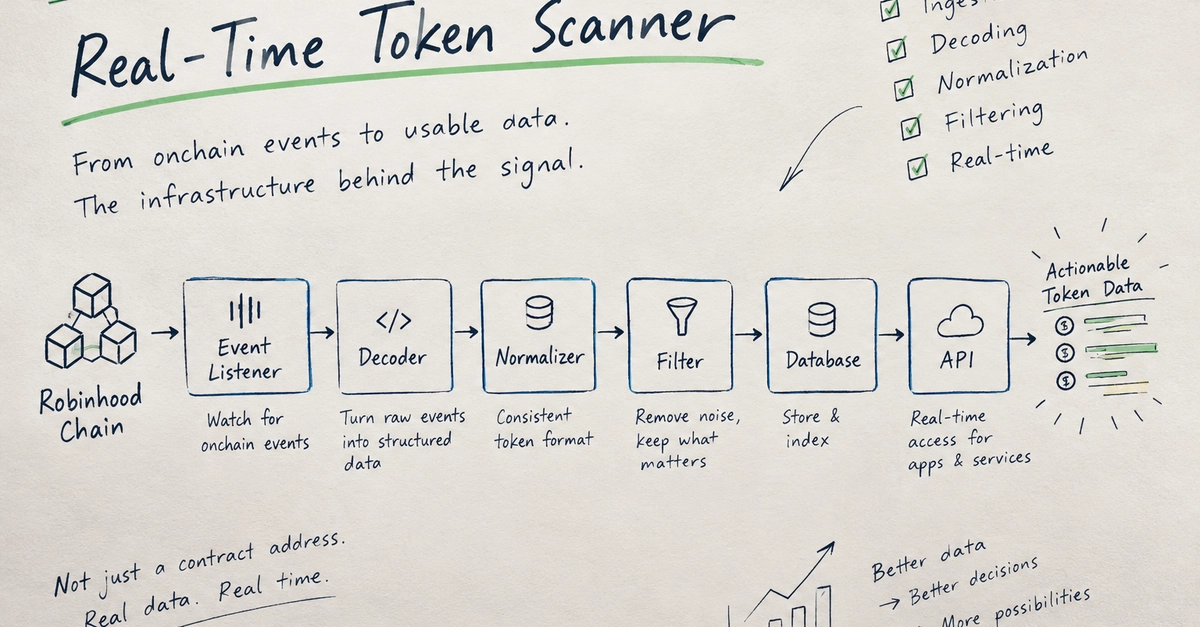
Launching a new token on a blockchain is just the first step. The real challenge lies in transforming raw, on-chain activity into structured, reliable, and real-time data that other systems can readily consume. This is the core problem addressed by a new real-time token scanner being developed for the Robinhood Chain, focusing initially on token activity related to Pons. The goal is to move beyond simply finding contract addresses to providing actionable intelligence derived from blockchain events.
The fundamental data pipeline for this scanner follows a clear sequence: Chain events are ingested, then decoded, normalized, and finally filtered to produce actionable data. While each individual step is conceptually straightforward, the engineering effort intensifies when aiming for a reliable, end-to-end pipeline. The first iteration of this architecture prioritizes simplicity to establish a functional baseline before introducing more complex features and optimizations.
Core Architecture: Event Listener and Data Processing
The initial architecture for the Robinhood Chain token scanner is designed for clarity and modularity. At its heart is an event listener component that directly interfaces with the Robinhood Chain. This listener is responsible for capturing raw event data emitted by smart contracts, particularly those related to token activity. Think of this listener as a highly attentive observer, continuously watching the blockchain for specific types of transactions and contract interactions.
Once events are captured, they enter a critical processing pipeline. The first stage is ingestion, where raw event data is collected and temporarily stored. This is followed by decoding, where the raw, often hexadecimal, data is parsed into a human-readable and machine-understandable format. This involves understanding the ABI (Application Binary Interface) of the smart contracts involved to correctly interpret function calls, arguments, and event logs.
The decoded data then undergoes normalization. This crucial step ensures that data from various sources and contract types conforms to a consistent schema. Without normalization, comparing or aggregating data from different tokens or protocols would be an arduous task. The scanner aims to present all token-related events in a uniform structure, making subsequent analysis far simpler.
Filtering and Actionable Data Generation
Following normalization, the data enters the filtering stage. This is where the scanner applies specific criteria to identify events of interest. For a token scanner, this might include filtering for new token deployments, significant token transfers, liquidity pool events (like additions or removals), or specific contract interactions that indicate potential trading activity or scam attempts. The filtering logic is key to distinguishing noise from valuable signals.
The final output of this pipeline is actionable data. This isn't just raw event logs; it's structured information that can be directly used by other applications, dashboards, or analytical tools. For instance, a filtered event might indicate a new ERC-20 token with a rapidly increasing liquidity pool, providing an immediate signal for potential trading opportunities or risks. The efficiency and accuracy of the filtering stage directly determine the utility of the generated data.
Engineering Challenges and Future Iterations
While the pipeline stages are well-defined, achieving reliability across the entire system presents significant engineering challenges. These include ensuring low latency for real-time processing, handling high volumes of blockchain events without data loss, managing state effectively, and robust error handling. The system must be resilient to network disruptions, chain reorgs, and contract upgrade scenarios.
Future iterations will likely focus on enhancing the filtering capabilities, potentially incorporating machine learning models to detect anomalous or malicious token behaviors. Further optimization of the ingestion and decoding processes will be necessary to scale with the growth of the Robinhood Chain ecosystem. Developing comprehensive monitoring and alerting systems will also be critical for maintaining the operational integrity of the scanner.
The development of this real-time token scanner on Robinhood Chain represents a critical step towards making on-chain data more accessible and useful for developers, traders, and security analysts. By systematically processing raw blockchain activity, it aims to unlock new insights and applications within the rapidly evolving token landscape.