The 7% Payroll Benchmark
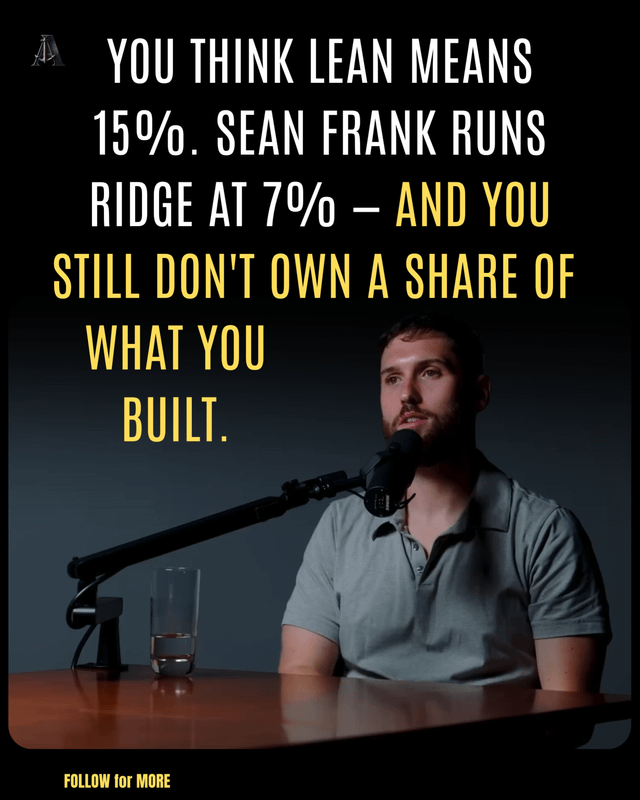
Most operators consider a 15% payroll-to-revenue ratio to be lean. Sean Frank, CEO of Ridge, operates at an astonishing 7%. This isn't achieved through aggressive cost-cutting on individuals, but through a fundamental structural approach that leverages external platforms and AI to absorb functions traditionally handled by in-house teams. The implication is a radical rethinking of what a core operational team needs to encompass.
Frank's strategy hinges on replacing entire departments with sophisticated third-party services or intelligent automation. For instance, Shopify handles the heavy lifting of web development, a task that often requires a dedicated team in other organizations. Similarly, Meta's algorithms can perform a significant portion of customer acquisition work, reducing the need for a large marketing or sales development team. The rise of AI is also making substantial inroads into customer experience (CX) roles, automating responses and support functions that previously demanded human intervention.
What remains is a highly specialized, much smaller core team. This team is focused on the high-leverage activities that truly drive the business forward: product development, creative direction, and a few key operational roles. This lean structure allows Ridge to maintain agility, reduce overhead, and concentrate resources on strategic growth initiatives rather than on managing large, functional departments.

Rethinking Departmental Needs
The traditional business model often involves building out distinct departments for every major function: engineering, marketing, sales, customer support, HR, finance, and operations. Each department has its own leadership, staff, and overhead. Frank's approach challenges this paradigm by asking whether each of these functions truly needs an in-house team or if a more efficient alternative exists.
Consider customer acquisition. Historically, this meant hiring sales development representatives (SDRs), account executives (AEs), and marketing specialists. Frank suggests that advanced algorithms, particularly those offered by major advertising platforms like Meta, can automate significant parts of the lead generation and initial qualification process. This doesn't eliminate the need for strategic marketing and sales leadership, but it drastically reduces the headcount required for execution.
Customer experience (CX) is another area ripe for this structural shift. While high-touch, complex support issues will always require human intervention, a large volume of common queries can be handled by AI-powered chatbots and knowledge bases. Platforms like Zendesk or Intercom, when integrated with sophisticated AI, can automate routine support tasks, triage issues, and provide instant answers to frequently asked questions. This frees up human CX agents to focus on more complex, high-value interactions, thereby reducing the overall number of agents needed.
Web development is a prime example of a function that can be outsourced or replaced. For many businesses, especially e-commerce or SaaS companies, maintaining a custom-built website or platform can be a significant expense. Services like Shopify, Squarespace, or even robust CMS platforms with extensive plugin ecosystems can provide a highly functional, scalable, and professional online presence with minimal in-house development expertise. This allows companies to focus their engineering resources on the core product rather than the storefront or marketing website.
The Core Team: Specialization is Key
With external platforms and AI handling many of the execution-heavy tasks, the remaining team at Ridge is composed of highly specialized individuals focused on strategy, innovation, and oversight. This includes:
- Product Team: Responsible for defining the product vision, roadmap, and core features. They work closely with engineering (which may also be lean or outsourced for specific projects) to ensure the product meets market needs and strategic goals.
- Creative Team: This team focuses on brand identity, marketing messaging, and the overall user experience design. They ensure that the company's outward-facing communications and interfaces are compelling and aligned with the brand strategy.
- Operations Specialists: A small, highly skilled group that manages the core operational infrastructure, oversees the integration of various platforms, monitors key performance indicators (KPIs), and ensures the smooth functioning of the business. These individuals need to be adept at managing technology stacks and understanding business processes deeply.
This structure implies that individuals in these roles must be versatile and possess a broad understanding of their domain, as they may be the primary decision-makers or strategists for their function. For example, a product manager might need to understand the capabilities of AI tools to leverage them effectively, and a creative lead might need to understand how to optimize campaigns run by advertising algorithms.
Implications for Other Companies
Frank's model is not universally applicable. Companies with highly complex, bespoke technical needs, deeply regulated industries, or unique customer interaction requirements may find it harder to adopt such a lean structure. However, for many businesses, particularly those in software, e-commerce, and digital services, this approach offers a compelling blueprint for efficiency.
The key takeaway is to critically assess each business function and identify opportunities to leverage external technology and AI. This isn't about simply cutting costs; it's about fundamentally redesigning operational workflows for maximum leverage. By offloading execution to specialized platforms and intelligent automation, companies can free up their most valuable human capital to focus on innovation, strategy, and growth. This shifts the focus from managing headcount to managing technology integrations and strategic partnerships.
The question for founders and operators becomes: which parts of my business can be replaced by a platform or an AI, and what is the optimal structure for the human team that remains? This requires a deep understanding of available technologies and a willingness to challenge traditional organizational structures. The 7% payroll figure is a stark indicator of what's possible when this reevaluation is done rigorously.