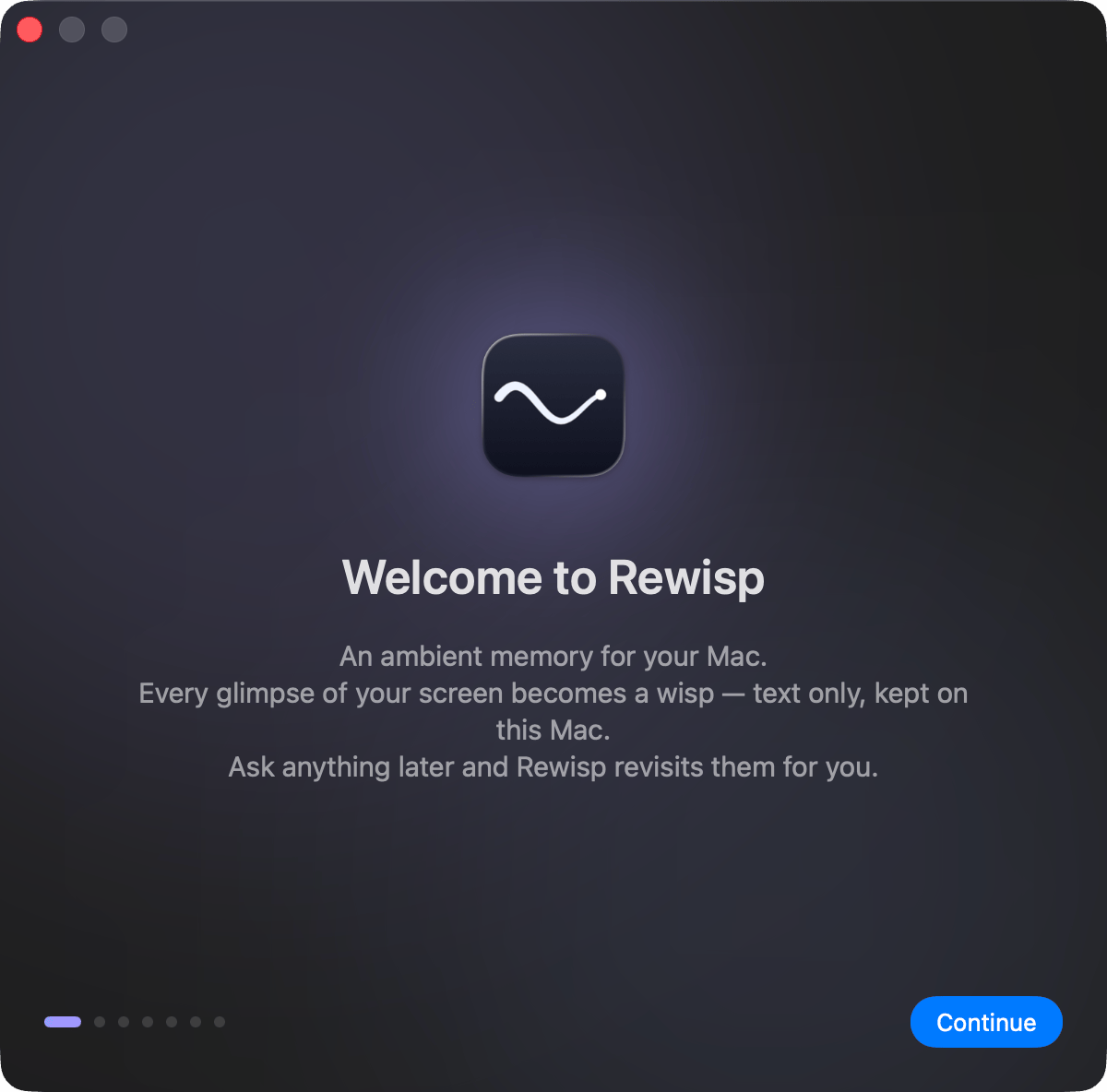
Rewisp: Your Mac's Persistent Memory
Rewisp, a new application for macOS, introduces the concept of "ambient memory" for your computer. The core promise is simple yet powerful: see it once, ask forever. This means users can recall information they've previously encountered on their Mac without the burden of actively saving, bookmarking, or meticulously organizing it. Instead of relying on explicit notes or search histories, Rewisp aims to create a passive, ever-present repository of your digital interactions.
The application functions by continuously observing and indexing the content displayed on your screen. This includes text, images, and even the context of applications you are using. When you need to retrieve a piece of information – perhaps a specific line of code from a tutorial you watched last week, a contact detail from an email you skimmed, or a product name from a webpage you briefly visited – you can simply ask Rewisp. The system then searches its indexed memory to find and present the relevant information.
This approach moves away from traditional information retrieval methods that require deliberate user action. Typically, recalling information involves searching through browser history, saved documents, notes applications, or chat logs. Rewisp seeks to automate this process, acting as an extension of your own memory. It’s designed for those moments when you know you saw something important but can’t quite remember where or when.
How Ambient Memory Works
Rewisp's underlying technology involves capturing and indexing screen content in real-time. When the application is active, it monitors the visual and textual elements presented on the user's display. This data is then processed and stored in a searchable format. The key differentiator here is the "ambient" nature; the user doesn't need to perform specific actions to save information for future recall. The act of simply viewing content makes it potentially retrievable.
Consider the analogy of a highly organized assistant who silently observes every document you read and every conversation you have, meticulously filing away details without you ever having to ask them to. When you later ask, "What was that client's phone number I saw on Tuesday?" they can instantly provide it. Rewisp aims to be that digital assistant for your Mac.
The system builds a searchable index of this captured content. When a user queries Rewisp, the application searches this index to find the most relevant matches. This could involve keywords, phrases, or even visual recognition elements, depending on the sophistication of the indexing. The goal is to provide a natural language interface for retrieving past digital experiences.

Potential Use Cases and Implications
The implications of such a tool are broad, particularly for knowledge workers, developers, researchers, and students. Developers, for instance, often encounter code snippets, API documentation, or Stack Overflow answers that they need to reference later. With Rewisp, they could simply ask, "Show me the Python command I used to parse JSON yesterday," and the app would ideally surface the relevant screen capture or indexed text.
Students could recall specific facts, definitions, or diagrams from lectures or online resources without needing to take extensive notes. Researchers might find it invaluable for remembering details from papers or datasets they briefly reviewed. For anyone who juggles multiple projects and information streams, Rewisp promises to reduce the cognitive load associated with information recall.
The success of Rewisp hinges on its ability to accurately capture and retrieve information while respecting user privacy and system performance. The continuous monitoring of screen content raises questions about data security and local processing. The developers emphasize that the data is processed locally on the user's machine, mitigating some privacy concerns. However, the sheer volume of data captured and indexed could present performance challenges on older or less powerful Macs.
The Ambient Computing Trend
Rewisp taps into a growing trend in computing often referred to as "ambient computing" or "pervasive computing." This paradigm shifts computing from explicit, device-centric interactions to a more integrated, background presence. Think of smart assistants that respond to voice commands without being explicitly activated, or wearable devices that passively collect health data. Rewisp’s ambient memory fits this model by making information retrieval an implicit, background service rather than an active search task.
This approach could fundamentally change how we interact with our digital environments. Instead of managing vast amounts of digital information through folders, bookmarks, and search engines, users might rely more on their system's ability to remember *for* them. This aligns with the broader vision of technology becoming more intuitive and less intrusive, fading into the background to serve users more seamlessly.
The challenge for Rewisp, and ambient computing in general, lies in balancing utility with user control and privacy. While the promise of effortless recall is compelling, users need to trust that their captured data is secure and that they have granular control over what is remembered and how it is accessed. The long-term success will depend not only on technical accuracy but also on building that trust.
What's Next for Rewisp?
As Rewisp enters the market, its reception will likely depend on its practical effectiveness and the user experience it provides. Early adopters will be key to testing its limits and identifying areas for improvement. The concept of ambient memory is ambitious, and its successful implementation could indeed change how Mac users manage their digital lives.
The surprising detail here is not the existence of a new productivity app, but the specific approach to information recall it champions. By aiming to make every piece of information seen on a Mac permanently searchable without active user intervention, Rewisp is pushing the boundaries of personal computing memory. It shifts the paradigm from active information management to passive, intelligent recall.
If Rewisp can deliver on its promise without compromising performance or privacy, it could become an indispensable tool for anyone who works extensively on their Mac and struggles with information overload. The question remains whether this ambient approach will become a mainstream feature or a niche productivity hack.