The Challenge of Persistent Failures
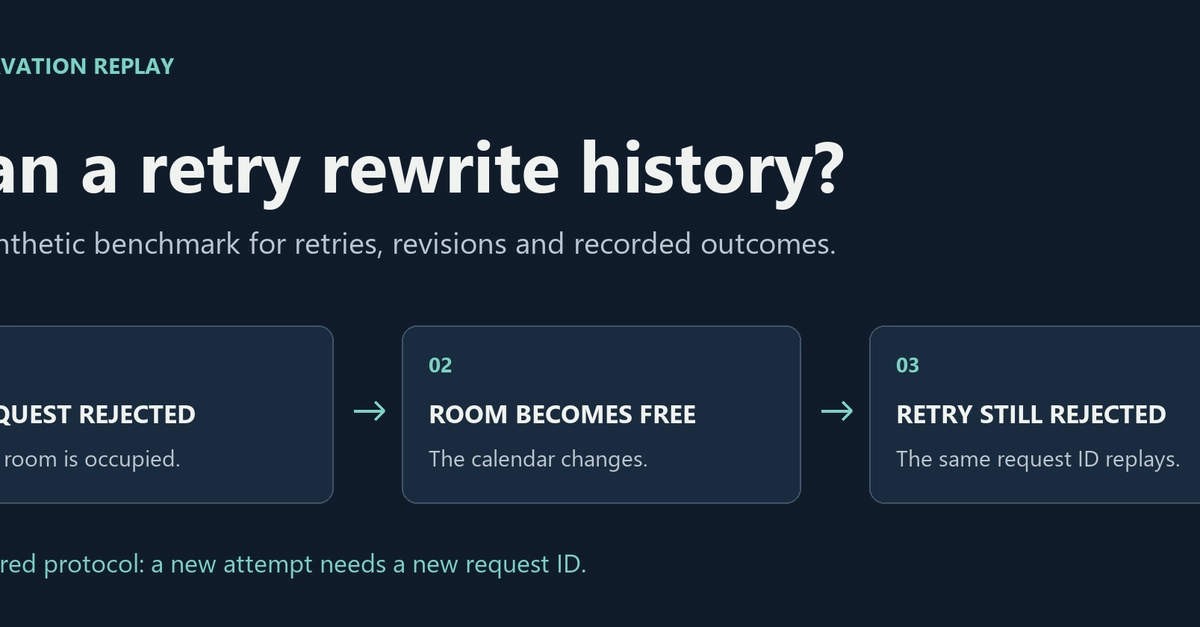
In many real-world reservation systems, a failed request should remain failed, even if the underlying conditions change. Consider a hotel room booked, leading to a subsequent request for the same room to fail. If the original booking is canceled and the room becomes available, should an identical retry of the *original* failed request now succeed? According to the contract defined by the new 'Reservation Replay' benchmark, the answer is a definitive no.
This benchmark, submitted for the Kaggle Benchmarking Challenge, focuses on a critical aspect of system reliability: strict adherence to request idempotency and state reconstruction. It’s not a claim about all reservation APIs, but a specific test for models designed to understand and replicate system behavior. The core principle is that a failed request, identified by a unique request ID, must consistently produce the same outcome. A genuinely new attempt to book requires a new, distinct request ID.
The benchmark’s objective is to evaluate a model's ability to not only reconstruct the final state of a calendar but also to accurately trace every decision made throughout a synthetic event log. Simply checking the final calendar state can mask errors in intermediate decision-making. Therefore, Reservation Replay mandates that the model must prove it understood the entire sequence of events and decisions, not just the end result.
Understanding Reservation Replay
The benchmark simulates event logs that detail actions taken within a reservation system. These logs include events like creating a booking with a specific ID and time range, and the system's corresponding decision. For instance, an event might be: "Create booking x in A [0,10), request r1". The required decision for this event, if the room is available, would be "CREATED".
However, the benchmark’s crucial test lies in handling retries and resource availability changes. If a request `r1` initially attempts to book a room within the interval [0,10) and fails because the room is occupied, the system is expected to record a "REJECTED" decision for `r1`. Later, if the room becomes free (e.g., the original booking is canceled), and the *same* request `r1` is replayed, the benchmark contract dictates that it must still result in a "REJECTED" state. This ensures that the system's state is predictable and that past failures are not retroactively undone by subsequent unrelated events.
A genuinely new attempt to secure the room would need a new request ID, say `r2`. If `r2` is submitted after the room becomes free, it would then be allowed to succeed and result in a "CREATED" decision. This distinction is vital for maintaining data integrity and preventing race conditions or unintended double-bookings.
The benchmark evaluates models on their ability to predict these outcomes accurately. It presents a sequence of events and asks the model to output the system’s decision for each event. The model must learn the implicit rules of the system, which include the strict idempotency of requests identified by their IDs and the handling of resource availability changes.
Why This Matters: System Robustness and AI Evaluation
The implications of this benchmark extend beyond academic curiosity. In critical systems like airline ticketing, hotel bookings, or resource scheduling, ensuring that failed requests stay failed is paramount. Allowing a retry of a previously rejected request to succeed due to a change in external state can lead to chaos. It could result in overbooking, incorrect inventory, and a loss of trust in the system. This is akin to a cashier accepting a coupon that was expired yesterday; the system must remember its past decisions and apply rules consistently.
For AI models tasked with understanding or simulating complex systems, this benchmark provides a rigorous test. It moves beyond simple state prediction to evaluating a model's grasp of temporal logic and strict rule adherence. Models need to learn to differentiate between a system’s current state and the history of decisions that led to that state. They must internalize the concept that a request ID is a unique identifier for a specific transaction attempt, and its outcome should be immutable.
This benchmark is particularly relevant for applications of AI in operations, logistics, and any domain where state management and transaction integrity are critical. It challenges models to go beyond pattern matching and demonstrate a deeper understanding of system contracts and the consequences of state transitions.
The Benchmark's Design and Evaluation
The synthetic event logs are generated to include various scenarios: successful bookings, rejections due to conflicts, cancellations, and replays of previously rejected requests. The model's performance is measured by its accuracy in predicting the correct decision for each event in the log. This includes correctly identifying when a replayed request must fail and when a new request can succeed.
The evaluation process involves comparing the model's predicted decisions against the ground truth defined by the benchmark's contract. A model that correctly predicts the "REJECTED" outcome for a replayed failed request, even after the resource is freed, demonstrates a superior understanding of the system's temporal logic and idempotency rules. Conversely, a model that allows the replayed request to succeed would fail this critical test.
This benchmark is designed to be a valuable tool for researchers and developers working on AI for temporal reasoning and state management. It provides a standardized way to assess how well AI systems can handle the nuances of real-world transactional systems, where consistency and adherence to historical outcomes are as important as the current state.