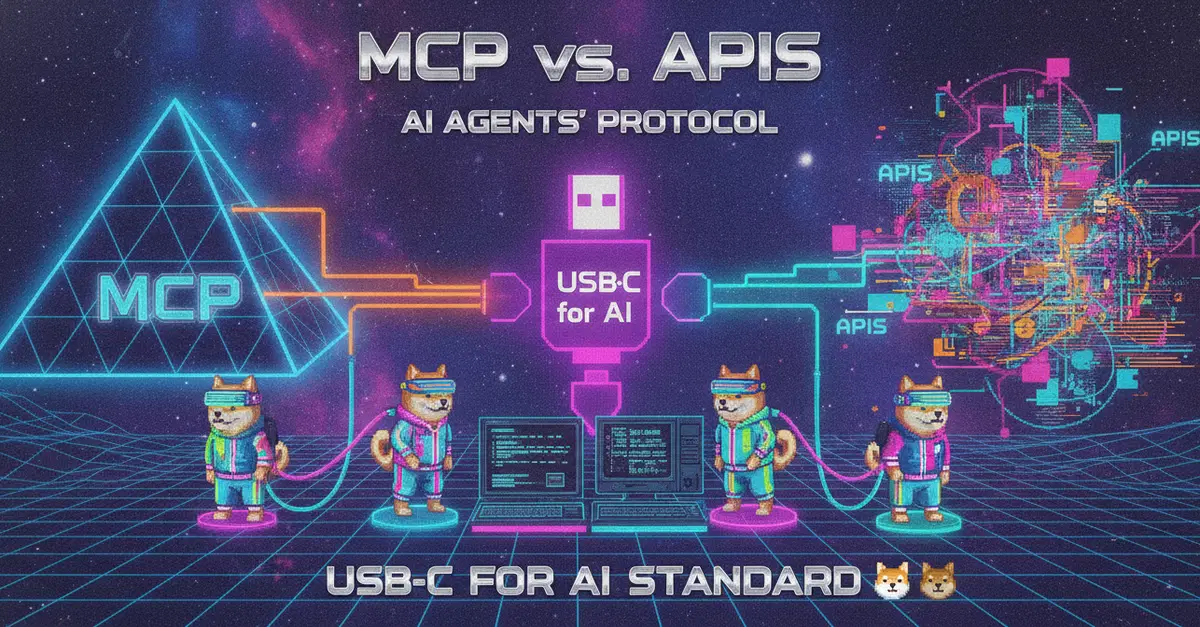
The API Paradigm Under Strain
For two decades, software communication has relied on Application Programming Interfaces (APIs). Developers meticulously read documentation, hardcoded endpoints, and parsed responses. This model, effective for human-written integrations, fundamentally breaks down when the entity making the API calls is an AI model instead of a human developer. Language models operate differently; they need context, can generate dynamic requests, and their reasoning processes aren't as predictable as a developer's. This disconnect created a significant bottleneck for building sophisticated AI agents that could reliably interact with external systems and data.
The limitations of traditional APIs for AI agents stem from several core issues. APIs are inherently static. They define fixed inputs and outputs. An AI agent, however, might need to discover capabilities, adapt its queries based on partial information, or handle unexpected data formats. The rigid contract of an API often struggles to accommodate this dynamic nature. Furthermore, passing complex context or reasoning chains through API calls can become cumbersome, requiring extensive serialization and deserialization that adds latency and complexity. This is akin to trying to use a rotary phone to access the internet – the underlying technology isn't designed for the task.
Introducing the Model Context Protocol (MCP)
To address this gap, the Model Context Protocol (MCP) was developed. Anthropic open-sourced MCP on November 25, 2024, defining it as a new standard for connecting AI assistants to data systems. The protocol aims to provide a more flexible, context-aware, and agent-native way for AI models to interact with the digital world.
MCP is designed with the unique requirements of AI agents in mind. Unlike traditional APIs, MCP focuses on context. It allows agents to pass rich contextual information, including their current reasoning state, goals, and even uncertainty, to the systems they interact with. This enables systems to respond more intelligently, providing data or performing actions that are precisely tailored to the agent's current needs. Think of it less like a fixed menu at a restaurant and more like a conversation with a chef who understands your dietary restrictions, preferences, and current hunger level, then customizes a meal on the spot.
Industry Adoption and the 'USB-C for AI' Analogy
What began as an Anthropic initiative has rapidly gained significant traction across the AI landscape. Within a year of its open-sourcing, major players have integrated MCP into their platforms. OpenAI adopted MCP in its Agents SDK in March 2025, subsequently rolling it out across ChatGPT and its Responses API. Google DeepMind followed suit, adding support to its Gemini models. This broad adoption by leading AI research labs and product companies signals a paradigm shift in how AI agents will interface with external services and data.
The rapid, cross-company adoption has led many to liken MCP to the USB-C standard for consumer electronics. Just as USB-C unified charging and data transfer across a vast array of devices, MCP is emerging as a universal connector for AI agents. This standardization is crucial. It means developers can build integrations once, knowing they are likely to work across multiple AI platforms. This drastically reduces development friction, accelerates innovation, and fosters a more interconnected AI ecosystem. Thousands of developers are now building tools and agents that leverage MCP, anticipating its widespread use.
Key Benefits and Implications of MCP
MCP offers several distinct advantages over traditional API-based approaches for AI agents:
- Enhanced Contextual Understanding: MCP allows for richer context to be passed between the agent and the system, enabling more nuanced and accurate responses.
- Dynamic Interaction: Agents can discover capabilities, adapt requests on the fly, and handle evolving data structures more effectively.
- Reduced Latency and Complexity: By providing a more native interface, MCP can streamline communication, reducing the overhead associated with serializing complex AI states for traditional APIs.
- Interoperability: Widespread adoption means agents built with MCP can potentially interact with a wider range of services and platforms without custom integration work for each.
- Improved Agent Reasoning: Systems that understand an agent's context can provide more targeted information or assistance, thereby improving the agent's overall reasoning capabilities.
The implications for the AI development community are profound. Developers no longer need to maintain separate integration strategies for each AI model or platform they wish to connect to. They can focus on building agent logic and leveraging MCP to abstract away the complexities of inter-system communication. This shift accelerates the development of more capable and autonomous AI agents across various domains, from enterprise automation to personal assistants.
The Future of AI Agent Connectivity
The move towards a standardized protocol like MCP represents a maturing of the AI agent landscape. As AI models become more sophisticated and are tasked with increasingly complex operations, the need for robust, flexible, and efficient communication channels becomes paramount. Traditional APIs, while a cornerstone of modern software, were not designed with the unique characteristics of AI agents in mind. MCP fills this void, providing a foundation for the next generation of AI-powered applications.
The broad adoption by OpenAI, Google, and the developer community suggests that MCP is well on its way to becoming the de facto standard for AI agent connectivity. This will likely spur further innovation in agent design, tooling, and the types of applications that can be built. What remains to be seen is how MCP will evolve to accommodate emerging AI paradigms, such as multi-modal agents or decentralized AI networks, and whether it can maintain its interoperability promise as more specialized use cases emerge.