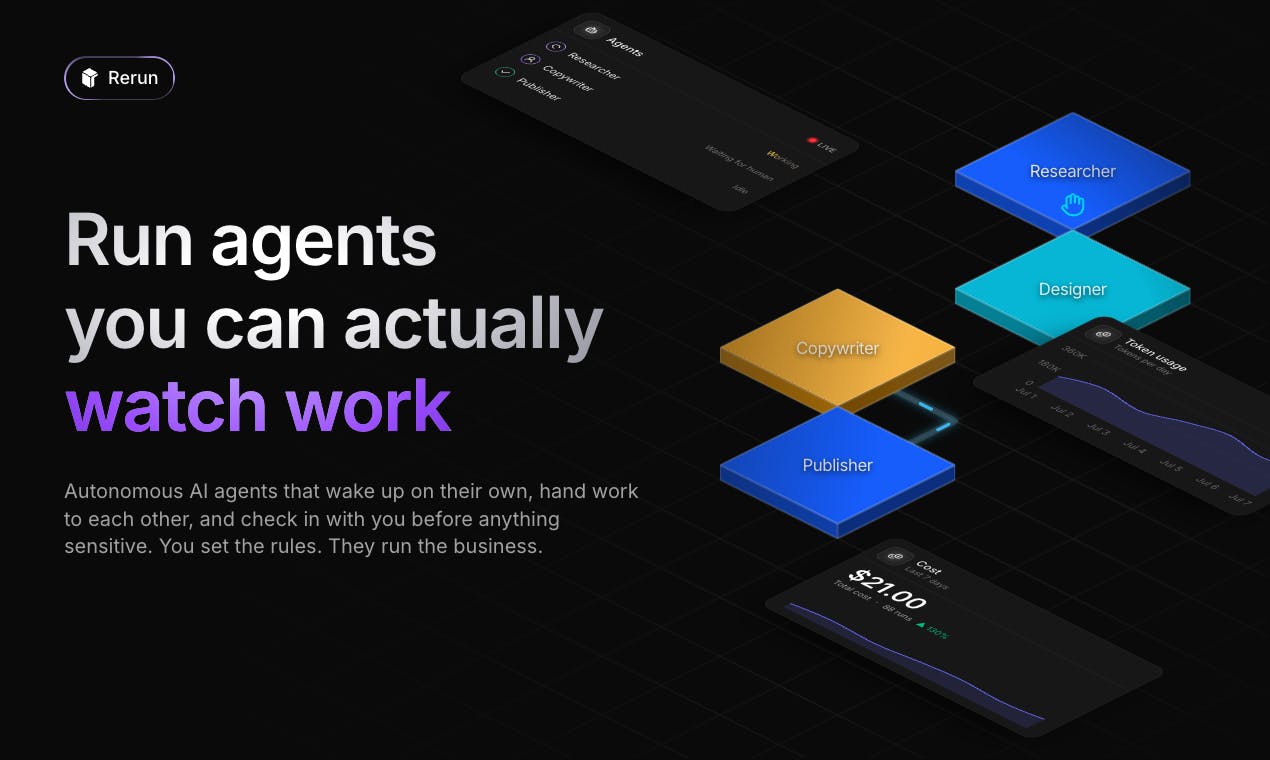
Rerun: A Unified Platform for AI Agent Development
Rerun emerges as a new platform aiming to demystify and accelerate the process of building AI agents. The core proposition is simplicity: providing developers with an integrated environment that handles the complexities of agent creation, deployment, and management. This move addresses a growing need in the AI landscape, where the demand for specialized agents capable of performing a wide array of tasks is rapidly increasing.
Traditionally, developing AI agents has involved stitching together multiple tools and frameworks. This often requires deep expertise in areas like natural language processing, machine learning operations (MLOps), and software engineering. Rerun seeks to abstract away much of this complexity, allowing users to focus on defining the agent's logic and purpose rather than wrestling with underlying infrastructure.
The platform is designed to be accessible to a broad range of users, from seasoned AI researchers to developers new to the agent development space. Its emphasis on ease of use suggests a commitment to lowering the barrier to entry for AI-powered automation. This could unlock new applications and workflows across various industries.
Key Features and Functionality
While specific technical details are still emerging, Rerun's product positioning highlights several key areas of focus:
- Simplified Agent Creation: The platform likely offers intuitive interfaces and tools to define agent behaviors, goals, and constraints without requiring extensive coding for every component. This could involve visual programming elements or streamlined configuration files.
- Integrated Development Environment (IDE): Rerun appears to provide a cohesive environment where users can design, build, test, and debug their AI agents. This eliminates the need to switch between disparate tools, fostering a more efficient development cycle.
- Task-Specific Agent Focus: The platform's promise to build agents for "all your tasks" indicates a flexible architecture capable of supporting a wide spectrum of applications, from data analysis and content generation to customer support and workflow automation.
- Deployment and Management: Beyond creation, Rerun likely offers features for deploying agents to production environments and monitoring their performance. This end-to-end approach is critical for operationalizing AI agents effectively.
The goal is to make building AI agents as straightforward as developing other forms of software. This involves providing robust tools for defining agent capabilities, managing their state, and ensuring reliable execution. Think of it less like building a complex machine from scratch and more like assembling a sophisticated toolkit where the pieces are designed to fit together perfectly.
The Growing Demand for AI Agents
The rise of large language models (LLMs) has fueled a surge in interest in AI agents. These agents are not just passive responders; they can take actions, interact with external systems, and pursue complex objectives. This capability is driving innovation in areas such as:
- Autonomous Systems: Agents that can operate with minimal human intervention, performing tasks like managing cloud infrastructure, executing trading strategies, or conducting scientific research.
- Personal Assistants: More sophisticated digital assistants that can understand context, plan multi-step actions, and proactively help users manage their digital lives and workflows.
- Business Process Automation: Agents that can automate repetitive or complex business processes, improving efficiency and reducing operational costs.
- Creative Tools: Agents that assist creators in tasks like writing, coding, design, and content marketing.
However, building and maintaining these agents presents significant challenges. Developers must contend with issues like prompt engineering, context window limitations, tool integration, error handling, and ensuring agent safety and reliability. Rerun's platform aims to provide solutions to these common pain points.
Market Context and Competitive Landscape
Rerun enters a rapidly evolving market populated by various players offering tools and frameworks for AI agent development. Companies like LangChain and LlamaIndex have established themselves by providing open-source libraries that abstract away some of the complexities of LLM-based application development, including agent creation. Other platforms focus on specific aspects, such as agent orchestration or fine-tuning models for agentic behavior.
What distinguishes Rerun, based on its initial announcement, is its stated emphasis on an all-in-one, simplified approach. This suggests a strategy to compete by offering a more integrated and potentially less code-intensive experience compared to the modular, library-based approaches prevalent in the open-source community. The success of such a platform will depend on its ability to balance ease of use with the flexibility and power required by professional developers.
The company's challenge will be to demonstrate that its platform can support complex agent architectures and integrations without sacrificing its core promise of simplicity. Furthermore, as the AI agent landscape continues to mature, Rerun will need to adapt quickly to new research and technological advancements, ensuring its platform remains relevant and competitive.
The Unanswered Question: Scalability and Customization
While Rerun promises ease of use, a crucial question remains: how effectively does its simplified approach scale for highly complex or niche AI agent requirements? Developers often need granular control over agent reasoning processes, memory management, and tool usage. Will Rerun's abstraction layers provide sufficient hooks for deep customization, or will it primarily cater to more straightforward agent tasks? The platform's ability to balance accessibility with advanced customization will be key to its long-term adoption by a broad developer base.