
The Problem: UTC Timestamps vs. Local Days
A daily report designed to show each store's sales from the previous day consistently failed for a store in Lagos, Nigeria, and another in London. Both stores appeared to have zero sales for the last two hours of their operational day, a daily error in production that persisted despite working correctly in development and staging environments. The root cause was a fundamental misunderstanding of how to translate universal coordinated time (UTC) timestamps into local daily reporting periods across different geographical timezones.
The standard recommendation for storing timestamps is UTC. This practice, endorsed by frameworks like Django and default database settings in PostgreSQL, ensures data consistency and avoids ambiguity. For instance, an order placed at 2025-03-10 23:15:00+00:00 is unambiguous. It's a specific moment in time, universally understood.
However, when a report needs to aggregate data for "Tuesday's orders," the definition of "Tuesday" becomes critical and context-dependent. Tuesday in Lagos, for example, begins at 11 PM UTC on Monday. Tuesday in London begins at midnight UTC. If the reporting query simply uses UTC midnight as the cutoff for "Tuesday," any orders placed between 11 PM and midnight UTC on Monday would be incorrectly attributed to Monday for the Lagos store, and potentially missed entirely if the report logic isn't robust enough to handle the boundary.
This discrepancy means that for any store located east of the Greenwich Meridian (GMT), orders placed in the final hours of their local day, which fall within the last hours of UTC day, would be misclassified. The reporting system treated a universal timestamp as if it were a local one, leading to daily inaccuracies.
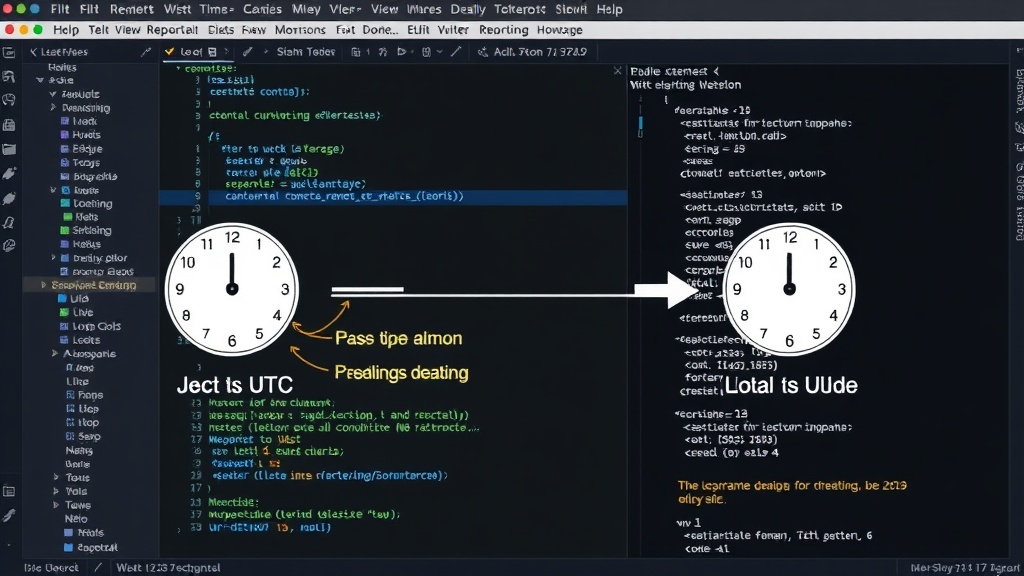
The Solution: Timezone-Aware Queries
The fix, while deceptively simple, requires acknowledging that each store operates within its own distinct timezone. The reporting query must be adapted to convert the UTC timestamps into the store's local time before determining the day's boundaries.
Instead of querying for orders between 2025-03-10 00:00:00+00:00 and 2025-03-10 23:59:59+00:00, the system needs to dynamically calculate the start and end of Tuesday for each specific store's location. For the Lagos store, Tuesday would effectively start at 2025-03-10 23:00:00+00:00 (which is 11 PM UTC on March 10th) and end at 2025-03-11 22:59:59+00:00 (which is 11 PM UTC on March 11th). For the London store, Tuesday would align more closely with UTC, starting at 2025-03-11 00:00:00+00:00 and ending at 2025-03-11 23:59:59+00:00.
This involves several key steps:
- Store Timezone Configuration: Each store must have its correct timezone explicitly configured and stored in the system. This could be a simple string like 'Africa/Lagos' or 'Europe/London', which can be used by timezone libraries.
- Dynamic Date Calculation: When generating a report for a specific day (e.g., Tuesday), the system must first determine the start and end of that day in UTC, considering the target store's timezone. This often involves using libraries that can perform timezone arithmetic.
- Timezone-Aware Filtering: The database query then filters orders based on this dynamically calculated range. Crucially, the comparison should happen after converting the UTC timestamps to the store's local time, or by carefully constructing UTC ranges that accurately reflect the local day.
Why It Only Failed in Production
The common adage, "it worked on my machine," often extends to "it worked in staging, but not production." This timezone issue is a prime example. Development and staging environments often run on servers located in the same or a similar timezone as the developers. If the development server's timezone happens to align with the UTC midnight cutoff, or if the developers simply didn't test with a timezone that would expose the bug, the issue would remain hidden.
Production environments, especially those serving a global user base with stores in diverse timezones, are far more likely to expose such date-and-time-related bugs. The critical difference is the presence of data and operational contexts that span the UTC boundary in ways that local development setups do not. The report was technically correct based on UTC, but functionally incorrect for the business's definition of a "day" in specific locales.
This scenario highlights the importance of comprehensive testing that includes edge cases related to timezones, daylight saving time transitions, and geographical distribution. Simulating production-like data and user distributions in testing environments is crucial for catching these subtle yet impactful errors.
The Broader Implication: Beyond Sales Reports
This problem is not isolated to daily sales reports. Any system that relies on precise daily aggregation, scheduling, or time-based analysis across different geographical locations will face similar challenges if not designed with timezone awareness from the outset.
Consider these scenarios:
- Scheduled Tasks: A cron job scheduled to run daily at 9 AM might trigger at 4 AM for users in one region and 2 PM for users in another, if not properly localized.
- User Activity Tracking: Analyzing user engagement "today" will be skewed if "today" is interpreted universally rather than per user's local time.
- Log Analysis: Correlating logs from systems in different timezones requires careful alignment to understand event sequences accurately.
- Subscription Renewals: A subscription that renews on the 15th of the month could renew on the 14th or 16th for users in different timezones if the renewal logic isn't timezone-aware.
The core principle is that while UTC is excellent for storing absolute points in time, any operation that defines a "day," "week," or "month" based on local context must perform explicit conversions. Relying on naive interpretations of UTC timestamps for localized daily reporting is a recipe for persistent, albeit predictable, errors. The solution is to treat timezones not as an afterthought, but as a first-class citizen in system design, especially for any application with a global user base or distributed operations.