Shifting Left with Replay QA
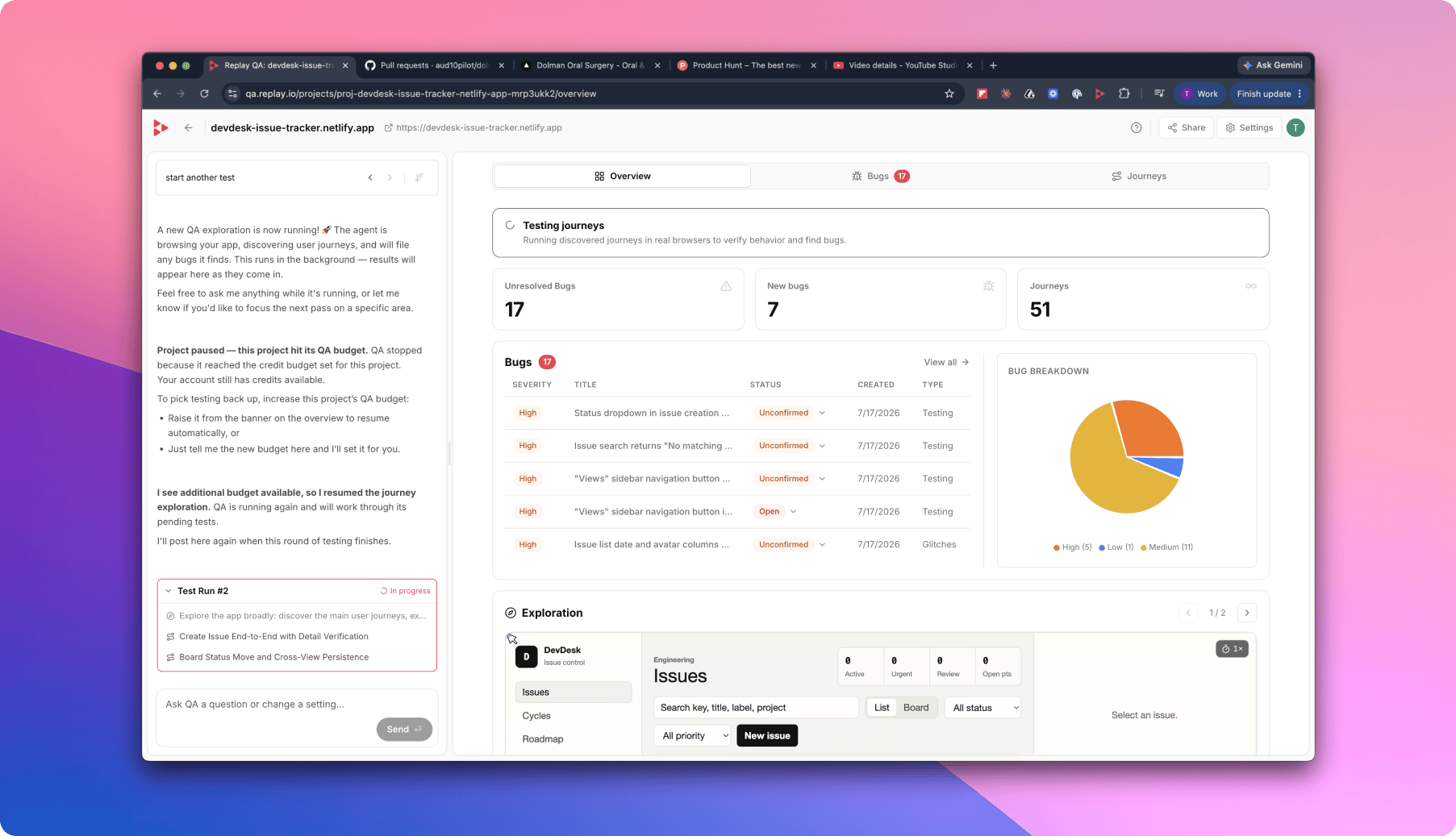
The constant struggle for development teams is to identify and fix bugs before they impact end-users. Traditional testing methodologies, while essential, often fall short in catching the subtle, intermittent, or environment-specific issues that slip through the cracks. Replay QA, a new entrant in the quality assurance space, proposes a novel approach to address this challenge by enabling developers to pinpoint and debug issues with greater precision and speed, effectively shifting bug detection further left in the development lifecycle.
The core promise of Replay QA is simple yet powerful: identify what is broken before your users do. This is not just a catchy slogan; it represents a fundamental shift in how development teams can approach quality assurance. Instead of relying solely on manual testing, automated test suites, or user-reported issues that have already caused frustration, Replay QA offers a way to proactively surface and resolve problems during the development and staging phases.
At its heart, Replay QA functions as a debugging tool that captures the full context of an application's state at the time of an error. This means that when a bug occurs, developers are not just presented with a stack trace or a generic error message. Instead, they receive a comprehensive recording of the application's execution, including user interactions, network requests, console logs, and the exact state of the DOM and JavaScript variables. This level of detail is akin to having a time machine for bugs, allowing developers to rewind and inspect the precise sequence of events that led to the failure.
Consider the common scenario of a bug that only appears under specific network conditions or after a complex series of user actions. Such bugs are notoriously difficult to reproduce and debug using conventional methods. A developer might try to replicate the steps manually, but the exact timing or environmental factor is hard to capture. Replay QA captures all of this automatically. When a bug is detected, the system saves a replay of the user's session, which can then be opened in a dedicated debugger. This debugger allows the developer to step through the recorded execution, inspect variables, and understand the flow of control, effectively recreating the bug on demand.
The Mechanics of Replay QA
Replay QA's approach is built upon the concept of recording and replaying application states. While the specifics of their proprietary technology are not fully detailed, the underlying principle involves instrumenting the application to capture critical events during runtime. This instrumentation is designed to be lightweight, minimizing any impact on application performance during normal operation. When an error is detected, either through automated tests or even by a proactive monitoring agent, the recorded session data is uploaded to the Replay QA platform.
The platform then provides a rich debugging interface. Developers can load a specific replay and interact with it as if they were experiencing the original session. This includes playing the recording forward and backward, setting breakpoints, inspecting the call stack, and examining the values of variables at any point in time. This is a significant departure from traditional logging, which often provides only a linear, textual representation of events. Replay QA offers a visual and interactive representation of the entire debugging process.
The implications for developer productivity are substantial. Debugging time is a significant cost for any engineering team. By reducing the time it takes to reproduce and understand bugs, Replay QA can free up valuable developer hours, allowing them to focus on building new features rather than chasing down elusive issues. Furthermore, the ability to share these replays easily among team members facilitates collaboration and knowledge sharing, making it easier for junior developers to learn from senior engineers' debugging techniques.
Broader Impact on Quality Assurance
The introduction of tools like Replay QA signals a broader trend in software development: the increasing convergence of development and operations, and the continuous push for higher quality through more integrated tooling. The traditional QA department, while still vital, is evolving. Developers are increasingly responsible for the quality of their own code, and tools that empower them to take ownership of this process are becoming indispensable.
Replay QA fits into this paradigm by providing a developer-centric debugging experience. It's not about replacing manual testers or automated testing frameworks, but rather about augmenting them. By providing a more robust way to diagnose issues that automated tests might miss or that manual testers struggle to reproduce, Replay QA enhances the overall effectiveness of the QA process. It allows teams to catch bugs that are often only discovered in production, or in the final stages of user acceptance testing, when they are most costly to fix.
The challenge for any new QA tool is adoption. Developers are often inundated with new tools and frameworks, and adding another layer to the workflow requires a clear value proposition. Replay QA's value proposition is its ability to dramatically reduce the time and frustration associated with debugging complex issues. If the tool can deliver on its promise of making bug reproduction and resolution significantly faster and more intuitive, it has the potential to become a standard part of the development toolkit.
What remains to be seen is how Replay QA scales with very large applications and complex state management. The ability to capture and replay the state of a massive single-page application with thousands of components and intricate data flows presents a significant technical challenge. The performance overhead during recording and the fidelity of the replay mechanism will be critical factors in its long-term success. Furthermore, the integration with existing CI/CD pipelines and issue tracking systems will determine how seamlessly it fits into established workflows.
Conclusion
Replay QA enters the market with a clear mission: to help development teams find and fix bugs earlier and more efficiently. By providing a powerful, context-rich debugging experience that captures the full lifecycle of an error, the tool aims to reduce the burden of bug hunting and improve overall software quality. For developers who have ever spent hours trying to reproduce a phantom bug, the promise of a