
The Problem: Redis Keyspace Scans
In large-scale applications, Redis often serves as a critical caching layer. Developers frequently store related data under keys that follow a pattern, such as user:{userId}:profile or product:{productId}:details. When an entity, like a user's profile, is updated, the cache needs to be invalidated. The naive approach involves scanning the entire Redis keyspace for keys matching a certain pattern. For instance, to invalidate all caches related to a specific user, one might scan for keys starting with user:{userId}:.
This method works, but it scales poorly. As the number of keys in Redis grows, a full keyspace scan becomes prohibitively expensive. Imagine a system with millions of keys. A scan operation might take seconds, or even minutes, during which time the cache is effectively unavailable for updates, and the Redis instance itself might become unresponsive to other read/write operations. This is akin to searching for a specific book in a library by reading every single title on every single shelf – highly inefficient and disruptive.
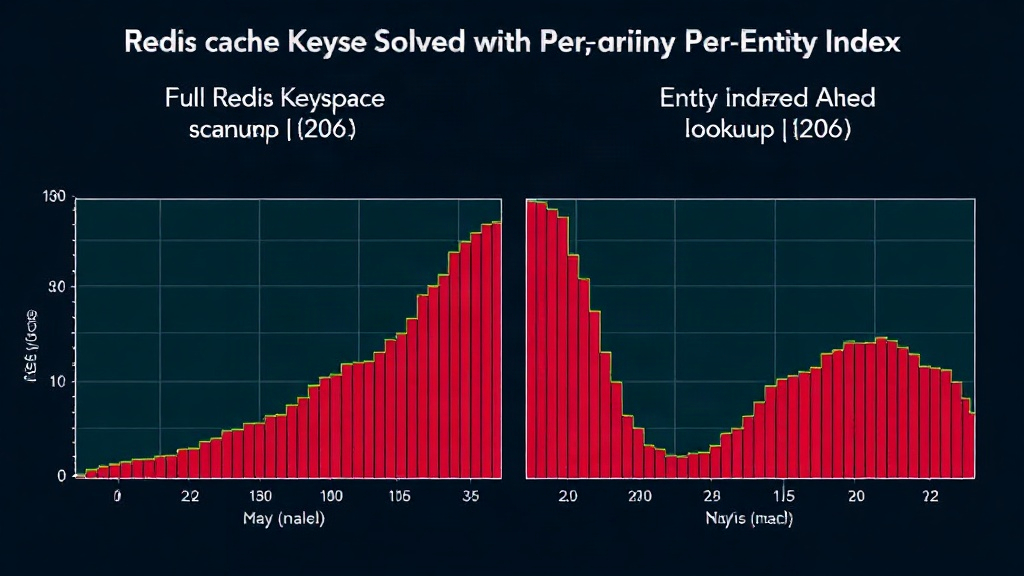
The performance impact of these scans is not theoretical. As demonstrated in local benchmarks, a full keyspace scan on a set of 10 million keys can be orders of magnitude slower than a targeted lookup. When a single cache invalidation event triggers such a scan, it can lead to significant latency spikes, impacting user experience and application stability. This problem becomes particularly acute for systems with high write volumes or frequent data changes, where cache invalidation is a constant necessity.
The Solution: Per-Entity Indexing
The core issue with keyspace scans is the lack of a direct way to identify all cache keys associated with a particular entity. A more efficient solution involves maintaining a secondary index, specifically designed to map entities to their corresponding cache keys. Instead of scanning the entire database, the application can query this index to retrieve only the relevant keys for invalidation.
Consider the user profile example. When a user's profile is updated, the application would first look up the user ID in a dedicated index. This index would store a list of all Redis keys related to that user, such as user:{userId}:profile, user:{userId}:settings, and user:{userId}:activity_log. With this list, the application can then directly delete only those specific keys from Redis, bypassing the need for a broad scan.
This approach transforms cache invalidation from a broadcast storm into a targeted strike. The performance difference is dramatic. Benchmarks show that querying an index to retrieve a small set of keys and then deleting them is significantly faster than scanning millions of keys. This is because index lookups, when properly implemented (e.g., using Redis Sets or HashMaps), are typically O(1) or O(log N) operations, whereas keyspace scans are O(N), where N is the total number of keys. This fundamental shift in complexity is what makes per-entity indexing a game-changer for performance-sensitive applications.
Implementing Per-Entity Indexing in Redis
Implementing this pattern requires careful consideration of data structures. One common and effective method is to use Redis Sets. For each entity (e.g., a user), create a Set named entity:index:{entityType}:{entityId}. This Set would store all the keys in Redis that pertain to that specific entity.
For example, if a user with ID 123 has their profile, settings, and recent activity cached, the application would ensure the following keys exist:
user:123:profileuser:123:settingsuser:123:activity_log
And the corresponding index Set would be:
entity:index:user:123containing members:user:123:profile,user:123:settings,user:123:activity_log
When the user's profile is updated, the application executes the following Redis commands:
SMEMBERS entity:index:user:123: Retrieve all keys associated with user 123.- For each key returned (e.g.,
user:123:profile), executeDEL <key>.
This process is significantly faster than scanning the entire keyspace. The `SMEMBERS` command retrieves the set members efficiently, and the subsequent `DEL` commands target only the necessary keys.
Another viable approach involves using Redis Hashes. A Hash can map entity IDs to a collection of their associated keys. For instance, a Hash named entity_indices:{entityType} could store entries where the field is the entity ID and the value is a serialized list or Set of keys. While Hashes offer more structured data, Sets are often simpler and more direct for this specific indexing use case.
When to Use Per-Entity Indexing
This indexing strategy is most beneficial for applications that:
- Store a large number of keys in Redis (millions or more).
- Frequently update cached entities, requiring cache invalidation.
- Experience performance degradation or latency spikes due to cache invalidation operations.
- Have clearly defined relationships between entities and their cached data, allowing for predictable key naming conventions.
If your Redis instance is small, your data rarely changes, or your cache invalidation needs are minimal, the overhead of maintaining these indices might outweigh the benefits. However, for systems operating at scale, where performance and reliability are paramount, a per-entity index is not merely an optimization; it's a necessity.
The surprising detail here is not the complexity of the solution, but how a simple structural change—adding a layer of metadata to track relationships—can yield such drastic performance improvements. It highlights a common theme in distributed systems: careful data modeling and indexing are often the most powerful tools for optimizing performance.