New Execution Rules Reshape Crypto Trading Dynamics
Crypto trading venues are implementing significant changes to their execution rules, most notably a 150-millisecond "taker delay" and volume-based rate tiers. These adjustments, detailed by developer abrownfox001 on Dev.to, fundamentally alter the landscape for high-frequency trading bots and sophisticated traders who rely on near-instantaneous order book access and execution. The implications extend beyond mere latency increases; they represent a strategic shift by exchanges to manage market dynamics, potentially curbing certain predatory trading strategies while creating new challenges for bot developers.
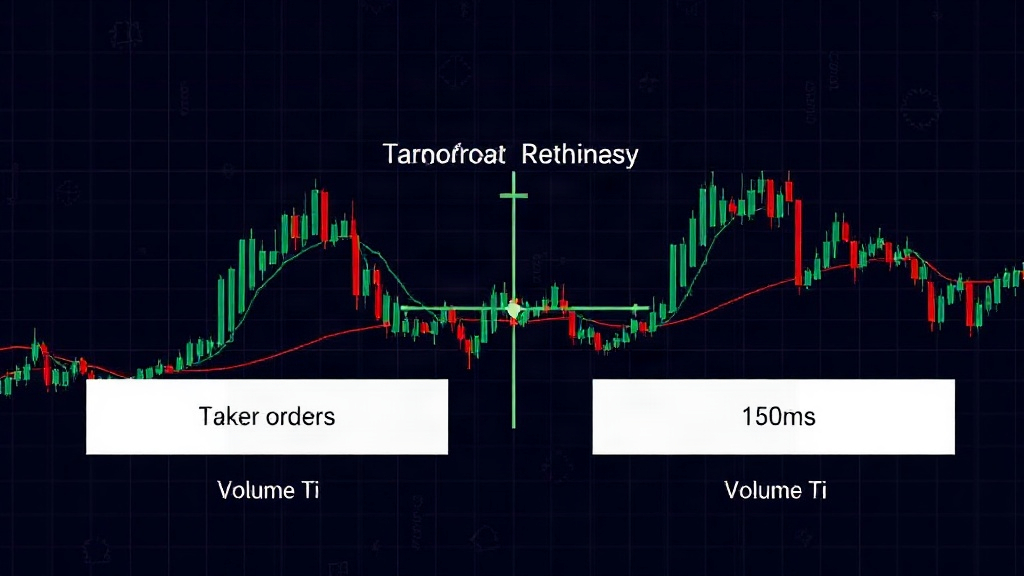
The core of the change revolves around how taker orders, which immediately match with existing orders on the book, are processed. Historically, the race to place a taker order meant that the fastest bot or trader, often leveraging co-location and sophisticated infrastructure, would gain an advantage. The introduction of a 150ms delay means that even the most technically optimized takers now face a standardized latency, leveling the playing field in a significant way. This delay is not arbitrary; it’s a deliberate mechanism designed to alter the speed advantage that previously dominated certain trading strategies.
Understanding the Taker Delay and Its Impact
A 150ms delay might sound minuscule to the uninitiated, but in the realm of algorithmic trading, it’s an eternity. This delay affects the ability of bots to exploit micro-price discrepancies or front-run orders. Previously, bots could detect an incoming large order and place their own taker order milliseconds before it, effectively capturing a slightly better price or profiting from the price impact of the larger order. With the 150ms delay, this exploitable window is standardized, making such predatory tactics significantly less effective, if not entirely impossible.
The implications for bot developers are substantial. Systems that were optimized for sub-millisecond latency now need to account for this fixed delay. This means re-architecting strategies that relied on speed arbitrage or rapid order book manipulation. Instead of focusing on shaving off nanoseconds, developers must now consider strategies that are more resilient to this standardized latency, perhaps focusing on longer-term signals or different market inefficiencies.
Volume-Based CLOB Rate Tiers: A New Constraint
Complementing the taker delay, exchanges are also implementing volume-based CLOB (Central Limit Order Book) rate tiers. This means that the speed and volume of orders a trading entity can send are now directly tied to their trading volume on the platform. Higher volume traders might receive more favorable rate limits, while lower volume traders could find their order submission speeds throttled. This tiered system is a direct attempt to manage the load on exchange infrastructure and to disincentivize excessive order flow from smaller, potentially disruptive, participants.
The rationale behind these tiers is multifaceted. From an exchange's perspective, it helps maintain stability and performance, especially during periods of high volatility when order flow can spike. It also serves as a cost-management tool, as high-volume, high-frequency trading often requires significant computational resources from the exchange. For traders, it means that the cost of high-frequency strategies is no longer solely about latency or algorithm efficiency, but also about the economic scale of their operations. Building a successful trading bot now requires not only a sophisticated algorithm but also a significant capital deployment to justify higher rate limits.
The Strategic Shift in Market Making and Arbitrage
These changes collectively signal a strategic shift by exchanges away from a pure speed-based competition towards a more controlled and potentially more stable trading environment. For market makers, the 150ms delay means that their ability to provide liquidity by quoting tight bid-ask spreads and hedging rapidly is fundamentally altered. They must now factor in this delay when calculating their risk and pricing their quotes. The arbitrage opportunities that rely on extremely fast execution across different venues or asset pairs are also significantly curtailed.
The developer, abrownfox001, highlights this with their TWAP (Time-Weighted Average Price) prediction trigger system. Such systems often rely on precise timing and rapid execution to capture small price movements based on historical data. The introduction of a fixed taker delay forces a re-evaluation of the effectiveness and implementation of these strategies. If the venue changed how taker orders are allowed to race, a correct prediction of price movement P(up) can still fail if the execution mechanism is no longer favorable.
Broader Implications for the Crypto Ecosystem
These execution rule changes are not isolated incidents but likely represent a growing trend in the digital asset trading space. As crypto markets mature and attract more institutional capital, exchanges are under pressure to provide more robust and stable trading environments, akin to traditional financial markets. The introduction of delays and tiered access is a common mechanism in traditional exchanges to manage order flow, prevent market manipulation, and ensure fair access based on economic contribution.
What remains to be seen is how quickly other major exchanges will adopt similar measures. The success or failure of these implementations, and the community's response, will dictate the future direction of algorithmic trading strategies in crypto. Will this lead to a bifurcation of markets – some prioritizing speed and others stability? And what will be the impact on retail traders who are less equipped to adapt to these complex changes?
For developers, the challenge is to adapt. The provided GitHub repository for the TWAP prediction trigger system serves as a case study in how these new constraints might be addressed. The accompanying YouTube walkthrough offers a glimpse into the practical application and potential refactoring required for bots operating under these new rules. Ultimately, the crypto trading landscape is evolving, demanding greater sophistication and a strategic understanding of the underlying exchange mechanics, not just the trading algorithms themselves.