The Stale Closure Problem in React
React developers frequently encounter a common dilemma when handling events. Writing an inline event handler that depends on component state or props leads to a performance pitfall: each render creates a new function reference. This breaks optimizations like React.memo, causes unnecessary re-runs of effects, and forces listeners to re-subscribe. The alternative, wrapping the handler in useCallback, introduces its own challenge: the dreaded dependency array. Forgetting a dependency can lead to the handler referencing outdated state, a bug known as a stale closure. This bug is pervasive in production React applications.
The official React team recognized this recurring issue and proposed a solution in a 2022 RFC (Request for Comments). The proposed hook, now available as useEvent in the @reactuses/core library, aims to provide a stable callback function whose identity never changes across renders, regardless of the dependencies it might capture. This stability is crucial for performance and predictable behavior in complex React applications.
How useEvent Works
The core innovation of useEvent lies in how it manages the callback. Unlike useCallback, which memoizes a function based on its dependencies, useEvent returns a stable function reference. This means the function itself is always the same instance across renders. Internally, it likely uses a mutable ref to hold the latest version of the callback you provide. When the stable function is invoked, it accesses the current callback from the ref, ensuring it always operates with the latest state and props.
Think of it less like a memoized function that gets updated when dependencies change, and more like a remote control. The remote control (the useEvent hook) always looks the same and you always use the same button. However, the signal it sends to the TV (the actual callback logic) is always the latest version, ensuring you're always changing the current channel, not one from last week.
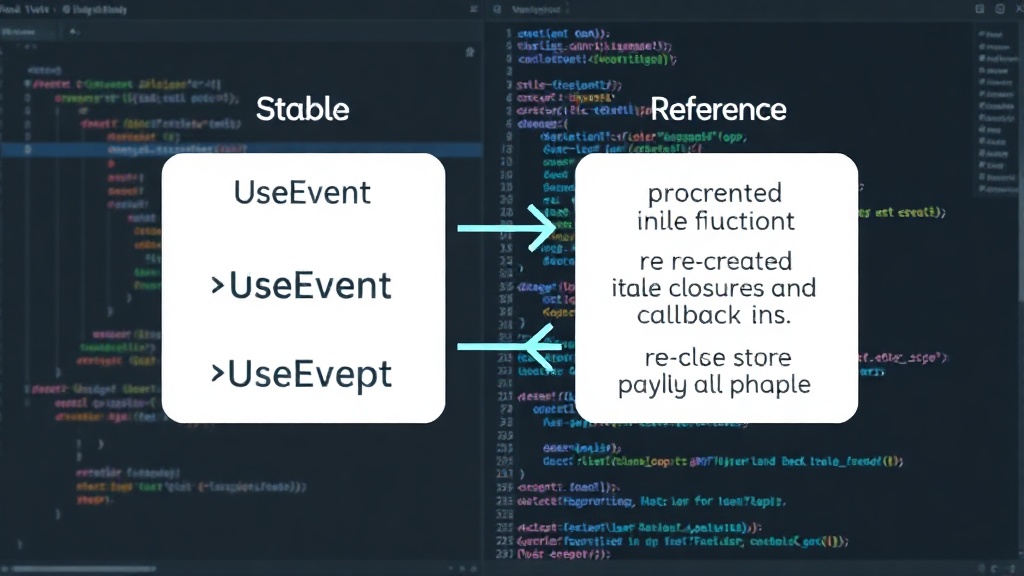
This distinction is critical. When you pass a function generated by useEvent to a child component, or use it within a useEffect, the reference remains constant. This constant reference prevents unnecessary re-renders in memoized children and ensures effects don't re-run unless absolutely intended by their own dependency arrays. The handler will always have access to the most up-to-date state and props without the developer having to meticulously manage dependency arrays.
Benefits of useEvent
The primary benefit of useEvent is the elimination of stale closures. Developers can write event handlers that read state and props without fear of the handler becoming outdated. This simplifies component logic and significantly reduces a common source of bugs.
Performance is another major win. By providing a stable callback reference, useEvent allows React to optimize rendering. Components wrapped with React.memo that receive these stable callbacks will not re-render unnecessarily. Effects that subscribe to these callbacks will also behave more predictably, not re-subscribing on every render if the callback reference hasn't actually changed.
Consider an input field with a debounced search handler. With useCallback, managing the debounce timer and ensuring it uses the latest search term can be complex. A stale closure might mean the debounce fires with an old term. useEvent simplifies this: the handler always references the current input value, and the debounce logic can be written more straightforwardly, knowing it's always operating on fresh data.
When to Use useEvent
useEvent is particularly valuable in scenarios where:
- Event handlers need access to the latest state or props.
- Callbacks are passed down to memoized child components (e.g., those wrapped in
React.memo). - Callbacks are used as dependencies in
useEffect,useMemo, oruseCallback, and you want to avoid unnecessary re-computations or re-runs. - You are dealing with complex event listeners or subscriptions that should always use the most current data.
It's not a direct replacement for useCallback in all cases. If your goal is specifically to memoize a function that performs a computationally expensive task and you *want* it to re-run only when certain dependencies change, useCallback remains the appropriate tool. However, for stable callbacks that simply need to access the latest component data, useEvent offers a more robust and simpler solution.
The Future of Callbacks in React
The introduction of useEvent signals a maturing of React's API, addressing a long-standing pain point for developers. While it's currently available as a community package, its presence in an official RFC suggests it may eventually be integrated directly into React itself. This would make it a standard part of the React developer's toolkit, further simplifying the development of performant and bug-free applications.
The broader implication is a shift towards more declarative and less imperative patterns for managing stateful logic within event handlers. By abstracting away the complexities of dependency management for callbacks, useEvent allows developers to focus more on the application's core logic and less on the intricacies of React's rendering and memoization strategies.
What nobody has fully explored yet is the potential impact of useEvent on server components and concurrent rendering. How will stable callbacks interact with the unique rendering paradigms and data fetching models of these newer React features? The promise of stable references is compelling, but its integration into the evolving React ecosystem warrants close observation.