The React Flight Protocol: A Double-Edged Sword
React Server Components (RSCs) offer a compelling paradigm shift, enabling developers to render UI on the server and stream interactive components to the client. This is largely facilitated by the custom Flight protocol, a sophisticated mechanism designed for efficient data transfer. However, like many powerful tools, the Flight protocol harbors inherent risks. Its reliance on deserialization, a process of converting serialized data back into its original object form, creates potent deserialization sinks. These sinks, when not properly secured, become prime targets for attackers.
Durgesh Pawar's research, detailed in Smashing Magazine, uncovers a critical vulnerability dubbed "React2Shell." This exploit leverages manipulation of the Flight protocol to achieve remote code execution (RCE) with a CVSS score of 10.0, the highest possible severity. The core issue lies in how the Flight protocol handles the deserialization of incoming data, particularly when dealing with complex or untrusted inputs.
Understanding Deserialization Sinks and React2Shell
Deserialization vulnerabilities occur when an application deserializes untrusted data without proper validation. An attacker can craft malicious serialized data that, when deserialized, executes arbitrary code on the server or client. In the context of RSCs and the Flight protocol, this means an attacker could potentially send specially crafted Flight messages that, upon deserialization by the React runtime on the server, trigger unintended code execution.
The "React2Shell" vulnerability specifically targets the deserialization process within the Flight protocol. By understanding the structure and expected data formats of Flight messages, an attacker can craft payloads that exploit weaknesses in how these messages are parsed and processed. This could involve injecting malicious objects or commands that are then executed by the server's React environment. The impact is severe: complete compromise of the server running the RSCs.
Weaponizing the Protocol
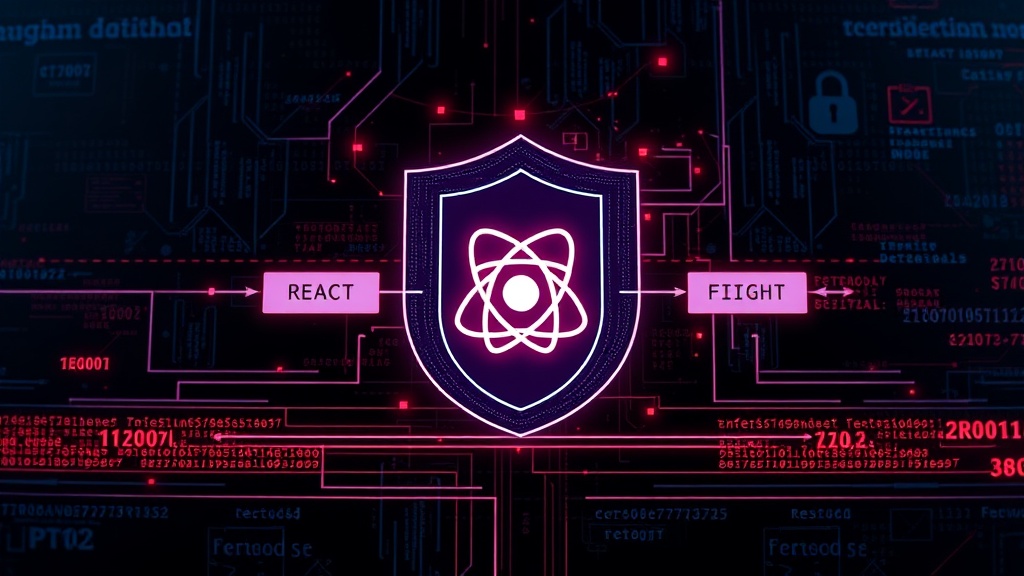
The process of weaponizing the Flight protocol for the React2Shell exploit involves several key steps. First, an attacker must identify the specific endpoints and data structures that are susceptible to deserialization attacks within the RSC framework. This often requires deep introspection of the application's code and network traffic.
Once a vulnerable sink is identified, the attacker crafts a malicious serialized object. This object is then embedded within a Flight protocol message. The message is sent to the target RSC server. If the server's deserialization logic is flawed, it will process the malicious object, leading to the execution of arbitrary code. This could range from data exfiltration to full system control.
Consider the deserialization process as akin to opening a package. If the package is supposed to contain only books, but an attacker has secretly swapped a book for a dangerous device, you wouldn't know until you try to unpack it. In "React2Shell," the Flight protocol is the delivery mechanism, and the malicious object is the dangerous device hidden within a seemingly legitimate package.
Defending Against React2Shell and Similar Threats
Defending against deserialization vulnerabilities, particularly in complex protocols like Flight, requires a multi-layered approach. The primary defense is to ensure that any data being deserialized is strictly validated and sanitized. This means implementing robust checks to ensure that only expected data types and structures are processed.
For developers building with RSCs, this translates to rigorous input validation on all data received via the Flight protocol. Avoid deserializing untrusted data directly. If deserialization is unavoidable, ensure that the deserializer is configured to only allow safe, expected types and that any potentially dangerous operations are disallowed. Whitelisting trusted data formats and structures is generally more secure than blacklisting potentially malicious ones.
Furthermore, keeping React and related libraries updated is crucial. Vulnerabilities are often patched in newer versions. Relying on the latest stable releases of React and any server-side rendering frameworks can mitigate known risks. Security tooling that can detect and flag potential deserialization payloads in network traffic can also provide an additional layer of defense.
Broader Implications for Server Components
The discovery of "React2Shell" highlights a critical security consideration for the broader adoption of server components and custom communication protocols. As applications increasingly shift logic and rendering to the server, the attack surface expands. Any custom protocol designed for efficient data streaming or component rendering must be meticulously scrutinized for deserialization vulnerabilities.
The trend towards more sophisticated server-side rendering and component-based architectures means that developers must prioritize security from the outset. This includes understanding the security implications of serialization and deserialization, implementing secure coding practices, and conducting thorough security audits of custom protocols and data handling mechanisms. The ease with which "React2Shell" can lead to RCE serves as a stark reminder that performance and interactivity must not come at the expense of security.
What remains to be seen is how broadly the Flight protocol is adopted beyond its initial implementation, and whether similar deserialization vulnerabilities will emerge in other custom server-component communication protocols. The onus is now on framework maintainers and developers to ensure that the mechanisms enabling modern web interactivity do not inadvertently become the conduits for devastating security breaches.