Bridging React into Preact: A Production Strategy
Sama Abasi is set to present at React Day Berlin 2026, detailing a complex technical challenge: integrating React components into an established Preact-based form engine. The talk, titled "How I Brought React Into a Preact Form Engine: A Production Bridge Pattern," promises a deep dive into the practicalities and trade-offs of such a hybrid architecture. This isn't about a new library; it's about a pragmatic solution for a common problem in evolving front-end codebases where different frameworks coexist.
The core of Abasi's presentation will focus on a "bridge pattern" implemented in a production environment. This suggests a deliberate architectural choice designed to facilitate communication and interoperability between two distinct JavaScript rendering libraries. In many organizations, legacy codebases built with one framework (Preact, in this case) must eventually accommodate or integrate with newer components or features developed using another (React). Achieving this without a complete rewrite requires careful engineering.
Abasi plans to cover the specific implementation details of this bridge, highlighting how components from one framework can render and interact with components from another. This involves understanding the lifecycle methods, state management, and rendering mechanisms of both React and Preact and finding common ground or translation layers. The goal is to allow developers to leverage the strengths of both ecosystems – perhaps Preact for its performance and small footprint in the core engine, and React for its richer component ecosystem or developer familiarity for specific features.
Trade-offs and Lessons Learned
Beyond the technical implementation, Abasi will candidly discuss the trade-offs involved. Integrating different JavaScript frameworks rarely comes without compromise. These might include:
- Performance overhead: Running two rendering engines or managing complex inter-framework communication can introduce performance penalties.
- Bundle size increase: Including both React and Preact, along with any necessary bridging logic, will inevitably increase the final JavaScript bundle size.
- Development complexity: Maintaining and debugging a hybrid codebase can be more challenging than a pure-framework application. Developers need to understand the nuances of both React and Preact, as well as the custom bridge.
- Tooling and ecosystem fragmentation: Certain React-specific tools or libraries might not work seamlessly with Preact, or vice-versa, requiring workarounds or alternative solutions.
The inclusion of "what I'd do differently next time" signals a commitment to sharing hard-won wisdom. This forward-looking perspective is invaluable for other teams facing similar integration challenges. It suggests that the initial implementation, while functional, may have had aspects that could be optimized or approached more efficiently with hindsight. This could involve better separation of concerns, more robust error handling, or a more streamlined data flow between the two frameworks.
The React Day Berlin 2026 Context
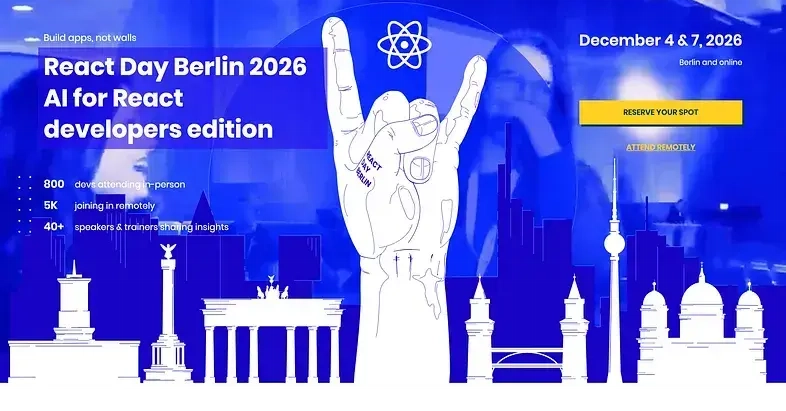
React Day Berlin is a prominent conference for the React ecosystem. While this talk specifically addresses bridging React into Preact, the themes of interoperability, pragmatic engineering, and managing complex front-end architectures are highly relevant to the broader React community. Many developers work in environments where gradual migration or integration of new technologies is the norm, rather than complete overhauls.
The conference dates are set for December 4 & 7, 2026, with the format—remote or in-person—yet to be determined. Abasi's talk is slated for a duration of up to 20 minutes, a common length for technical deep dives that require concise explanations and focused takeaways.
Interested attendees can register using a speaker badge provided by Abasi, which grants partial free access to the stream. This offers a low-barrier entry point for developers keen to learn from this practical case study. The presentation is a testament to the evolving landscape of front-end development, where mastering the integration of different tools and frameworks is becoming as critical as mastering a single one.