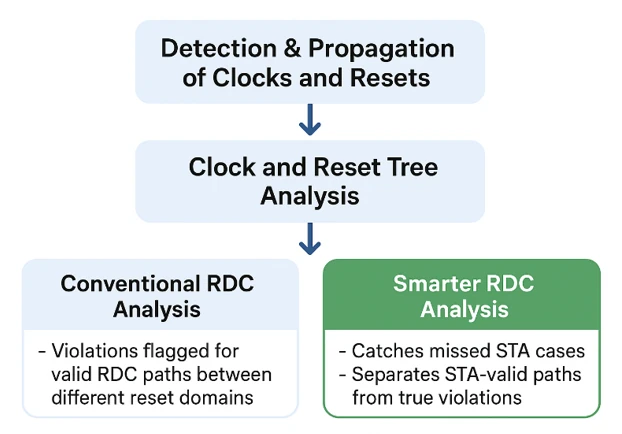
The Challenge of RDC Violations
The quest for reliable hardware designs is perpetually challenged by the sheer volume of potential violations flagged by static analysis tools. Specifically, Register-Transfer Level (RTL) Design Constraint (RDC) violations can overwhelm design teams. Traditional approaches often produce a high rate of false positives, making it difficult to distinguish between actual design risks and inconsequential issues that arise from safe implementation choices. This 'chaff' obscures the 'wheat' – the critical violations that demand immediate attention. The primary hurdle is that RDC violations are context-dependent. A violation that might be critical in one part of a design could be benign in another, depending on clocking, reset schemes, and data flow.
Consider an analogy: Imagine a fire alarm system that blares for every puff of smoke, regardless of whether it's from a smoldering cigarette or a raging inferno. While the alarm technically detects smoke, its constant, undifferentiated alerts lead to complacency and make it impossible to prioritize genuine threats. This is precisely the problem in RDC analysis. The goal is not merely to detect violations but to classify them by their potential impact on the final silicon. This requires a deeper understanding of the design's intent and its operational context.
Integrating Structural Analysis and Timing Awareness
To tackle this, advanced methodologies are emerging that combine multiple analytical dimensions. The first critical element is robust structural analysis. This involves understanding the connectivity and hierarchy of the RTL design. Tools must be able to trace paths, identify fan-in and fan-out, and map dependencies between different modules. This provides a foundational understanding of the design's architecture.
Layered on top of structural analysis is timing awareness. RDC violations often manifest due to timing mismatches or race conditions. By incorporating timing information – such as clock frequencies, signal propagation delays, and setup/hold times – into the analysis, tools can better predict when a violation might actually lead to functional issues. For instance, a glitch that occurs and resolves within a single clock cycle might be acceptable, whereas one that persists across clock edges could be problematic. This requires sophisticated static timing analysis (STA) techniques integrated directly into the RDC checking flow.
Context-Based Classification for Precision
The most significant advancement comes from context-based classification. This approach moves beyond simply flagging a rule violation and instead attempts to understand the 'why' and 'where' of the violation within the broader design. This involves several key components:
- Path Sensitivity: Analyzing the specific data path affected by the violation. Is it on a critical control path, a high-speed data path, or a less sensitive housekeeping path?
- Clock Domain Crossing (CDC) Awareness: Many RDC violations are related to improper handling of signals crossing between different clock domains. Understanding the CDC strategy (e.g., using FIFOs, synchronizers) and verifying that violations respect these mechanisms is crucial.
- Reset Domain Awareness: Similar to CDC, violations related to reset signals need to be evaluated within the context of the reset strategy. Are reset signals properly synchronized and asserted/de-asserted?
- Functional Equivalence Checks: In some cases, a violation might be deemed acceptable if subsequent logic or design choices ensure functional correctness under all operating conditions. This is particularly relevant for complex asynchronous designs.
By combining these elements, the analysis engine can assign a severity score or a 'risk level' to each violation. This allows design teams to prioritize their efforts, focusing on the violations that pose the greatest threat to design correctness and silicon functionality. The aim is to transform RDC checking from a noisy alert system into an intelligent risk assessment tool.
The Impact on Design Workflows
Implementing such a sophisticated RDC analysis framework has profound implications for semiconductor design workflows. Instead of spending days sifting through hundreds or thousands of false positives, engineers can focus on a curated list of high-priority issues. This accelerates the verification process, reduces time-to-market, and ultimately leads to more robust and reliable silicon. The challenge lies in the complexity of building and maintaining these advanced analysis engines, which require deep expertise in both RTL design and formal verification methodologies. However, the return on investment in terms of reduced debug time and improved design quality is substantial.
Looking Ahead: Automation and AI
The future of RDC violation analysis likely involves further automation and the integration of machine learning. AI could potentially be used to learn from past design cycles, identify common violation patterns, and even predict the likelihood of certain violations leading to bugs. This would enable even more precise filtering and proactive design guidance. The ultimate goal is to make RDC analysis an integral, intelligent part of the design process, rather than a tedious post-processing step.