
Why Rate Limiting is Essential
Rate limiting is a critical mechanism for any API or service exposed to external clients. Its fundamental purpose is to answer a simple, yet vital, question on every incoming request: has this client exceeded its allowed usage threshold, and should this request be rejected? While this sounds straightforward, implementing it effectively becomes complex in distributed environments. Without rate limits, a single uncooperative client—whether due to a runaway retry loop, aggressive scraping, a credential stuffing attack, or simply inefficient code—can flood the system with thousands of requests per second. This overload can degrade performance for all users, exhaust resources, and lead to denial-of-service conditions. Beyond preventing abuse, rate limiting enforces fair usage policies among tenants, ensuring that no single entity monopolizes shared resources. It also frequently serves as a billing boundary, distinguishing between different service tiers (e.g., a free tier with 100 requests per minute versus a paid tier with 10,000).
Token Bucket Algorithm
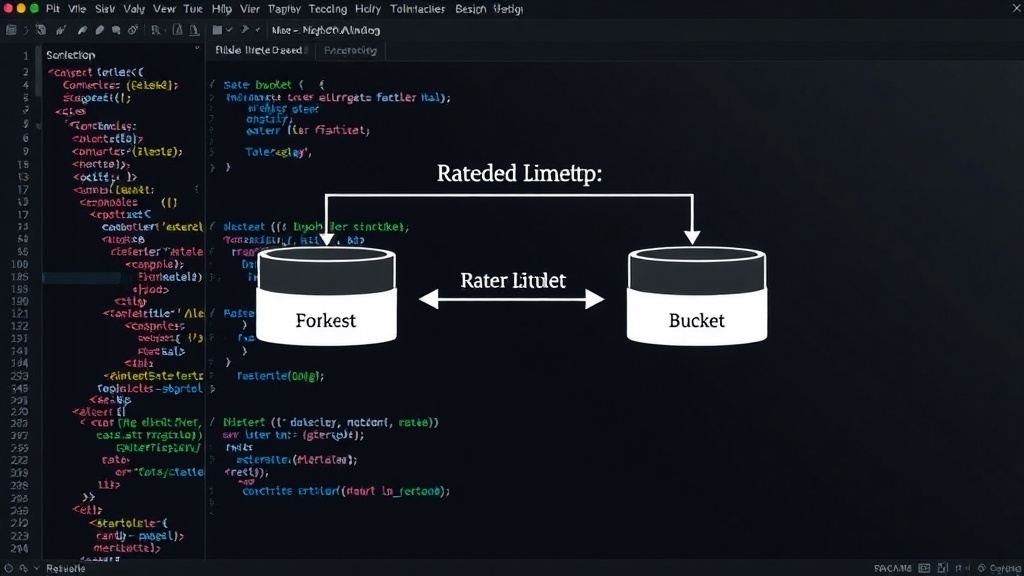
The token bucket algorithm is a widely adopted approach for rate limiting. It models a bucket with a fixed capacity that can hold a maximum number of tokens. Tokens are added to the bucket at a constant rate, say, 10 tokens per second. Each incoming request consumes one token from the bucket. If a request arrives and the bucket is empty, it is rejected. A key advantage of the token bucket is its ability to handle bursts of traffic. A client that has been inactive can accumulate tokens up to the bucket's capacity. When it suddenly needs to send multiple requests, it can consume these accumulated tokens, provided the bucket isn't empty. This allows for smoother traffic patterns, accommodating occasional spikes without immediate rejection, as long as the average rate over time adheres to the refill rate. The algorithm's state is typically the current number of tokens in the bucket and the last time tokens were added. To implement the refill, you calculate how many tokens should have been added since the last request based on the refill rate and the elapsed time, ensuring the token count does not exceed the bucket's capacity.
Sliding Window Algorithm
The sliding window algorithm offers a different perspective, focusing on a fixed time window. Instead of tracking tokens, it tracks requests within a defined interval, such as the last minute. When a request arrives, the system checks how many requests the client has made within the current time window. If this count exceeds the defined limit, the request is rejected. A common implementation uses timestamps. Each request's timestamp is recorded, and when a new request comes in, all timestamps older than the window duration are discarded. The count of remaining timestamps then determines if the new request is allowed. For example, if the limit is 100 requests per minute, and a client has made 99 requests in the last 60 seconds, the 100th request would be rejected. This approach is simpler to reason about in terms of strict limits over a given period. However, it can be less forgiving of bursts than the token bucket. If a client sends 100 requests at second 59 of a minute, and then another 100 requests at second 1 of the next minute, it could technically send 200 requests within a 2-second span, even if the average rate is much lower. Variations exist, such as the sliding log window, which keeps a log of request timestamps and efficiently prunes old ones, offering a more accurate sliding window count.
Challenges in Distributed Systems
The real complexity emerges when a service is scaled horizontally behind a load balancer, with multiple API servers each handling requests independently. If each server maintains its own independent rate limiter state (e.g., its own token bucket or request count), there's no global view of a client's total activity. Server A might have allowed 50 requests from a client, while Server B has allowed another 50. If the limit is 100 requests per minute, the client might be rejected by Server B on its 51st request, even though the total across both servers is only 101, which might still be acceptable depending on the exact limit and timing. This lack of shared state leads to inconsistent rejection decisions and undermines the rate limiting policy. The system effectively doesn't know the client's true request rate across the entire infrastructure.
Making Rate Limiting Distributed
To address the distributed state problem, a centralized or shared state mechanism is required. Several strategies exist:
Centralized Counter/State Store
The most common approach involves using an external, shared data store accessible by all API servers. This store acts as the single source of truth for rate limiting state. When a request arrives at any API server, that server queries the shared store to check the client's current usage. After processing the request (either allowing or rejecting it), the server updates the state in the shared store. Popular choices for this shared store include:
- Redis: Its in-memory nature provides very low latency, crucial for not significantly impacting request processing time. Redis commands like
INCR(increment) andEXPIRE(set TTL) are often used. For example, a token bucket could be simulated by storing the token count and last refill time, or a sliding window could be implemented using sorted sets to store request timestamps. - Memcached: Similar to Redis, offering fast key-value access.
- Databases (SQL/NoSQL): While generally slower than in-memory stores, they can offer durability and consistency guarantees. However, the high read/write volume for rate limiting can become a bottleneck and expensive.
The challenge with a centralized store is latency and availability. Every request requires a network round trip to the state store. If the store becomes slow or unavailable, rate limiting can fail open (allowing unlimited requests, defeating the purpose) or fail closed (rejecting all requests, causing a denial of service). To mitigate this, techniques like client-side caching of recent state or local in-memory counters with periodic synchronization to the central store can be employed, though these introduce eventual consistency issues.
Distributed Consensus (e.g., ZooKeeper, etcd)
For extremely critical scenarios demanding strong consistency, distributed consensus systems could theoretically be used. However, these are typically overkill for rate limiting due to their higher latency and complexity compared to key-value stores. They are more suited for coordination tasks like leader election or configuration management.
Alternative: Client-Side Enforcement (Less Common for APIs)
In some specific client-server architectures (e.g., within a single application's internal components), rate limiting might be enforced client-side. However, for public or multi-tenant APIs, this is not a viable solution as clients can easily bypass client-side checks.
Considerations for Implementation
When designing a distributed rate limiter, several factors are paramount:
- Latency: The rate limiting check must add minimal overhead to the request path.
- Accuracy: The limit should be enforced as closely as possible to the defined policy, minimizing false positives (unnecessary rejections) and false negatives (unnecessary allowances).
- Scalability: The rate limiter itself must scale with the service it protects.
- Availability: The rate limiter should be highly available; its failure should not bring down the service.
- Cost: The operational cost of the rate limiting infrastructure must be considered.
The choice between token bucket and sliding window often depends on the desired traffic shaping behavior. Token bucket is generally preferred for its burst handling capabilities, while sliding window offers stricter adherence to limits over defined intervals. For distributed systems, the critical decision is how to manage shared state reliably and performantly, with Redis being a popular and effective choice for many use cases.