Railway's Limitations for Enterprise Production
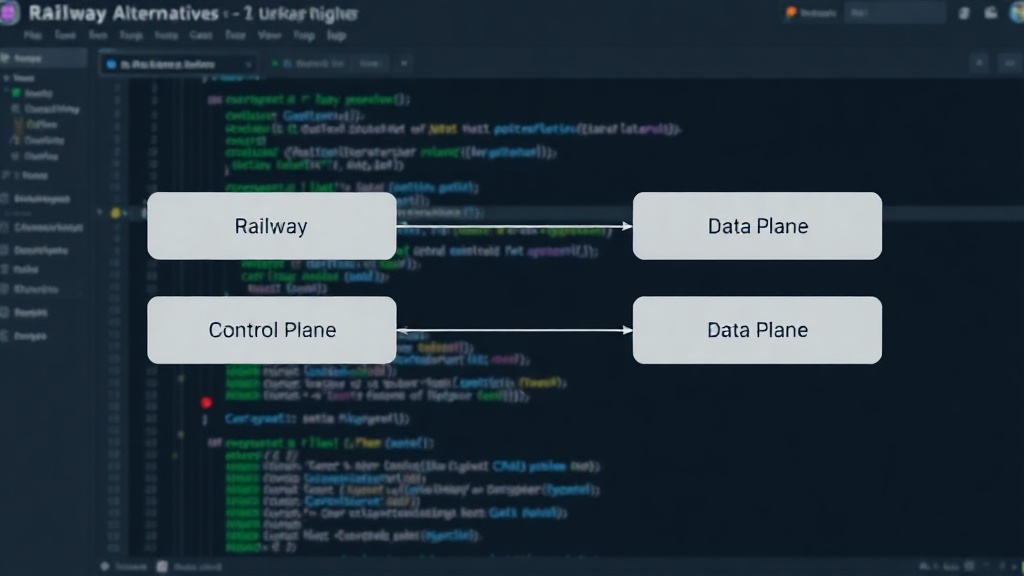
Railway has carved out a niche for itself, proving invaluable for rapid prototyping, hackathons, and internal innovation sandboxes. Its ease of use and swift deployment cycles make it an attractive option when the cost of downtime or data loss is minimal. However, as enterprises look towards 2026, Railway's current architecture and feature set present significant hurdles for serious production workloads. The platform's track record, marred by notable outages in May 2026 (a GCP account suspension) and July 2026 (a US East network failure), highlights an inherent architectural coupling between its control plane and data plane. This entanglement means that issues impacting Railway's infrastructure can directly translate to unavailability or data integrity problems for hosted applications. Furthermore, critical governance features, essential for enterprise-grade compliance, security, and operational control, are often gated behind higher-tier plans, making a truly robust enterprise deployment potentially more expensive and complex than anticipated.
The Need for Robust Governance and Reliability
Enterprises operate under stringent requirements for uptime, data security, and regulatory compliance. A platform default for production must offer predictable performance, granular control over deployments, comprehensive audit trails, and robust disaster recovery mechanisms. Railway's current model, while excellent for developer velocity in low-stakes environments, falls short on these fronts. The platform's reliance on underlying cloud providers, coupled with its integrated control and data planes, creates a single point of failure that enterprises typically strive to eliminate through multi-region strategies, independent infrastructure management, and explicit separation of concerns. The governance aspect is equally critical; enterprises need to manage user access, enforce deployment policies, monitor resource utilization effectively, and ensure data residency requirements are met. These are not merely 'nice-to-have' features but fundamental necessities for operating in regulated industries or maintaining critical business functions.
Key Enterprise Alternatives and Their Strengths
Given these limitations, enterprises must look beyond Railway for their production needs in 2026. The landscape offers several categories of alternatives, each catering to different enterprise priorities:
Full Cloud Ownership: AWS, GCP, and Azure
For organizations that require complete control over their infrastructure, security, and compliance posture, the major cloud providers remain the default choice. AWS, Google Cloud Platform, and Microsoft Azure offer a vast array of services that can be assembled into highly reliable, secure, and scalable application platforms. This approach involves leveraging services like Kubernetes (EKS, GKE, AKS), serverless compute (Lambda, Cloud Functions, Azure Functions), managed databases, and robust networking solutions. While this offers the highest degree of flexibility and control, it also demands significant in-house expertise in cloud architecture, operations, and security. The trade-off is immense power and customization at the cost of increased operational overhead and complexity.
Controlled Container Orchestration: Northflank and Kubernetes
For enterprises that want more control than a managed platform but less complexity than building from scratch on raw cloud infrastructure, solutions like Northflank and self-managed Kubernetes clusters on cloud VMs offer a compelling middle ground. Northflank, for instance, provides a managed Kubernetes experience with a focus on developer productivity and governance features, abstracting away much of the underlying Kubernetes complexity while retaining control. For those with specific data sovereignty needs or a desire for deep customization, deploying and managing Kubernetes clusters directly on cloud providers (using services like EC2, Compute Engine, or Azure VMs) provides granular control over networking, storage, and security policies. This path requires expertise in Kubernetes administration but offers greater flexibility and data control compared to higher-level managed platforms.
Frontend-Heavy Workloads: Vercel, Netlify, and Cloudflare
When the primary workload consists of frontend applications, static sites, and edge computing functions, platforms like Vercel, Netlify, and Cloudflare Pages are excellent alternatives. These platforms are optimized for Jamstack architectures, serverless functions, and global content delivery networks (CDNs). They offer seamless integration with Git, automated deployments, and performance optimizations that are crucial for modern web experiences. While they excel at frontend delivery and edge logic, they are generally not suited for backend-heavy, stateful, or computationally intensive applications that require persistent compute instances or complex database management, areas where Railway and other platforms might still play a role in development.
Managed Platforms for Lower-Risk Applications: Render, DigitalOcean App Platform, and Platform.sh (Upsun)
For enterprises running applications that are less critical, have lower regulatory burdens, or where a degree of risk is acceptable in exchange for simplicity and cost-effectiveness, managed platforms like Render, DigitalOcean App Platform, and Platform.sh (now Upsun) present viable alternatives. These platforms offer a more opinionated, integrated experience, abstracting away much of the infrastructure management. They provide managed databases, easy deployments from Git, and built-in scaling. They strike a balance between the ease of use of Railway and the control of full cloud ownership, making them suitable for internal tools, less regulated customer-facing applications, or stages of development where rapid iteration is prioritized over absolute uptime guarantees. The key here is understanding the platform's SLA, its data handling policies, and its compliance certifications to ensure they align with business requirements.
Choosing the Right Path Forward
The decision of which platform to adopt hinges entirely on the specific nature of the workload, the enterprise's risk tolerance, compliance obligations, and available in-house expertise. There is no one-size-fits-all replacement for Railway. Enterprises must conduct a thorough assessment of their application's requirements, categorizing them by compute needs, data storage and access patterns, security mandates, regulatory compliance, and performance expectations. This detailed understanding will guide the selection process, ensuring that the chosen platform not only supports current needs but also scales and evolves with the business, providing the necessary governance and reliability that Railway, in its current form, cannot consistently deliver for demanding production environments.