
The Core Misconception: Fine-tuning for Knowledge
The most significant and costly misunderstanding in applied AI today is the belief that fine-tuning a large language model (LLM) teaches it about specific internal documents. This is fundamentally incorrect. Fine-tuning does not imbue a model with new factual knowledge from your datasets. Instead, it primarily alters the model's behavior and style. This distinction is critical, as attempting to use fine-tuning for knowledge injection leads to immense waste in GPU compute and time.
The real divergence in how we augment LLMs lies between providing external knowledge at query time and shaping the model's inherent response patterns. Think of it less like a database and more like teaching a student to write essays in a particular style versus giving them a library to reference for facts.
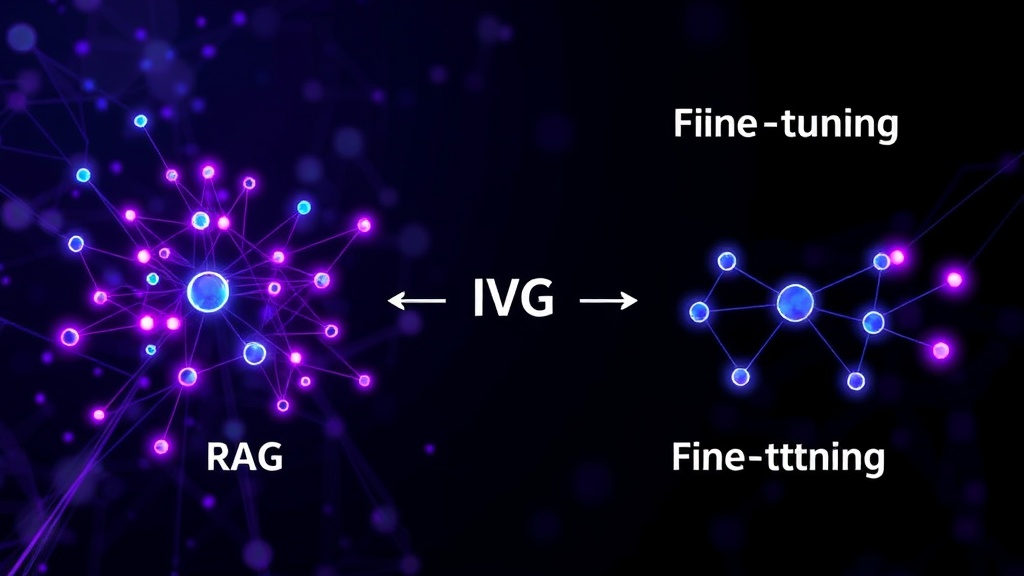
Retrieval-Augmented Generation (RAG): Knowledge Injection
Retrieval-Augmented Generation, or RAG, is the technique for providing an LLM with access to external, up-to-date information at the moment a query is made. It acts as a dynamic knowledge base. When a user asks a question, a RAG system first retrieves relevant documents or data snippets from a pre-defined corpus (e.g., internal company documents, a knowledge base, or recent news articles). These retrieved snippets are then fed into the LLM's prompt, along with the original question. The LLM uses this contextual information to generate an answer.
The key advantage of RAG is that it allows the model to access and cite specific, factual information without altering its underlying parameters. This makes it ideal for applications requiring up-to-date or proprietary knowledge. If your documents change, you update the retrieval index, not retrain the model. This is akin to giving a student a set of reference books they can consult while answering questions, ensuring their answers are based on the latest available information.
Fine-tuning: Behavior and Style Adaptation
Fine-tuning, on the other hand, involves further training a pre-trained LLM on a specific dataset. This process adjusts the model's internal weights. The primary outcome of fine-tuning is not the acquisition of new factual knowledge but the adaptation of the model's behavior. This includes:
- Writing Style: Teaching the model to adopt a specific tone, voice, or formatting (e.g., professional, casual, code generation in a particular style).
- Task Specialization: Improving performance on a narrow task, such as summarization, translation, or sentiment analysis, by reinforcing patterns seen in the fine-tuning data.
- Safety and Alignment: Steering the model away from undesirable outputs or towards more helpful and harmless responses.
When you fine-tune a model on your internal documents, you are not teaching it the facts contained within those documents. Instead, you are teaching it to mimic the *style* or *format* of those documents, or to respond to certain types of queries in a way that resembles how information is presented in your dataset. If a document in your fine-tuning set states 'The project deadline is EOD Friday,' the model learns that 'EOD Friday' is a common way to express a deadline, not that *this specific project's* deadline is EOD Friday. The model doesn't 'know' the project details; it learns a linguistic pattern.
Why the Confusion Persists
The confusion arises because fine-tuning datasets often contain factual information. When a fine-tuned model answers a question correctly using that information, it can appear as though the model has learned the facts. However, this is often a side effect of the model learning to associate certain query patterns with specific types of answers that were prevalent in the fine-tuning data. It's a probabilistic association rather than genuine knowledge recall. If the underlying facts change or new information emerges, a fine-tuned model will not automatically update its knowledge; it will continue to generate responses based on the patterns it was trained on.
This is where the GPU budgets get torched. Teams spend weeks and significant compute resources fine-tuning models on large document sets, only to find the model hallucinates or provides outdated information because it was never equipped to access or verify real-time facts. The model becomes a stylistic mimic, not an informed agent.
When to Use RAG vs. Fine-tuning
The choice between RAG and fine-tuning, or often a combination of both, depends entirely on the objective:
Use RAG When:
- You need the LLM to access and reason over specific, factual, and potentially frequently changing information (e.g., product catalogs, legal documents, customer support knowledge bases, real-time news).
- You need to reduce hallucinations by grounding the model in verifiable data.
- You want to maintain explainability and traceability, as you can often see which documents were used to generate the answer.
- You need to onboard new knowledge quickly without extensive retraining.
Use Fine-tuning When:
- You need the LLM to adopt a specific writing style, tone, or persona (e.g., brand voice, chatbot personality).
- You need to improve the model's proficiency in a specialized task that requires nuanced output patterns, not just factual recall.
- You are optimizing for efficiency or latency on a known set of tasks where external retrieval might be slower.
- You want to instill specific safety guardrails or alignment behaviors that are difficult to achieve through prompting alone.
The Synergy: Combining RAG and Fine-tuning
For many advanced applications, the most powerful approach is to combine RAG with fine-tuning. You might:
- Fine-tune a model for style and task efficiency, making it better at understanding user intent and generating well-formatted responses.
- Use RAG to provide the specific, up-to-date knowledge needed for accurate answers.
For instance, a customer support chatbot could be fine-tuned to sound empathetic and follow a specific escalation protocol. Simultaneously, it would use RAG to pull the latest product specs or troubleshooting steps from a knowledge base before formulating its response. This hybrid approach leverages the strengths of both techniques, providing accurate, contextually relevant, and stylistically appropriate answers.
Conclusion: A Clearer Path Forward
Understanding the fundamental difference between RAG (knowledge) and fine-tuning (behavior) is paramount for anyone building with LLMs. Misapplying fine-tuning for knowledge retrieval is an expensive and common pitfall. By correctly identifying whether your goal is to inject facts or shape response patterns, you can deploy resources more effectively, build more reliable AI applications, and avoid burning through GPU budgets on a fundamental misunderstanding.