The Limitations of Standard RAG in Dynamic Environments
Retrieval Augmented Generation (RAG) has become a cornerstone for grounding Large Language Models (LLMs) in factual, external knowledge. The standard RAG paradigm is elegant: embed documents into a vector space, embed a user's query, and retrieve the top-k most similar documents using cosine similarity. This approach excels when dealing with static knowledge bases, providing LLMs with relevant context for tasks like question answering or summarization.
However, this model falters when applied to dynamic, evolving systems, particularly multi-agent simulations. Consider a simulated civilization where agents, representing citizens or governing bodies, make decisions, learn from past events, and experience consequences that ripple through time. In such an environment, simple cosine similarity between a current crisis and historical events is insufficient. It fails to capture the causal relationships that are critical for intelligent decision-making within the simulation.
The core problem lies in the retrieval mechanism. Cosine similarity identifies documents that are semantically alike to the query. It doesn't inherently understand temporal relationships, causality, or the impact of past decisions on present circumstances. For instance, a drought from last month might be semantically dissimilar to today's food riot, even though the drought directly caused the riot. Similarly, a council's vote against grain reserves might not be the most 'similar' document to a current famine, but it is directly responsible for it. This disconnect between semantic similarity and causal relevance means that standard RAG can retrieve information that sounds plausible but lacks the critical context of cause and effect, leading to flawed decision-making within the simulation.

Designing a Causality-Aware RAG Variant
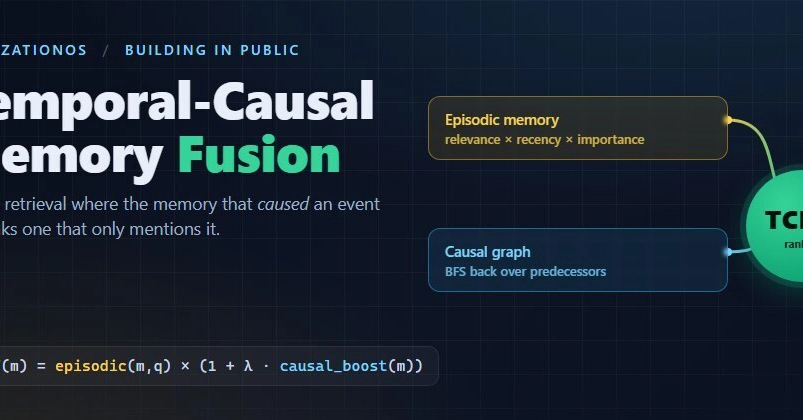
To address these limitations, a new RAG variant was designed for CivilizationOS, a multi-agent simulation project. The goal was to move beyond simple semantic matching and incorporate an understanding of historical impact and causality. This new design aims to retrieve memories not just based on what they *sound like* in relation to the current situation, but on how they *led to* it.
The fundamental shift involves augmenting the retrieval process with metadata and a more nuanced understanding of memory relationships. Instead of treating all retrieved documents equally based solely on their vector similarity, the system prioritizes memories that have a demonstrable causal link to the current state or query. This requires a richer representation of each memory, going beyond just the embedded text.
One approach is to enrich the metadata associated with each document or memory. This metadata could include:
- Timestamp: Precise date and time of the event or decision.
- Causal Linkage: Explicit pointers to preceding events that influenced this one, and subsequent events that were influenced by it. This could be implemented through a knowledge graph or a directed acyclic graph (DAG) structure.
- Agent/Source: Which agent or group made the decision or experienced the event.
- Impact Score: A quantifiable measure of the significance or consequence of the event.
When a query is made, the retrieval process would first identify semantically similar candidates, as in standard RAG. However, instead of returning the top-k directly, these candidates would be re-ranked or filtered based on their associated metadata. For example, a memory with a strong causal link to a recent, impactful event would be prioritized over a semantically similar but causally disconnected memory.
The Honest Tradeoffs
Implementing such a causality-aware RAG system introduces several complexities and tradeoffs:
Increased Complexity and Computational Cost
Maintaining and querying a richer metadata structure, especially one that represents causal links (like a graph), is significantly more computationally intensive than simple vector similarity searches. Building and updating these causal links requires sophisticated analysis of simulation logs or explicit definition within the simulation's rules. The storage requirements also increase substantially.
Data Sparsity and Ground Truth Issues
Defining and accurately capturing causal links in a complex simulation is challenging. It requires either a highly structured simulation environment where causality is explicitly programmed, or advanced AI techniques to infer causality from observed events. In many real-world or complex simulation scenarios, direct causal pathways can be obscured by numerous contributing factors, leading to sparse or ambiguous causal data.
Potential for Over-Focus on Causality
While prioritizing causality is crucial, completely neglecting semantic similarity could also be detrimental. Sometimes, a semantically similar past event, even if not directly causal, might offer valuable analogous solutions or insights. The design must strike a balance, ensuring that both direct causal influence and relevant analogous situations are considered.
Engineering Overhead
Developing and integrating this specialized RAG variant requires significant engineering effort. It involves not only the core retrieval logic but also the infrastructure for metadata management, graph traversal (if used), and potentially causal inference algorithms. This is a departure from the relatively straightforward implementation of standard RAG.
Implications for Multi-Agent Systems
This causality-aware RAG variant represents a critical step forward for multi-agent systems that require sophisticated memory and decision-making capabilities. By understanding not just what happened, but why it happened and what led to it, agents can make more informed, strategic, and historically grounded decisions.
For simulations aiming to model complex social, economic, or ecological systems, this approach allows for more realistic emergent behaviors and more accurate prediction of outcomes. It moves us closer to AI systems that can learn from history in a meaningful, rather than superficial, way. The challenge now lies in efficiently and accurately encoding and retrieving this causal information within dynamic, large-scale simulations.
The broader implication is a potential shift in how we think about LLM memory and context. For systems that operate in dynamic, evolving environments—from game AI to autonomous agents managing complex systems—the ability to reason about cause and effect in their historical data will become paramount. This design offers a blueprint for moving beyond simple information retrieval to a more sophisticated form of historical reasoning.