
The Challenge of Raw Questions in RAG
Retrieval Augmented Generation (RAG) systems aim to provide accurate, contextually relevant answers by grounding large language models (LLMs) in external knowledge bases. A critical bottleneck in RAG performance lies in how user questions are processed. Raw, natural language questions are inherently ambiguous and unstructured. They often contain implicit assumptions, multiple intents, or lack the specificity needed to effectively query a knowledge base. Simply passing a raw question to a retrieval system can lead to irrelevant document retrieval, poor context selection, and ultimately, inaccurate or nonsensical generated answers.
Consider a user asking, "What's the latest on Project Chimera?" This question is straightforward for a human, but for a RAG system, it's a black box. Does "Project Chimera" refer to a specific internal project, a research paper, a product codename, or something else entirely? What does "latest" imply – the most recent status update, the last published document, or the most recent decision? Without a mechanism to parse these nuances, the RAG system might retrieve outdated information, documents about a different "Project Chimera," or simply fail to find anything relevant.
Introducing Context Engineering for Question Parsing
Context engineering for RAG question parsing addresses this challenge by systematically transforming a raw, unstructured user query into a set of structured, typed fields. These fields act as precise instructions, guiding both the retrieval and generation phases of the RAG pipeline. Instead of a single, opaque string, the system receives distinct, interpretable signals. This approach moves beyond simple keyword matching, enabling a more sophisticated understanding of user intent and the specific information required.
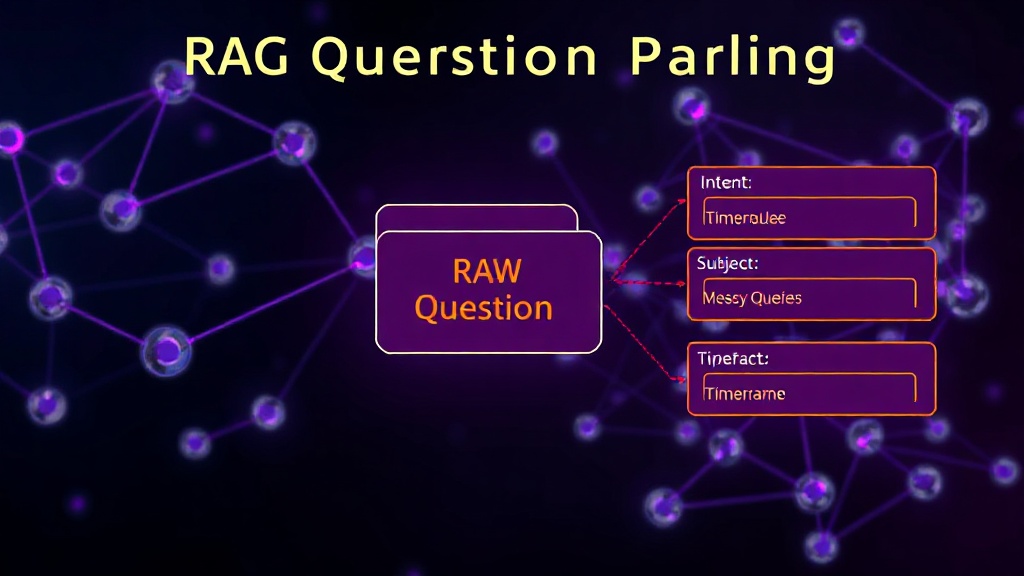
The core idea is to deconstruct the user's natural language question into discrete, semantically meaningful components. Each component is then assigned a specific type, which dictates its role in the RAG process. For instance, a question might be parsed into fields such as:
- Intent: The primary goal of the question (e.g., `get_status`, `find_document`, `compare_versions`).
- Subject/Entity: The main topic or entity the question is about (e.g., `Project Chimera`, `Q3 Financial Report`, `API v2.1`).
- Timeframe: Specific temporal constraints (e.g., `last_week`, `Q4 2023`, `since_launch`).
- Attribute: Specific properties or details being sought (e.g., `performance_metrics`, `bug_list`, `release_notes`).
This transformation is not a trivial task. It requires a model capable of understanding natural language, identifying entities, inferring intent, and disambiguating terms. The output of this parsing step is a structured representation, often a JSON object or a set of key-value pairs, that can be directly consumed by downstream components.
How Typed Fields Steer Retrieval
Once the raw question is parsed into typed fields, these fields become powerful levers for controlling the retrieval process. Traditional keyword-based retrieval often suffers from the 'bag-of-words' problem, where the order and context of words are lost. Typed fields, however, provide explicit constraints and directives.
For example, if the parsed fields are:
- Intent: `find_document`
- Subject/Entity: `API v2.1`
- Attribute: `release_notes`
The retrieval system can use these fields to construct a highly targeted query. It might search for documents containing "API v2.1" specifically tagged as "release notes," or prioritize documents whose metadata matches these criteria. This is far more precise than searching for the raw phrase "release notes for API v2.1," which might miss documents where "release notes" are implicitly referred to or where the version number is presented differently.
Furthermore, the Intent field can dictate the type of retrieval needed. A `get_status` intent might trigger a search for summary documents or dashboard metrics, while a `find_document` intent would look for full text documents. The Timeframe field can be used to filter results by date, ensuring that only the most recent or relevant information is fetched. This systematic filtering significantly reduces the noise in the retrieved documents, ensuring that the LLM receives a high-quality, focused context window.
Guiding Generation with Parsed Context
The benefits of question parsing extend beyond retrieval; they are equally crucial for the generation phase. The structured output from the parser provides the LLM with a clear understanding of what information is expected and how it should be presented.
When the LLM receives the typed fields, it can tailor its response more effectively. If the parsed fields indicate a `compare_versions` intent for `API v2.0` and `API v2.1` focusing on `performance_metrics`, the LLM knows to structure its output as a comparison, highlighting specific performance differences between the two versions. It can avoid generating a generic overview of the APIs and instead focus on the precise comparative data retrieved.
This structured context acts as a prompt engineering layer, but one that is dynamically generated based on the user's actual query. The LLM doesn't need to infer the user's intent from a lengthy, potentially ambiguous prompt; it's explicitly told. This leads to more concise, accurate, and directly relevant answers. The structured output can also inform the LLM about the desired format of the answer, whether it's a table, a summary, a list, or a direct factual statement.
The surprising detail here is not that parsing questions improves RAG, but the degree to which a systematic, context-engineered approach can elevate performance. It moves RAG from a probabilistic guessing game to a more deterministic, controlled information retrieval and synthesis process. Without this explicit structuring, the LLM is left to interpret the raw query and the retrieved documents, introducing compounding layers of potential error.
The Engineering Behind the Transformation
Implementing this context engineering for question parsing typically involves leveraging advanced NLP techniques, often powered by LLMs themselves. The process can be thought of as a specialized form of prompt engineering or fine-tuning. A dedicated model, or a carefully constructed prompt for a general-purpose LLM, is trained or instructed to take a raw question as input and output a structured format (e.g., JSON) containing the typed fields.
The training data for such a model would consist of pairs of raw questions and their corresponding structured, typed field representations. For example:
Raw Question: "Show me the sales figures for Q3 2023 in the EMEA region."
Parsed Output: {
  "intent": "get_sales_report",
  "timeframe": "Q3 2023",
  "region": "EMEA",
  "metric": "sales_figures"
}
The challenge lies in creating diverse and representative training data that covers the wide range of potential user queries and intents within a specific domain. The model must be robust enough to handle variations in phrasing, jargon, and implicit information. Techniques like few-shot learning or using LLMs with strong in-context learning capabilities can be employed to adapt these parsers to new domains with less explicit training data.
Future Implications and Unanswered Questions
Context engineering for RAG question parsing represents a significant step towards more intelligent and reliable AI-powered information systems. By formalizing the interpretation of user queries, it enhances the precision of both retrieval and generation, leading to demonstrably better user experiences and more accurate outcomes. This approach is particularly vital for enterprise applications where accuracy and specificity are paramount.
What nobody has addressed yet is the scalability of fine-tuning or prompting these parsing models across an ever-expanding number of specialized domains. As RAG systems are deployed in more niche areas, the cost and effort required to create domain-specific parsing models could become a significant barrier. Furthermore, the potential for bias within the parsing models themselves, leading to skewed retrieval or generation based on subtle linguistic cues, warrants deeper investigation.
Ultimately, this technique transforms RAG from a system that *tries* to answer questions into one that *understands* what question it is trying to answer, and then systematically retrieves and synthesizes the information to provide a precise response. It's about engineering intelligence into the very first step of the RAG pipeline.