
The Challenge of RAG Prompt Engineering
Retrieval Augmented Generation (RAG) systems offer a powerful way to ground Large Language Model (LLM) responses in factual, external knowledge. However, crafting effective prompts for RAG can be complex and brittle. Traditional methods often involve stitching together context, user queries, and instructions into a single, monolithic prompt. This approach struggles with variability, making it difficult to adapt to different types of questions or enforce specific generation behaviors. The core issue lies in how to dynamically assemble a generation prompt that is both flexible enough to handle diverse queries and robust enough to ensure consistent, accurate outputs.
Consider a RAG system designed to answer questions about a company's internal documentation. A user might ask a factual question like "What is the Q3 revenue target?" or a more nuanced one like "Summarize the key takeaways from the Q3 earnings call." A static prompt might excel at the first but falter on the second, potentially hallucinating or providing an incomplete summary. The goal is to create a system that can intelligently adapt its prompt based on the nature of the user's query, ensuring that the LLM receives the most appropriate instructions and context for generating a high-quality response.
This variability problem is exacerbated by the fact that RAG systems often operate within enterprise contexts where data is constantly updated, and the types of questions users ask can evolve. A prompt that works today might become suboptimal tomorrow. The need for a more structured, programmatic approach to prompt generation is clear. This is where a novel method for assembling RAG generation prompts from a base prompt, question-specific rules, and a dispatcher comes into play, offering a more maintainable and adaptable solution.
A Structured Approach to Prompt Assembly
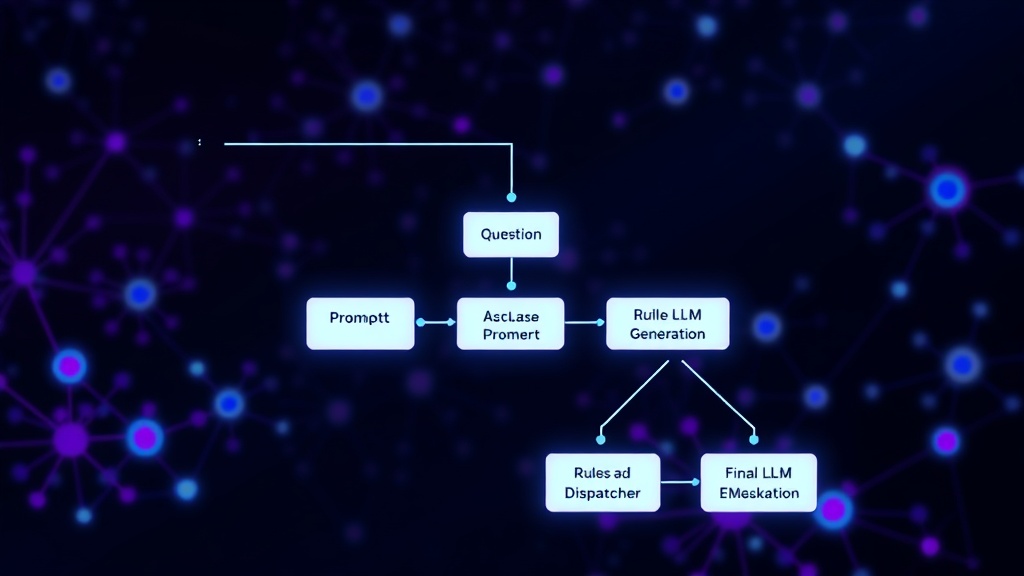
The proposed method breaks down prompt assembly into three key components: a fixed BASE prompt, a set of rules for each question type, and a dispatcher that orchestrates the process. This modular design addresses the limitations of monolithic prompts by separating concerns and enabling dynamic construction.
The BASE Prompt
The BASE prompt serves as the foundational instruction set for the LLM. It contains the core directives and context that are common to all RAG generations. This might include instructions on the desired output format, the persona the LLM should adopt, or general guidelines for using the provided context. Keeping this base fixed ensures a consistent underlying behavior across all generated responses, reducing the cognitive load on the LLM and simplifying maintenance. It acts as the unchanging core, providing the essential framework for any query.
Question-Specific Rules
Instead of a single, complex prompt, this approach utilizes a registry of question-specific rules. Each rule is tailored to a particular type of question or information retrieval task. For instance, a rule for factual questions might instruct the LLM to directly extract information from the provided context and present it concisely. A rule for summarization questions might direct the LLM to synthesize information from multiple retrieved documents and provide a high-level overview. These rules are designed to be granular and actionable, guiding the LLM's generation process in a precise manner.
Think of these rules as specialized instructions that a skilled editor would give to a writer. For a factual report, the editor might say, "Stick strictly to the data, quote sources." For a feature analysis, they might say, "Identify the pros and cons, then offer a balanced perspective." This system automates that editorial guidance, applying the right instruction based on the detected nature of the user's query.
The Dispatcher
The dispatcher is the central orchestrator. When a user asks a question, the dispatcher first parses the question to understand its intent and type. Based on this analysis, it selects the appropriate question-specific rule(s) from the registry. It then combines the chosen rule(s) with the fixed BASE prompt and the retrieved context to construct the final generation prompt. This assembled prompt is then sent to the LLM for response generation.
The dispatcher's ability to accurately classify questions and select the correct rules is crucial. This classification can be achieved through various methods, including keyword analysis, intent recognition models, or even another smaller LLM. The output of this classification directly determines which set of instructions the LLM will follow, ensuring that the generation process is highly targeted.
Benefits and Implications
This structured approach to RAG prompt assembly offers several significant advantages:
- Maintainability: By separating the base instructions from question-specific logic, updates and modifications become simpler. Changes to the core behavior are made in the BASE prompt, while new question types or refinements to existing ones can be handled by adding or modifying rules in the registry.
- Flexibility: The system can easily adapt to new types of questions or information retrieval tasks by simply adding new rules. This makes the RAG system more robust and future-proof.
- Control: Developers gain finer-grained control over the LLM's generation process. By specifying precise rules for different question types, they can better steer the model towards desired outputs, reducing hallucinations and improving accuracy.
- Efficiency: While not immediately obvious, this structured approach can lead to more efficient LLM usage. By providing highly specific instructions, the LLM may require fewer tokens or less processing to arrive at a correct answer, potentially reducing inference costs.
The core innovation here is treating prompt engineering not as a monolithic task, but as a dynamic assembly process. It’s akin to a modular software architecture, where components can be swapped or updated independently. This paradigm shift from static to dynamic prompt construction is essential for building scalable and reliable enterprise-grade RAG applications.
Future Directions
What remains to be seen is the scalability of the rule registry and dispatcher for extremely complex enterprise environments with thousands of document types and intricate query patterns. Developing robust and efficient methods for automatically generating and managing these rules, perhaps through meta-learning or human-in-the-loop systems, will be key to widespread adoption. The interplay between the retrieval mechanism and the prompt assembly logic also warrants further investigation to ensure seamless integration and optimal performance.