The Debugging Nightmare of LangChain's Abstraction
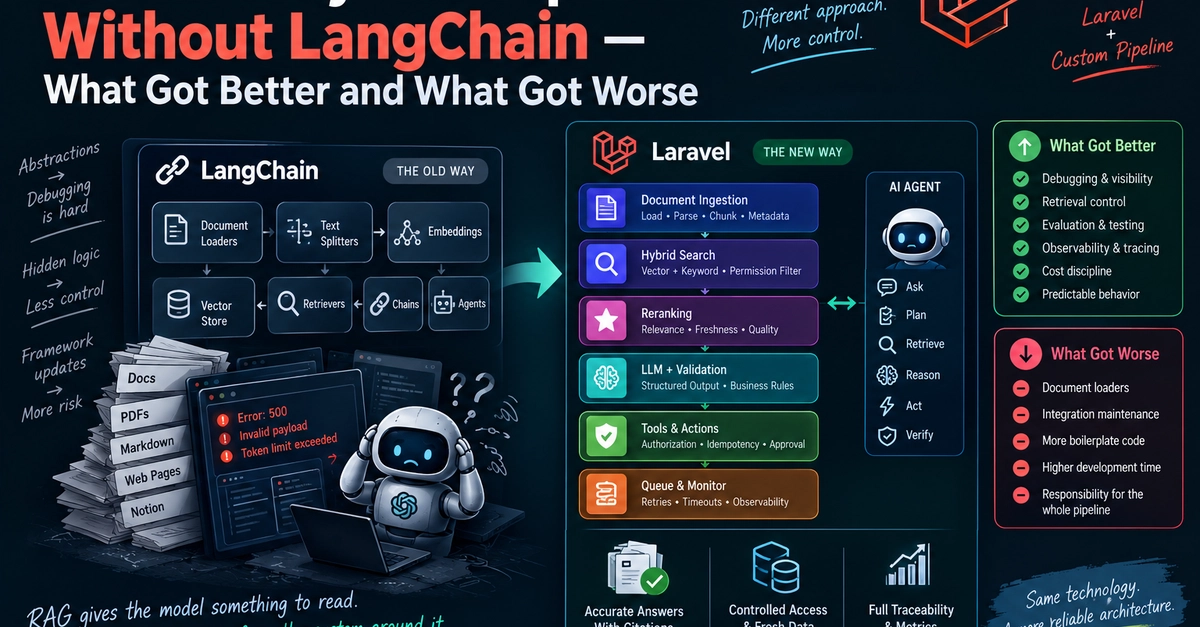
The tipping point for abandoning LangChain wasn't a hallucination, but a subtly wrong answer. The RAG system produced a plausible-sounding response, complete with a citation, yet it was factually incorrect. This wasn't a failure of the underlying LLM, but a systemic issue within the pipeline. The problem stemmed from a disconnect: one part of the pipeline applied a metadata filter, while another part did not. The final prompt assembly masked this inconsistency, creating a coherent-looking but flawed output. Debugging this required navigating through LangChain's wrappers, runnable compositions, and framework-specific assumptions. The real question—why retrieval favored the wrong document—was obscured by the framework's layers of abstraction. This experience shifted the author's perspective: LangChain became an optional integration layer, not the core of the RAG system.
This isn't an indictment of frameworks. LangChain undeniably solved a critical problem in the nascent LLM ecosystem. It provided developers a rapid path to compose applications when the fundamental building blocks were still being discovered. However, as Retrieval Augmented Generation (RAG) matured from experimental demos to production-ready systems, the limitations of a heavily abstracted framework became apparent. The need for granular control and transparent debugging outpaced the convenience of pre-built components.
Building Without the Framework: What Improved
The decision to rebuild the RAG pipeline without LangChain was driven by a desire for greater control and clarity. The primary improvements realized were in performance and debuggability. By removing the framework's overhead, the pipeline became leaner and faster. This reduction in latency is critical for real-time applications where quick, accurate responses are paramount.
More significantly, debugging became a direct process. Instead of tracing issues through abstract layers, the author could pinpoint problems directly within the retrieval and processing stages. When retrieval favored an incorrect document, the root cause could be identified and addressed without the obfuscation of framework-specific logic. This direct access to the pipeline's internal state allowed for more precise tuning of retrieval strategies, metadata handling, and prompt construction.
The custom implementation allowed for fine-grained control over each component. This included:
- Precise Document Retrieval: The ability to fine-tune how documents were selected, ensuring that metadata filters were consistently applied and that the most relevant chunks were prioritized.
- Optimized Prompt Engineering: Direct control over prompt construction allowed for more effective communication with the LLM, reducing the likelihood of misinterpretation or irrelevant information being included.
- Streamlined Data Flow: Eliminating framework-specific data structures and transformations simplified the data pipeline, reducing potential points of failure and improving overall efficiency.
The Trade-offs: What Got Worse
While the custom pipeline offered significant advantages, it was not without its drawbacks. The most immediate consequence of ditching LangChain was the increased development overhead. Building and maintaining a RAG system from scratch requires a deeper understanding of each component's intricacies. This includes managing vector databases, embedding models, chunking strategies, and prompt templating manually.
The initial setup phase became more time-consuming. Instead of leveraging LangChain's pre-built integrations for various LLMs, vector stores, and document loaders, each integration had to be implemented individually. This meant writing custom code to handle API connections, data serialization, and error management for each service used.
Furthermore, the composability that LangChain offered, while sometimes cumbersome, was a powerful feature for rapid prototyping. Replicating this flexibility in a custom solution requires significant engineering effort. The ability to easily swap out components or chain complex operations, which LangChain provides through its `Runnable` interface, had to be custom-built. This can slow down the iteration cycle, especially when experimenting with different models or retrieval techniques.
The ecosystem is still evolving rapidly. LangChain, with its large community and active development, often provides early access to new models and techniques. Rebuilding without it means potentially lagging behind these advancements unless significant effort is dedicated to staying current and implementing new integrations manually.
The Future of RAG: Frameworks vs. Custom Builds
The experience highlights a critical tension in LLM application development: the balance between abstraction and control. For developers building complex, production-grade RAG systems, the need for transparency and granular control often outweighs the convenience of high-level frameworks like LangChain. The ability to debug effectively, optimize performance, and ensure data integrity becomes paramount.
However, frameworks still hold value, particularly for rapid prototyping, educational purposes, or when developers need to quickly stitch together existing components. They lower the barrier to entry and accelerate the initial development cycle. The key seems to be understanding when and where to apply these frameworks. Treating them as optional integration layers, rather than the core architecture, might offer a more sustainable approach.
The question remains: as RAG systems become more sophisticated and integral to business operations, will the trend move towards highly customized, optimized pipelines, or will frameworks evolve to offer the necessary depth of control and debuggability without sacrificing ease of use? The answer likely lies in a hybrid approach, where modular, well-defined components can be assembled with either framework-agnostic tools or specialized libraries, allowing developers to choose the level of abstraction that best suits their needs at any given stage of development.