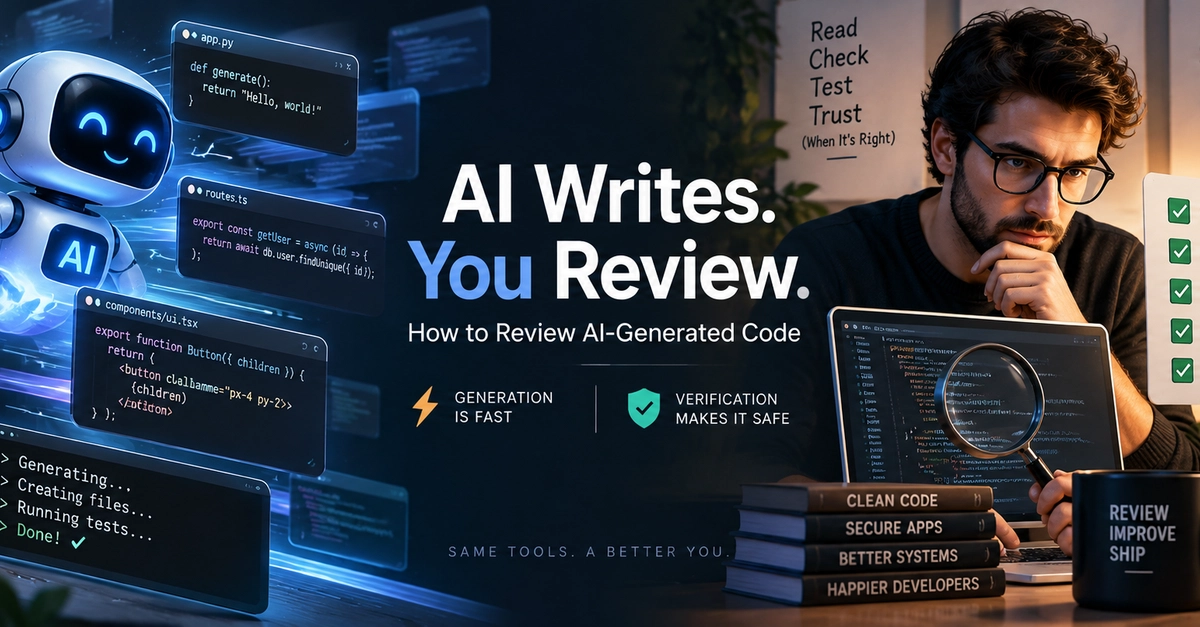
The AI Code Generation Reality
AI tools like GitHub Copilot, Claude Code, and Cursor can now generate functional code in minutes. Describe a feature, and these agents can produce a working implementation. This capability is no longer surprising; it's a rapidly evolving reality for software development teams.
The Stack Overflow 2025 Developer Survey highlights this shift: 84% of developers report using or planning to use AI coding assistants. Yet, a significant challenge persists. Developers frequently encounter AI-generated code that is "almost right, but not quite." This nuance is precisely where human developers remain indispensable.
The Shifting Role: From Coder to Critical Reviewer
The core question for development teams is no longer whether AI can write code, but whether that code can be trusted for production. The "almost right" output from AI is the fertile ground for human expertise. Developers must pivot from primary code creation to rigorous, expert review. This involves understanding the AI's output, identifying subtle errors, ensuring security, and verifying that the generated code aligns with project requirements and architectural standards.
This transition means that a developer's value will increasingly be measured by their ability to critically assess, debug, and refine AI-generated code, rather than solely by their speed of writing new code from scratch. It demands a deeper understanding of potential pitfalls, edge cases, and the underlying logic that AI might miss or misinterpret.
Mastering the Art of AI Code Review
To effectively review AI-generated code, developers need a structured approach. This involves:
- Deep Understanding of Requirements: Before reviewing, ensure a crystal-clear grasp of the feature's intended functionality, performance expectations, and security constraints. AI can hallucinate or misinterpret ambiguous prompts.
- Security First: AI models can inadvertently introduce vulnerabilities. Developers must actively scan for common security flaws like injection vulnerabilities, insecure deserialization, broken access control, and cross-site scripting (XSS). Treat AI-generated code with the same, if not higher, level of security scrutiny as human-written code.
- Performance Profiling: AI might produce code that works but is inefficient. Developers should profile the generated code under various loads to identify performance bottlenecks. This includes checking for excessive memory usage, inefficient algorithms, and unnecessary I/O operations.
- Edge Case Analysis: AI models are trained on vast datasets but may not account for obscure or highly specific edge cases. Developers must proactively think about boundary conditions, invalid inputs, and unexpected user interactions that the AI might not have anticipated.
- Readability and Maintainability: While AI can produce syntactically correct code, it may not always adhere to team coding standards or be easily readable and maintainable by other human developers. Reviewers must ensure the code is well-documented, follows established patterns, and is structured logically.
- Verification Against Design: Ensure the generated code aligns with the overall system architecture, design patterns, and existing codebase conventions. AI might propose solutions that are locally optimal but globally suboptimal.
This critical review process is not merely about finding bugs; it's about ensuring the integrity, security, and long-term viability of the software. It requires a developer to act as a safeguard, a quality assurance specialist, and an architect, all within the review cycle.
The Future of the Developer Role
The rise of AI code assistants marks a significant evolution, not an extinction, of the developer role. The emphasis shifts from the manual, often repetitive, task of writing boilerplate code to the more complex, strategic work of critical thinking, problem-solving, and system design. Developers who embrace this shift and hone their review skills will be best positioned for success.
This requires continuous learning and adaptation. Developers must stay abreast of AI model capabilities and limitations, understand common AI-generated code pitfalls, and develop sophisticated debugging and analysis techniques. The ability to effectively prompt AI for better initial code, and then to expertly refine that code, will become a defining characteristic of a high-performing developer.
The ultimate responsibility for shipping reliable, secure, and efficient software still rests with humans. AI is a powerful tool, an accelerant, but not a replacement for human judgment and expertise. The developer's job becomes less about typing code and more about thinking critically about the code that gets typed, whether by human or machine.
What happens to the thousands of developers whose primary skill has been rapid, novel code generation? They must adapt. Their new value proposition lies in their ability to wield AI as a tool, directing its power with precision and ensuring the output meets uncompromising standards. The future developer is a master conductor, orchestrating AI's capabilities to produce robust software symphonies.