
The Dual Challenge of RAG Performance
Retrieval-Augmented Generation (RAG) applications promise to ground LLM responses in factual data, but ensuring they perform well is a complex engineering challenge. Unlike traditional applications, RAG systems have two critical dimensions of performance: speed and answer quality. A system can return an answer in milliseconds, but if that answer is a hallucination or irrelevant to the user's query, it's a failure. Conversely, a perfectly accurate answer that takes minutes to generate is also unacceptable in most interactive use cases.
Traditional load testing tools, familiar to many developers from their work with JMeter or k6, excel at measuring response times under load. They can tell you how quickly your API endpoint returns a 200 OK. However, these tools are blind to the semantic correctness of the generated output. They cannot distinguish between a factual, well-supported answer and a fabricated one, even if the latter is generated faster.
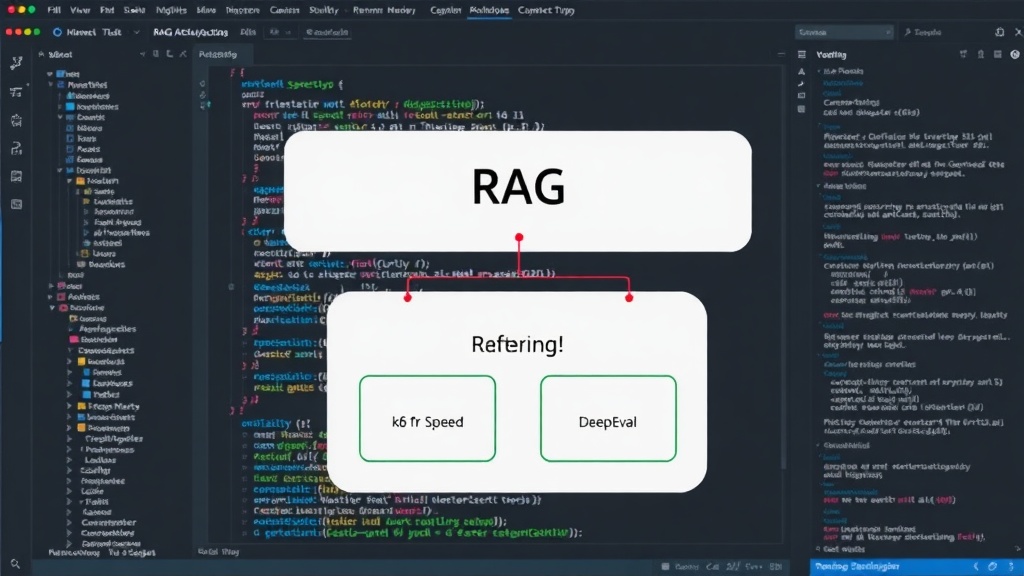
This is where the unique nature of RAG performance testing emerges. It necessitates a two-pronged approach, addressing both the mechanical speed of the system and the intellectual quality of its outputs. Failing to test both leaves significant gaps in ensuring a robust and reliable RAG application.
Testing for Speed: Load Testing with k6
For measuring the speed of a RAG application, developers can leverage established load testing frameworks. k6 is a popular, open-source load testing tool that allows engineers to write load tests in JavaScript. It's designed for performance engineers and developers, providing flexibility and powerful metrics.
When testing a RAG application with k6, the focus is on end-to-end latency. This includes the time taken for the user's query to be processed, relevant documents to be retrieved from the knowledge base, the LLM to generate a response based on the retrieved context, and the final answer to be returned to the user. Key metrics to track include:
- Response Time (Average, p95, p99): How long does a typical request take, and what is the experience for the slowest 5% and 1% of users?
- Throughput (Requests Per Second): How many queries can the system handle concurrently without performance degradation?
- Error Rate: Are there an increasing number of failed requests as load increases?
Setting up k6 involves defining virtual users (VUs) that simulate real user traffic. These VUs make requests to the RAG application's API endpoints, mimicking the expected user interaction flow. The k6 engine then collects and reports on the performance metrics, providing clear insights into the system's capacity and bottlenecks under various load conditions.
The goal here is not just to see if the system is fast, but to establish baseline performance levels and identify breaking points. For instance, you might discover that retrieval latency increases dramatically when the number of concurrent users exceeds 100, or that LLM generation time becomes the dominant factor at higher loads.
Testing for Quality: LLM-as-Judge with DeepEval
Measuring answer quality in RAG applications is significantly more challenging. Hallucinations, factual inaccuracies, and irrelevance are subtle errors that require semantic understanding to detect. This is where tools like DeepEval shine.
DeepEval is an open-source LLM evaluation framework that allows developers to assess the quality of LLM outputs. It employs an 'LLM-as-judge' approach, where another LLM is used to evaluate the RAG application's responses against specific criteria. This is akin to having an expert human reviewer, but automated and scalable.
Key metrics for RAG quality evaluation include:
- Faithfulness: Does the generated answer stick to the information present in the retrieved context? This directly combats hallucinations.
- Answer Relevancy: Is the generated answer directly relevant to the user's original query?
- Context Relevancy: How relevant are the retrieved documents to the user's query? (This can also be evaluated).
DeepEval allows you to define these metrics and use a configurable LLM (e.g., GPT-4, Claude) to score each response. For example, to test faithfulness, you would prompt the evaluation LLM with the user's query, the retrieved context, and the generated answer, asking it to determine if the answer is supported solely by the context. A score out of 1 indicates a high degree of faithfulness, while a score near zero suggests the answer introduced information not found in the context.
This method provides a quantitative measure of answer quality, turning subjective assessments into objective scores that can be tracked over time. It’s a crucial step for ensuring that the RAG application not only responds quickly but also provides accurate and useful information.
Integrating into CI/CD: Automating Regression Detection
The true power of performance and quality testing for RAG applications is unlocked when these tests are integrated into a Continuous Integration and Continuous Deployment (CI/CD) pipeline, such as GitHub Actions.
The workflow typically looks like this:
- A developer pushes code changes to a pull request.
- The CI pipeline is triggered.
- Speed Test: A subset of k6 tests runs to ensure critical latency and throughput metrics are within acceptable thresholds. If performance degrades significantly, the pipeline fails, preventing the merge.
- Quality Test: A set of DeepEval tests runs against a representative sample of queries. The LLM-as-judge evaluates the generated answers for faithfulness and relevancy. If quality scores drop below predefined thresholds, the pipeline fails.
- If both speed and quality tests pass, the pull request can be merged.
This automated approach acts as a safety net. It catches regressions in both performance and output quality automatically, before they ever reach production. This is particularly important for RAG systems where subtle changes in the retrieval logic, the LLM prompt, or the underlying data can have cascading negative effects on output quality.
By wiring these tests into the CI/CD pipeline, engineering teams can maintain high standards for both speed and accuracy, ensuring a reliable user experience. This shift-left approach to testing RAG applications is essential for building production-ready AI systems.
The Future of RAG Testing
As RAG architectures become more sophisticated, so too will the testing methodologies. We can anticipate more advanced LLM-as-judge techniques, potentially incorporating multi-turn conversation evaluation, and more granular performance metrics tailored to specific RAG components like vector databases or reranking models. The continuous integration of speed and quality testing is not just good practice; it's becoming a fundamental requirement for deploying trustworthy AI applications.