The RAG Reality Check
The standard approach to building Retrieval-Augmented Generation (RAG) systems is often simplistic: chunk documents into fixed-size blocks (e.g., 512 tokens), embed these chunks using a readily available model like text-embedding-3-small, and retrieve the top 5 most similar chunks. This method suffices for basic demonstrations. However, in production environments, this one-size-fits-all strategy quickly falters.
Consider legal contracts; a fixed 512-token chunk can split critical clauses mid-sentence, destroying context. API documentation, often dense and technical, can have its signal drowned out by irrelevant information if chunks are too large. Customer support tickets, which are inherently conversational, require overlapping context to maintain conversational flow, not rigid, non-overlapping windows.
The cumulative latency also becomes a significant bottleneck. A typical pipeline might involve 500ms for embedding, 200ms for vector search, and 300ms for the LLM response, easily exceeding a one-second per query time. Recognizing these limitations, one team decided to rebuild their retrieval layer from first principles, focusing on metrics that truly matter in production.
Chunking: One Size Fits None
The core problem with fixed-size chunking is its inability to adapt to varying content structures and informational densities. Legal documents, code repositories, and chat logs all have fundamentally different organizational principles. A strategy that works for one will inevitably fail for another.
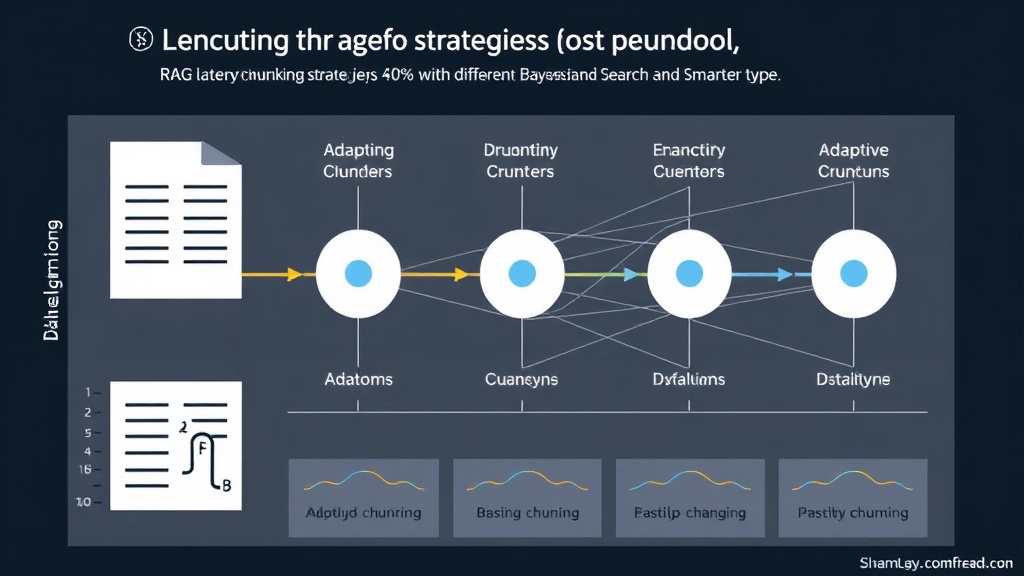
Instead of fixed-size chunks, the team adopted a more flexible approach. They moved towards semantic chunking, where chunks are defined by logical breaks in meaning rather than arbitrary token counts. This involves identifying sentence boundaries, paragraph structures, and thematic shifts. For conversational data, they implemented context-aware chunking, ensuring that related turns in a conversation were grouped together, often with overlapping context to preserve the dialogue flow. For highly structured data like API documentation, they explored metadata-aware chunking, using elements like function definitions or section headers to delineate meaningful units.
This adaptive chunking strategy directly addresses the context fragmentation issue. Legal clauses remain intact, conversational threads are preserved, and technical documentation is segmented into coherent functional units. The result is a richer, more accurate representation of the source material, leading to better retrieval performance.
Retrieval: Beyond Top-K
The next significant area for optimization was the retrieval mechanism itself. Relying solely on top-k retrieval, while simple, can be suboptimal. It retrieves a fixed number of results regardless of their relevance or the distribution of similarity scores. This can lead to including irrelevant documents if the top k are only marginally better than the next set, or missing relevant documents if they are slightly less similar but still highly pertinent.
The team introduced a more sophisticated retrieval strategy: Bayesian Search. This approach treats retrieval as an optimization problem. Instead of a brute-force search for the best chunks, Bayesian optimization iteratively models the performance of different retrieval parameters (like similarity thresholds, chunk sizes, or embedding models) and uses this model to select the most promising parameters to test next. It balances exploration (trying new parameter combinations) and exploitation (refining promising ones).
This method allows for a more intelligent and efficient search for the optimal retrieval configuration. It’s akin to a skilled angler not just casting a line randomly, but observing the water, adjusting bait, and repositioning based on subtle cues to find where the fish are biting. By modeling the relationship between retrieval parameters and retrieval quality (e.g., recall@k, precision@k), Bayesian search can converge on high-performing configurations much faster than grid search or random search.
Tuning for Performance: The Numbers
The impact of these changes was substantial. By moving away from fixed-size chunking and employing adaptive strategies, the system began to capture more relevant information. The introduction of Bayesian Search allowed for fine-tuning of the retrieval pipeline, optimizing parameters that had previously been set by convention.
The results were dramatic: the team achieved a 95% recall@10. This means that for any given query, at least 95% of the time, the 10 most relevant documents were retrieved. More critically, the overall query latency was reduced by 40%. This significant latency reduction stemmed from a combination of factors: more efficient retrieval due to better parameter tuning, and potentially smaller, more relevant chunks reducing the amount of data that needed to be processed by the LLM.
This shift from a heuristic-based approach ('semantic search + hope') to a measured, tunable retrieval pipeline demonstrates the power of applying optimization techniques to RAG systems. It highlights that building effective RAG at scale requires a deep understanding of the underlying data and a systematic approach to tuning every component of the pipeline, from how data is segmented to how it is searched.