The RAG Reality Check
The standard approach to building Retrieval Augmented Generation (RAG) systems often starts with a simple formula: chunk text into fixed-size segments (typically 512 tokens), embed these chunks using a common model like text-embedding-3-small, and then perform a top-k retrieval (often k=5) to feed into a large language model (LLM). This method works adequately for initial demonstrations and simple use cases. However, when RAG systems move into production environments, this one-size-fits-all approach quickly reveals its limitations.
Consider a legal contract. A 512-token chunk might arbitrarily split a critical clause mid-sentence, destroying its semantic integrity. Conversely, API documentation, often dense and technical, can have its signal drowned out by noise if chunks are too large. Customer support tickets present another challenge; conversations are inherently sequential, and context is best preserved through overlapping chunks rather than rigid, non-overlapping windows. These issues directly impact the quality of information retrieved and, consequently, the accuracy and coherence of the LLM's responses. Furthermore, the cumulative latency from embedding, vector search, and LLM inference can push query times beyond acceptable limits, often exceeding one second per query (e.g., 500ms embedding + 200ms vector search + 300ms LLM).
To address these production-level shortcomings, a team rebuilt their retrieval layer from first principles, focusing on metrics that truly matter in a live system. The goal was to move from a system that relies on "semantic search + hope" to a measured, tunable retrieval pipeline capable of achieving high recall.
Chunking: One Size Fits None
The fundamental flaw in the default RAG setup is the assumption that a fixed chunk size is optimal. In reality, the ideal chunk size depends heavily on the nature of the content and the specific query. A chunking strategy must adapt to the data's structure.
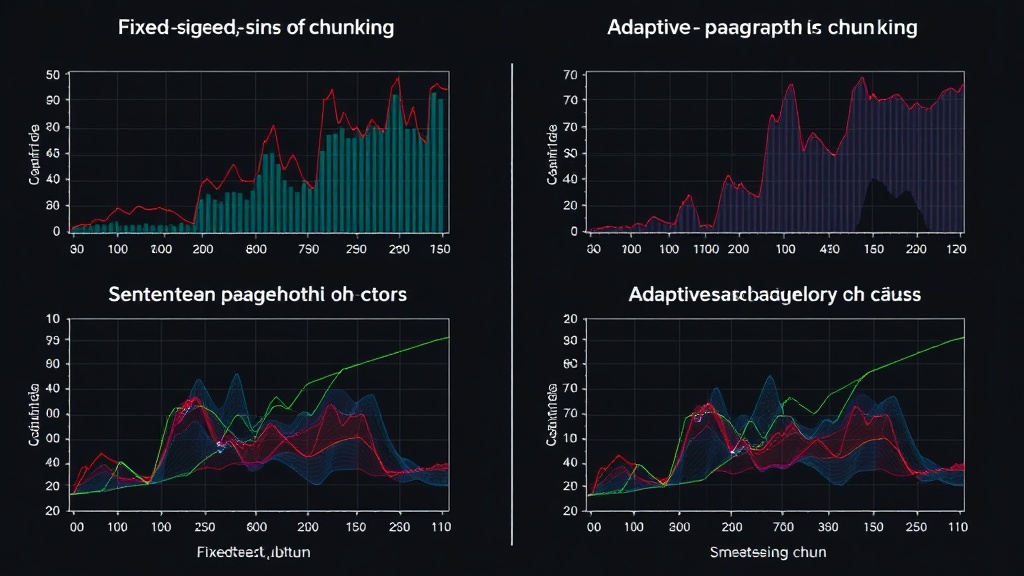
Instead of fixed-size chunks, the team adopted a more sophisticated approach. They implemented a strategy that considers sentence boundaries and paragraph structure. This means that a chunk might end at a natural break in the text, even if it's slightly shorter or longer than a predefined token limit. For conversational data, like customer support tickets, they introduced overlapping chunks. This ensures that context from one turn of conversation isn't lost when a new chunk begins, preserving the flow of dialogue. For technical documents or legal texts, they might employ recursive chunking, breaking down larger sections into smaller, semantically coherent units while maintaining a hierarchical relationship.
This adaptive chunking strategy directly combats the problem of split clauses or diluted signal. By respecting the natural linguistic and structural boundaries of the text, each chunk is more likely to represent a coherent piece of information. This improves the relevance of the embedded vectors and, by extension, the quality of the retrieved documents.
Retrieval: Beyond Top-K
The standard top-k retrieval method, while simple, is often suboptimal. It retrieves a fixed number of results, regardless of their actual relevance scores. This means potentially good results might be discarded if they fall outside the top k, and irrelevant results might be included if they happen to rank higher than slightly more relevant ones.
The team moved towards a more nuanced retrieval mechanism. Instead of a simple top-k, they implemented a strategy that considers a wider range of retrieval parameters and their impact on relevance. This involves exploring different similarity thresholds and potentially retrieving a larger superset of candidates that meet a certain relevance score, before applying a secondary, more refined ranking mechanism.
One key aspect is the understanding that different types of queries may benefit from different retrieval strategies. A factual question might require precise, granular information, while a more open-ended query might benefit from broader context. The system was designed to accommodate these variations, moving beyond a monolithic retrieval approach.
Bayesian Search for Optimized Retrieval
The most significant innovation lies in the application of Bayesian optimization to tune the RAG pipeline. Traditional RAG optimization involves manual trial-and-error, adjusting parameters like chunk size, embedding model, retrieval `k`, and similarity thresholds. This is time-consuming and often leads to suboptimal configurations.
Bayesian optimization is a powerful technique for finding the maximum of an unknown function. In this context, the "function" is the performance of the RAG system (e.g., measured by recall@k, latency, or a combination of metrics), and the "variables" are the tunable parameters of the chunking and retrieval pipeline. Bayesian optimization intelligently explores the parameter space, using previous results to inform where to sample next, thereby finding optimal parameters much more efficiently than random search or grid search.
The process typically involves defining an objective function that quantifies system performance. Then, the Bayesian optimization algorithm iteratively selects a set of parameters to test, evaluates the RAG system with those parameters, and uses the results to build a probabilistic model of the objective function. This model guides the selection of the next set of parameters to test, focusing on regions of the parameter space that are likely to yield high performance. For instance, it could explore the trade-off between chunk size and retrieval accuracy, or the impact of different embedding models on recall.
This systematic, data-driven approach allowed the team to identify a configuration that significantly reduced latency while simultaneously boosting performance. The result was a 40% reduction in query latency and a remarkable 95% recall@10, meaning that for any given query, the correct and relevant document was found within the top 10 retrieved results 95% of the time.
The Metrics That Matter
The success of this refactored RAG pipeline is measured not just by reduced latency but by a substantial improvement in retrieval accuracy. Achieving 95% recall@10 indicates that the system is consistently surfacing the most relevant information. This directly translates to more accurate, contextually appropriate, and helpful responses from the LLM.
The move from a fixed, heuristic-based approach to a tunable, optimized pipeline is critical. It transforms RAG from a demonstration tool into a production-ready system. The ability to systematically tune parameters using methods like Bayesian optimization provides a clear path for continuous improvement as data volumes grow and query patterns evolve.
What nobody has addressed yet is the long-term maintenance cost of such a sophisticated, dynamically optimized RAG pipeline. While Bayesian optimization finds optimal parameters, these parameters may need re-evaluation as underlying data distributions shift or new LLM models are introduced. Establishing automated retraining and monitoring for these RAG components will be key for sustained performance.