
RAG: A Powerful Augmentation, Not a Replacement
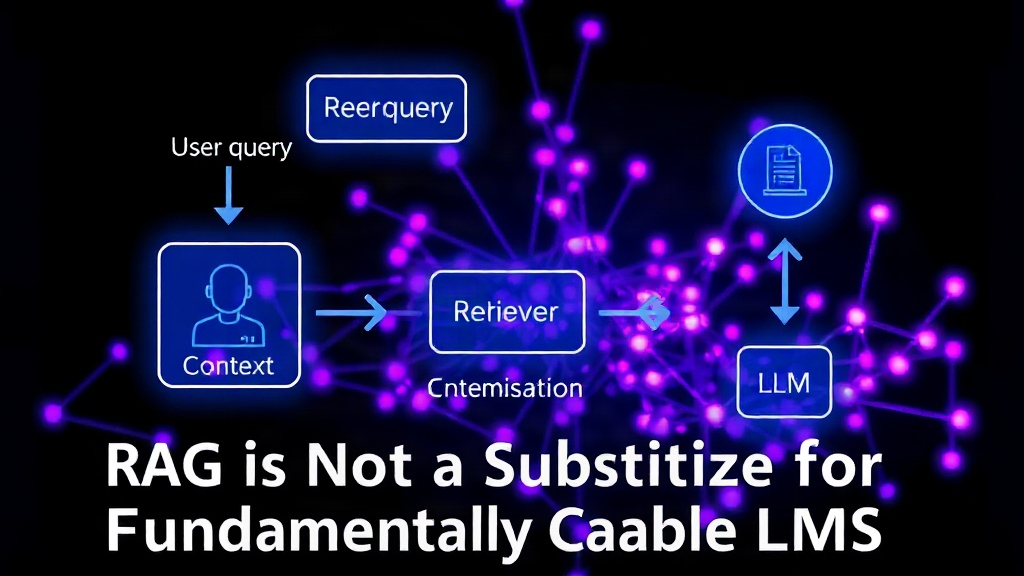
Retrieval-Augmented Generation (RAG) has become a cornerstone technique for enhancing Large Language Models (LLMs). It works by allowing an LLM to access and incorporate external, up-to-date information before generating a response. This external knowledge base can be anything from a company's internal documents to real-time news feeds. The core idea is simple: provide the model with relevant context, and it will produce more accurate, informed, and current answers. This approach is particularly effective for tasks requiring factual recall or knowledge beyond the model's training data cutoff.
However, a critical misconception is emerging: that RAG can somehow compensate for, or even replace, the need for a fundamentally strong and capable base LLM. This is a dangerous oversimplification. RAG is an augmentation strategy, a way to feed better information into a model. It is not a magic wand that transforms a weak model into a strong one. If the underlying LLM lacks reasoning abilities, struggles with complex instructions, or hallucinates even with perfect context, RAG will only amplify these issues or, at best, provide a veneer of improvement.
Think of RAG less like a brain transplant and more like giving a student an excellent library. If the student doesn't know how to read, understand, or synthesize information, the best library in the world won't help them write a coherent essay. Similarly, if an LLM cannot process, understand, and reason over the retrieved information, its output will remain flawed, regardless of the quality of the retrieved documents.
The Limitations of RAG
RAG's effectiveness is constrained by several factors. Firstly, the retriever component must be highly accurate. If it fails to find the most relevant documents or retrieves irrelevant ones, the LLM will be misled. Secondly, the LLM must be able to effectively utilize the retrieved context. This involves understanding the nuances of the provided text, distinguishing between conflicting information, and integrating it seamlessly with its own internal knowledge. Models that struggle with context window limitations or are prone to ignoring provided information will not benefit significantly from RAG.
Furthermore, RAG does not inherently imbue a model with better reasoning, summarization, or creative generation capabilities. If a model's core architecture or training makes it poor at logical deduction, for instance, feeding it more data via RAG will not magically make it a better reasoner. It might become better at reciting facts from that data, but it won't necessarily understand the implications or connections between them.
The illusion that RAG can fix a bad model often stems from observing improvements in tasks that primarily rely on factual recall. For example, asking an LLM factual questions about recent events. A RAG system can easily retrieve the correct answer from a search engine or database. However, when the task requires synthesis, abstraction, or complex problem-solving, the limitations of the base model become apparent. The model might retrieve all the necessary pieces of information but fail to put them together in a meaningful way.
When RAG Falls Short
Consider a scenario where an LLM is tasked with analyzing a complex legal document and providing a summary of potential risks. A RAG system can retrieve relevant case law and statutory definitions. However, if the base LLM lacks sophisticated legal reasoning capabilities, it might fail to identify subtle but critical risk factors. It might present a list of retrieved legal points without understanding their interplay or significance in the specific context of the document. The output, while informed, could be dangerously incomplete or misleading.
Another example is in creative writing or complex code generation. While RAG can provide style guides, character backstories, or API documentation, the actual generation process relies heavily on the LLM's inherent creativity, understanding of narrative structure, or coding logic. If the model is bland, repetitive, or generates syntactically correct but logically flawed code, RAG alone cannot fix these fundamental deficits. It can provide more raw material, but the sculptor's skill (the LLM's core capability) remains the limiting factor.
The Path Forward: Better Models, Smarter Augmentation
The pursuit of more capable LLMs must continue. This involves advancements in model architecture, training methodologies, and data quality. Focusing solely on augmentation techniques like RAG, while neglecting the core model's performance, is akin to putting premium fuel in a car with a broken engine. It might run slightly better, but it will never reach its potential.
Developers and researchers should view RAG as a complementary tool, not a panacea. The ideal scenario involves a powerful, well-trained LLM that is already proficient in reasoning, understanding, and generation, further enhanced by a robust RAG system. This combination allows for the best of both worlds: the LLM's inherent intelligence and the RAG's access to specific, current, or proprietary knowledge. The focus should remain on building and selecting models that exhibit strong performance on a wide range of tasks, and then strategically employing RAG to address their knowledge gaps or temporal limitations.
Ultimately, RAG is a powerful technique for injecting external knowledge into LLMs, making them more relevant and factual. However, it cannot compensate for a lack of fundamental intelligence or capability in the underlying model. A good model, augmented by RAG, is powerful. A bad model, even with RAG, will likely remain suboptimal.