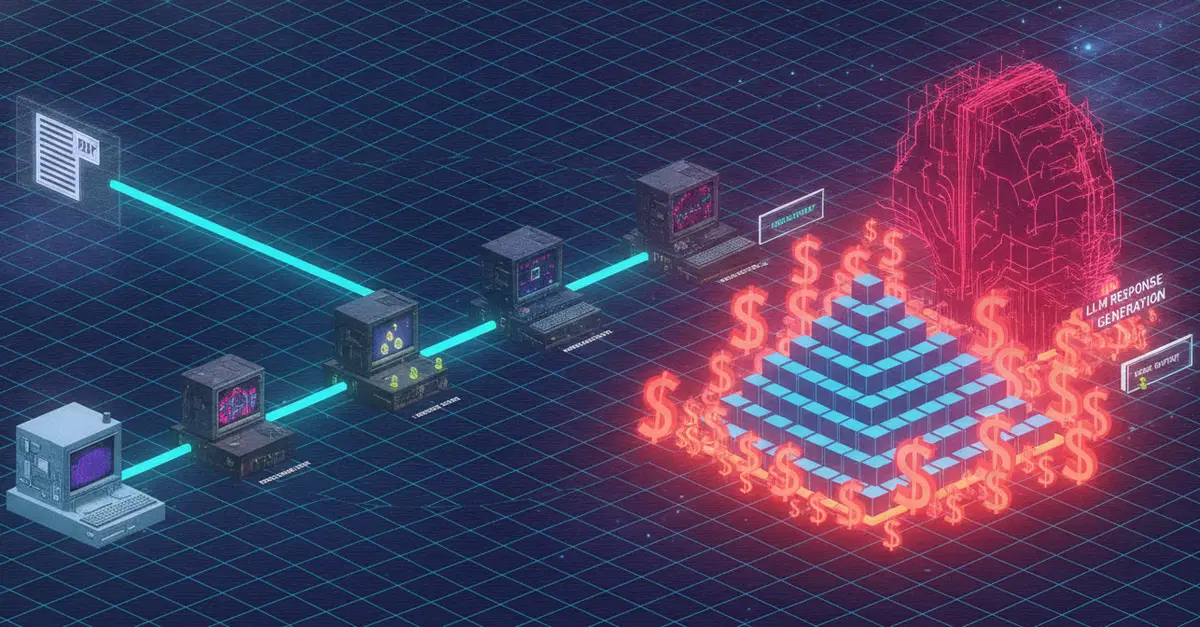
The Assumption About Embedding Costs
The prevailing wisdom in the RAG (Retrieval Augmented Generation) community is that embedding is prohibitively expensive. Developers are frequently advised to "avoid re-embedding at all costs." This belief, echoed by virtually every developer encountered and deeply ingrained in design decisions, suggests that the computational and financial resources required to generate embeddings are so substantial that minimizing them is paramount. Consequently, many RAG pipelines are built with strategies like semantic caching, aiming to reuse existing embeddings rather than generating new ones.
This article challenges that assumption. By meticulously dissecting a RAG pipeline and tracking actual costs, the investigation reveals that while embedding has a cost, it is often not the primary driver of expenditure. The real culprits are frequently found in other, less scrutinized stages of the process, particularly data loading and processing.
The impetus for this deep dive stems from a practical business principle: sustainable businesses understand precisely where their money goes. They don't just chase revenue; they obsess over efficiency. This philosophy, when applied to the technical architecture of a RAG system, offers a clearer picture of operational costs and potential optimization points. The goal is simple: burn less fuel, go further.
The journey began with a commitment to stop assuming and start measuring. Every stage of the RAG pipeline was examined to pinpoint where the actual financial drain occurs. What emerged was a surprising reordering of cost priorities, forcing a re-evaluation of common development practices.
Unpacking the RAG Pipeline and its True Costs
A typical RAG pipeline involves several key stages:
- Data Ingestion and Preprocessing: This involves collecting raw data, cleaning it, and preparing it for embedding. This can include parsing documents, removing noise, and segmenting text into manageable chunks.
- Embedding Generation: Each chunk of text is converted into a numerical vector representation using an embedding model.
- Vector Storage: These embeddings are stored in a vector database for efficient similarity search.
- Retrieval: When a user query is received, it is also embedded, and the vector database is searched for the most relevant text chunks based on vector similarity.
- Augmentation: The retrieved text chunks are combined with the original query.
- Generation: A large language model (LLM) uses the augmented prompt to generate a final response.
While the computational cost of running embedding models is undeniable, the investigation found that the cumulative cost of data loading, processing, and the subsequent LLM inference often dwarfs the expense of embedding. Consider the following breakdown:
The Data Loading Bottleneck
The process of ingesting, cleaning, and chunking large volumes of data can be surprisingly resource-intensive. This stage often involves significant CPU usage, memory consumption, and I/O operations, especially when dealing with diverse data formats (PDFs, HTML, DOCX, etc.) or complex preprocessing steps like OCR or advanced text cleaning. The overhead of managing these operations, orchestrating the data flow, and ensuring data integrity can quietly accumulate substantial costs, particularly if these tasks are not optimized for efficiency. This is akin to a factory spending too much time preparing raw materials, slowing down the entire production line before the main manufacturing even begins.
LLM Inference: The Silent Price Tag
The most significant cost center in many RAG systems is the final generation step, where a large language model synthesizes the retrieved information with the user's query. LLM inference, especially with larger, more capable models, requires substantial computational power (often GPUs) and can be a major expense. The cost here is not just about the number of tokens processed but also the latency and the complexity of the prompt. Each query that requires a complex retrieval and generation cycle incurs a direct cost associated with the LLM's operational time. This is where the "burn fuel" aspect of the business principle truly hits home.
Embedding Costs: A Re-evaluation
While embedding models do consume resources, their cost is often more predictable and, in many scenarios, less volatile than LLM inference or complex data pipelines. The computational cost per embedding is relatively stable once a model and batch size are chosen. The primary drivers of embedding cost are the volume of documents and the frequency of updates requiring re-embedding. However, when benchmarked against the continuous, query-by-query cost of LLM inference and the potential I/O and CPU demands of data loading, embedding often emerges as a secondary cost factor.
The surprise for many developers, and for the author of this investigation, is that the perceived high cost of embedding is often an overstatement when compared to the real-world operational expenses of a live RAG system. The focus on avoiding re-embedding, while valid for static datasets, can distract from optimizing the more dynamic and impactful costs associated with data handling and final response generation.
Rethinking Optimization Strategies
This cost re-evaluation has direct implications for how RAG pipelines should be optimized:
- Prioritize Data Pipeline Efficiency: Invest time in optimizing data ingestion, cleaning, and chunking. Efficient data handling reduces upstream costs and improves the quality of data fed into the embedding and LLM stages.
- Analyze LLM Inference Costs: Carefully select LLM models based on performance and cost. Explore techniques like prompt engineering to reduce the complexity and length of prompts, thereby lowering inference costs. Consider smaller, fine-tuned models for specific tasks where appropriate.
- Strategic Embedding: While avoiding unnecessary re-embedding is still wise, understand its relative cost. If data changes frequently, a well-managed re-embedding strategy might be more cost-effective than dealing with outdated or irrelevant information retrieved by an old embedding.
- Monitor and Measure Continuously: Implement robust monitoring to track costs at each stage of the pipeline. This data-driven approach is crucial for identifying new cost centers as the system scales or evolves.
The obsession with minimizing embedding costs, while well-intentioned, can lead developers to overlook more significant financial drains in their RAG systems. By shifting focus to data processing efficiency and LLM inference optimization, organizations can achieve more sustainable and cost-effective RAG deployments. The business principle holds true: know where your fuel is burned, and you can go further.