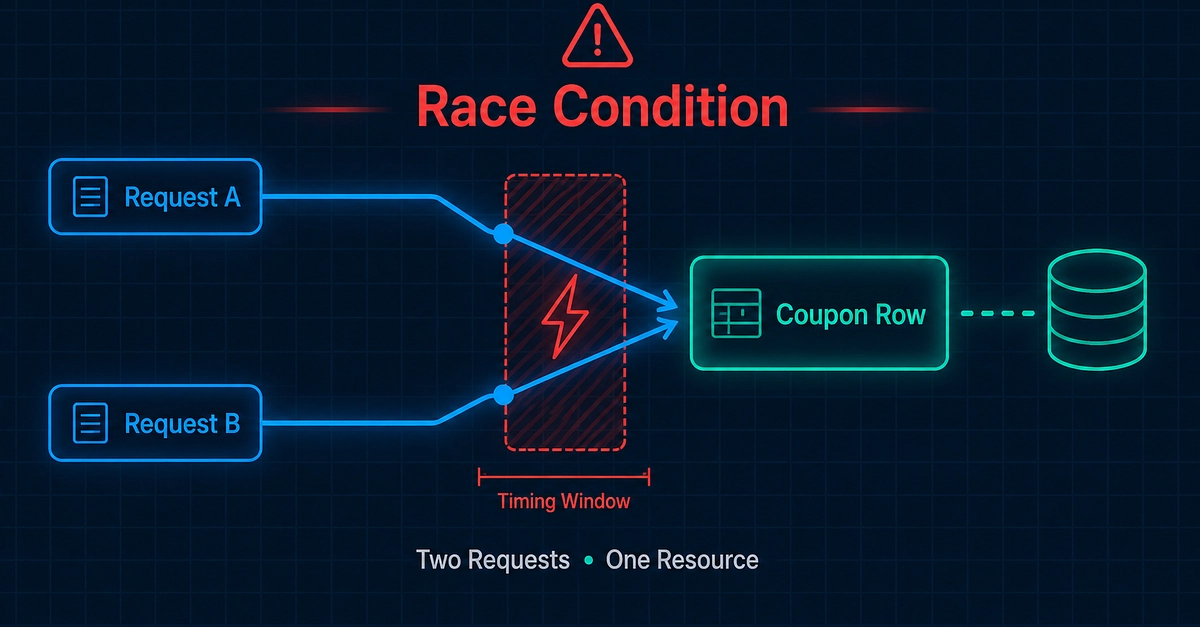
The Problem: The Missing Row
Imagine a support ticket: "The Teams page is empty. I added a member, but no team shows up." You check the API, and it's behaving exactly as written, returning an empty list. The problem isn't a bug in the API's retrieval logic, but a failure in the underlying data creation process. The crucial row that the page depends on was never created. This often happens when a system assumes a human will manually create a derived record, but the automated process that should have created it fails due to a race condition.
Consider a scenario where a user creates a new 'Team' and immediately adds a member. The system is designed to automatically provision a 'TeamMember' record and link it to the new 'Team'. However, if the user's request to create the 'Team' and the subsequent automated request to create the 'TeamMember' happen too close together, a race condition can occur. The 'Team' might be created, but before the system can reliably create the associated 'TeamMember' record, the user's request to view the 'Team' page might trigger. The page then queries for the 'TeamMember', finds none, and displays an empty state, even though the user's action was intended to populate it.
This isn't a failure of the database itself, but a timing issue in the application logic. The system faithfully reflects the state of the data, which is precisely the problem. The derived record simply never came into existence because the competing operations didn't coordinate properly.
Understanding Race Conditions in Record Creation
A race condition occurs when two or more operations access shared data, and the outcome depends on the unpredictable timing of their execution. In the context of auto-provisioning derived records, this typically involves two or more processes or threads attempting to create or modify related data simultaneously.
Let's break down a typical problematic flow:
- User initiates an action that requires a derived record (e.g., creating a team).
- The system begins the process of creating the primary record (the 'Team').
- Concurrently, or very shortly after, the system's automated logic attempts to create the derived record (the 'TeamMember') associated with the primary record.
- If the creation of the primary record is not yet fully committed or if the system attempts to look up the primary record before it's reliably available for the derived record creation, the derived record creation can fail silently or, worse, create a stale state.
- A subsequent request (e.g., viewing the team page) that relies on the derived record will find it missing, leading to the empty state reported by users.
The core issue is that the system makes assumptions about the state of the data at critical junctures. It assumes the primary record will be available, or that the creation of the derived record will have completed successfully, before subsequent operations proceed. When these assumptions are violated due to timing, the data integrity is compromised.
A .NET Solution: Leveraging Transactional Integrity and Idempotency
To combat this, we need a strategy that guarantees the derived record is created reliably, even if multiple requests arrive simultaneously. The solution involves a combination of robust transaction management and idempotent operations.
Transactional Creation
The most straightforward approach is to wrap the creation of both the primary record and its derived record within a single database transaction. This ensures that either both operations succeed, or neither does. If the derived record fails to create for any reason (including transient issues), the entire transaction is rolled back, preventing inconsistent states.
In .NET, using Entity Framework Core, this can look like:
using (var transaction = await _context.Database.BeginTransactionAsync())
{
    try
    {
        // 1. Create the primary record (e.g., Team)
        var team = new Team { Name = "New Project" };
        _context.Teams.Add(team);
        await _context.SaveChangesAsync();

        // 2. Create the derived record (e.g., TeamMember)
        // Ensure team.Id is available and valid here.
        var teamMember = new TeamMember { TeamId = team.Id, UserId = userId };
        _context.TeamMembers.Add(teamMember);
        await _context.SaveChangesAsync();

        // If both succeed, commit the transaction
        await transaction.CommitAsync();
    }
    catch (Exception ex)
    {
        // If any error occurs, roll back the transaction
        await transaction.RollbackAsync();
        // Log the exception and handle appropriately
        throw;
    }
}
This guarantees atomicity: the team and its member are created together or not at all. However, this doesn't fully solve the race condition if the system needs to *check for existence* before creating. A read-then-write operation within a transaction can still be problematic if not handled carefully.
Idempotent Provisioning with Locking
A more robust solution for auto-provisioning, especially when dealing with potentially concurrent requests that might check for the existence of a derived record before creating it, is to use an idempotent approach combined with locking mechanisms. Idempotency means that making the same request multiple times has the same effect as making it once.
Here's how you can implement this:
- Unique Key Constraint: Ensure your database table for the derived record has a unique constraint that enforces the relationship (e.g., a unique constraint on
(TeamId, UserId)forTeamMembers). This prevents duplicate derived records from being inserted, even if the application logic tries to create them multiple times. - Check-and-Create Logic: When a request comes in to create a primary record and its derived record, first check if the derived record already exists for that primary record and the relevant identifier (e.g., the user ID).
- Conditional Insertion: If the derived record does not exist, attempt to insert it. The unique key constraint will prevent a race condition where two processes try to insert the same derived record simultaneously; one will succeed, and the other will fail with a unique constraint violation.
- Handle Violations Gracefully: If the insert fails due to a unique constraint violation, it means another process has already created the derived record. This is not an error; it's the desired outcome. The system can simply ignore the violation and proceed as if the record was found.
This pattern can be implemented using SQL's INSERT ... ON CONFLICT DO NOTHING (PostgreSQL) or similar constructs in other databases. In .NET with Entity Framework Core, you might catch the DbUpdateException and inspect it for unique constraint violations. If it's a known unique constraint violation, you can simply reload the entity to get the already-created record.
Consider this C# pseudo-code:
public async Task EnsureDerivedRecordAsync(int primaryRecordId, string relevantIdentifier)
{
    // First, check if it already exists
    var existingDerivedRecord = await _context.DerivedRecords
        .FirstOrDefaultAsync(dr => dr.PrimaryRecordId == primaryRecordId && dr.Identifier == relevantIdentifier);

    if (existingDerivedRecord != null)
    {
        return; // Already exists, do nothing
    }

    // If not, attempt to create it.
    var newDerivedRecord = new DerivedRecord
    {
        PrimaryRecordId = primaryRecordId,
        Identifier = relevantIdentifier
    };

    try
    {
        _context.DerivedRecords.Add(newDerivedRecord);
        await _context.SaveChangesAsync();
    }
    catch (DbUpdateException ex)
    {
        // Check if the exception is due to a unique constraint violation
        if (IsUniqueConstraintViolation(ex))
        {
            // Another process created it. Re-fetch to get the actual entity.
            // This is the idempotent part: making the request again succeeds.
            await _context.Entry(newDerivedRecord).ReloadAsync();
            // Or find it again if reload isn't suitable:
            // existingDerivedRecord = await _context.DerivedRecords.FindAsync(newDerivedRecord.Id);
        }
        else
        {
            // It's a different error, re-throw
            throw;
        }
    }
}
The IsUniqueConstraintViolation method would need to inspect the inner exceptions and error codes specific to the database provider being used.
The Importance of Design: When to Auto-Provision
The decision of whether a record *should* be auto-provisioned by the system or created by the user is a critical design choice. Records that are essential for the core functionality of a feature, like the 'TeamMember' record for a 'Team' page to display correctly, are prime candidates for auto-provisioning. Relying on user action for these can lead to subtle bugs and poor user experiences.
By implementing transactional integrity and idempotent logic, developers can ensure that these derived records are created reliably, eliminating the