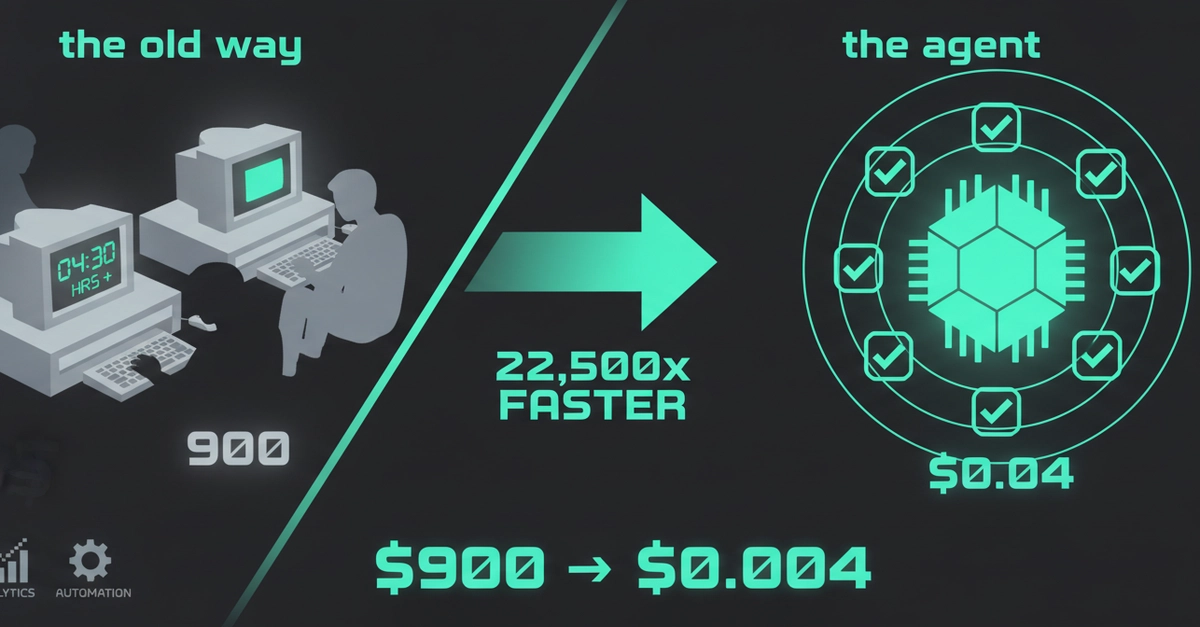
Monday, 9 AM. Conversion rates dip 3.2%. The product manager pings Slack: "What happened?" This is a familiar scene in SaaS companies. A data engineer queries the warehouse. A data analyst slices dashboards, examining segment by segment, device by device. Hours later, they might find the cause. Or they might conclude the drop was systemic and they just spent a morning chasing ghosts.
At an estimated $200 per hour for a data engineer and analyst pair, each investigation can cost around $900. For a SaaS company with meaningful traffic, these incidents occur two to three times a week. That amounts to over $150,000 annually spent answering a single, recurring question: "Why did this metric move?" Now, an AI agent built by developer Demba Sow promises to do the same job in two seconds for approximately $0.004, powered by Alibaba's Qwen large language model.
Automating the Data Investigation Workflow
The traditional process for diagnosing metric shifts involves several distinct, manual steps that require deep technical expertise and significant time. When a metric drops, a data engineer first needs to pull relevant data snapshots from the company's data warehouse. This involves understanding the schema, writing efficient SQL queries, and potentially dealing with large datasets. Simultaneously, or subsequently, a data analyst will slice and dice this data, looking for anomalies across different dimensions such as user segments, traffic sources, device types, geographic locations, and specific feature usage.
This investigative work is not just about querying; it's about hypothesis generation and testing. Analysts might hypothesize that a recent feature deployment caused the drop, or perhaps a marketing campaign underperformed, or a specific user cohort is experiencing issues. They then construct queries and visualizations to validate or invalidate these hypotheses. The process often involves cross-referencing data from different systems – application logs, CRM data, marketing analytics, and A/B testing platforms.
The surprising detail here is not the speed or cost difference, but the sheer volume of human hours currently dedicated to what is essentially a pattern-matching and root-cause analysis problem. This type of repetitive, albeit complex, diagnostic work is precisely what AI is suited to tackle. The agent's ability to ingest raw data, understand the context of metric movements, and generate hypotheses with associated evidence marks a significant shift in how data teams operate.

How the Qwen-Powered Agent Works
The agent's core functionality revolves around its ability to process and interpret data in a way that mimics a human analyst's thought process, but at machine speed. The developer explains that the agent takes two snapshots of data: one from before the metric change and one from after. It then compares these snapshots to identify significant deviations. This comparison isn't just a simple numerical difference; the agent analyzes which segments, dimensions, and features are most affected by the shift.
To achieve this, the agent leverages Qwen, a powerful large language model. LLMs are adept at understanding natural language instructions and generating human-like text, but their capabilities extend to complex data interpretation and reasoning. In this context, Qwen likely processes the data summaries and statistical differences, then uses its training to infer potential causes. It can weigh different factors, understand temporal relationships, and even consider common reasons for metric fluctuations in SaaS applications.
The agent's output is designed to be actionable. Instead of just stating that a metric dropped, it provides a concise explanation of *why* it dropped, citing specific segments or dimensions that are most impacted. For instance, it might report that the conversion rate drop was primarily driven by a decline in new users from the mobile app segment in North America, or that a specific feature update coincided with increased error rates for a particular user group. This level of detail allows product managers and engineers to immediately focus their attention on the most probable causes, bypassing the lengthy exploratory phase.
The Economic and Operational Impact
The economic implications are profound. By reducing the cost of each investigation from approximately $900 to fractions of a cent, companies can save hundreds of thousands of dollars annually. This direct cost saving is significant, but the indirect benefits are arguably more impactful. Faster incident response means quicker resolution of issues that affect user experience, revenue, and operational stability. For example, if a critical bug causes a drop in sign-ups, identifying and fixing it within minutes rather than hours can prevent substantial revenue loss and customer churn.
Furthermore, this automation frees up valuable data engineering and analyst time. Instead of spending their days on reactive investigations, these professionals can focus on more strategic, proactive work such as building predictive models, designing A/B tests, developing deeper insights into user behavior, and improving data infrastructure. This shift from reactive firefighting to proactive strategic analysis can significantly enhance a data team's overall contribution to the business.
The agent's success hinges on the underlying LLM's ability to perform complex reasoning tasks on structured data. Qwen's performance in this application suggests that LLMs are becoming increasingly capable of handling not just natural language processing but also analytical tasks that were once the exclusive domain of human experts. This opens up new avenues for AI-driven automation in fields that rely heavily on data analysis.
Broader Implications for Data Teams and AI Adoption
This development signals a broader trend: the increasing integration of AI into core business operations, particularly in areas that involve complex data analysis. For data teams, this agent represents a powerful new tool, not a replacement. It augments their capabilities, allowing them to operate more efficiently and effectively. The role of the data analyst may evolve to focus more on interpreting AI-generated insights, designing experiments to test hypotheses suggested by the AI, and ensuring the quality and integrity of the data the AI processes.
The success of this agent also highlights the growing maturity of open-source large language models like Qwen. While proprietary models often dominate headlines, robust open-source alternatives provide developers with flexibility and control, lowering the barrier to entry for building sophisticated AI applications. This democratizes access to advanced AI capabilities, enabling smaller companies or individual developers to create tools that can compete with those from larger, established players.
The question remains: what is the limit to this automation? While this agent handles a specific diagnostic task, many other data-related functions, such as strategic planning, experimental design, and complex causal inference, still require human intuition and domain expertise. However, as LLMs continue to advance, the boundary of what AI can automate in data analysis will undoubtedly continue to shift. If you're part of a data team, it's time to consider how such agents can integrate into your existing workflows to boost efficiency and strategic impact.