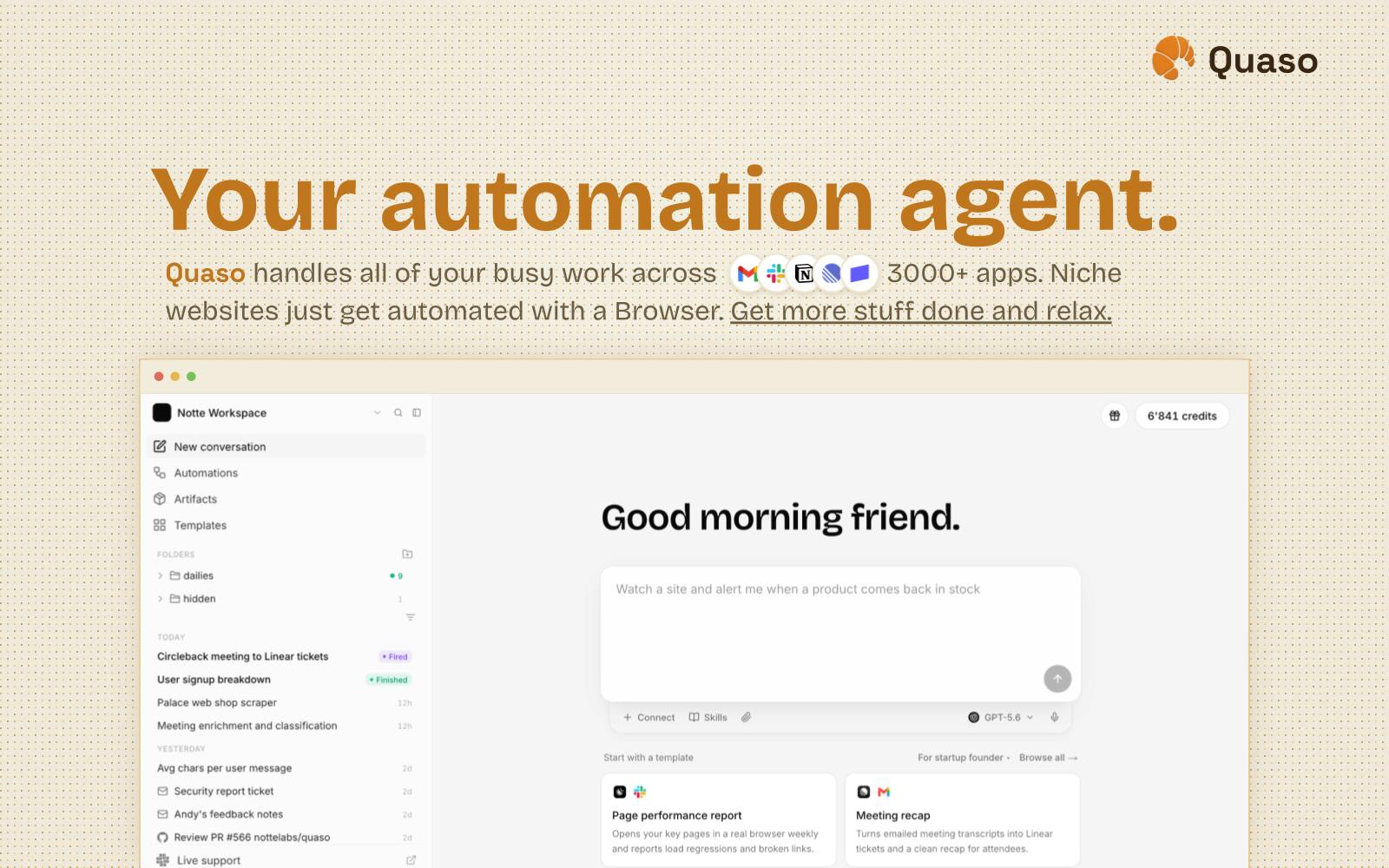
Introducing Quaso: The AI Automation Agent
In today's increasingly fragmented digital landscape, users often find themselves juggling multiple applications and browser tabs to complete even simple workflows. This constant context-switching can be a significant drain on productivity. Enter Quaso, a new AI automation agent aiming to simplify this process. Quaso positions itself as a tool that can perform tasks across different applications and within the web browser, leveraging artificial intelligence to understand and execute user-defined actions.
The core promise of Quaso is to act as an intelligent assistant that can automate repetitive or complex sequences of actions. Instead of manually clicking through menus, filling out forms, or copying and pasting data between different software, users can potentially delegate these tasks to Quaso. This capability is particularly relevant for professionals who rely on a suite of digital tools for their daily work, from project managers coordinating tasks to marketers analyzing campaign data, or even developers managing their coding environments.
At its heart, Quaso functions as an agent. This means it's designed to take initiative and perform actions on behalf of the user, rather than simply responding to direct commands. Think of it less like a chatbot that answers questions, and more like a highly competent intern who understands instructions and can navigate digital interfaces to get the job done. The agent's ability to operate across applications and the browser suggests a sophisticated understanding of user interfaces and task flows. This could involve anything from scheduling meetings across calendar applications, to extracting data from a website and inputting it into a spreadsheet, or even managing social media posts across different platforms.
How Quaso Aims to Automate Workflows
The underlying technology likely involves a combination of natural language processing (NLP) for understanding user instructions and computer vision or API integrations for interacting with applications and web pages. For instance, a user might instruct Quaso to "find all unread emails from my boss, summarize their content, and draft a reply based on my standard template." Quaso would then need to access the email client, parse the relevant emails, perform a summarization task (potentially using an integrated LLM), and then open the draft email interface to create the reply.
The challenge for any AI automation agent lies in its robustness and adaptability. Applications change their interfaces, websites update their layouts, and user needs evolve. Quaso's effectiveness will depend on its ability to learn from user interactions, adapt to these changes, and handle exceptions gracefully. The success of such an agent often hinges on its ability to interpret ambiguous instructions and to provide clear feedback to the user about its progress and any obstacles encountered.
One of the key differentiators for AI automation tools is the breadth of applications they can integrate with and the depth of actions they can perform within those applications. Quaso's claim to work "across apps or browser" suggests a broad scope. This could be achieved through a combination of specific integrations with popular software via APIs and more general browser automation techniques that mimic human interaction. The latter is often more brittle but allows for wider coverage of web-based tools.
The potential impact of such a tool is significant. For individuals, it could mean reclaiming hours spent on tedious digital chores, allowing them to focus on higher-value, creative, or strategic work. For businesses, widespread adoption of AI agents like Quaso could lead to substantial gains in operational efficiency, reduced error rates, and faster turnaround times for various business processes. The ability to automate complex cross-application workflows without extensive custom scripting or dedicated RPA (Robotic Process Automation) tools would lower the barrier to entry for automation.
The Competitive Landscape and Future Implications
The market for AI automation and agent-based tools is rapidly evolving. Quaso enters a space with established players offering various forms of workflow automation, from Zapier and IFTTT for simpler app integrations to more sophisticated RPA platforms and emerging AI-powered assistants. What sets Quaso apart, if its claims hold true, is the focus on an intelligent agent that can handle more complex, less predefined tasks across a broader spectrum of digital environments, including the unstructured environment of a web browser.
The surprising detail here is not the existence of AI automation tools, but the increasing sophistication and generalization of these agents. Previously, automation often required users to meticulously define every step. Now, tools like Quaso aim for a more intuitive, AI-driven approach where the agent infers intent and navigates the digital world more autonomously. This shift moves automation from a technical skill to a more accessible capability for a wider range of users.
If Quaso can deliver on its promise, it could significantly alter how individuals and teams manage their digital workflows. The ability to simply tell an AI agent what needs to be done, and have it orchestrate the necessary actions across disparate software, represents a step towards a more seamless and efficient digital experience. The success of Quaso will likely depend on its user experience, the reliability of its automation, and its ability to integrate with the ever-growing ecosystem of digital tools.
What nobody has addressed yet is what happens to the thousands of developers who built custom integrations or workflows on existing platforms if agents like Quaso become the de facto standard for cross-app automation. Will these existing integrations become obsolete, or will they find new ways to complement these AI agents?
For developers, this means a potential shift in how they approach building and integrating applications. The focus might move from building intricate UI-driven workflows to designing APIs and data structures that AI agents can more easily consume and manipulate. For founders, it signals an opportunity to build businesses that leverage these new automation capabilities or to integrate their own products to be discoverable and actionable by such agents, potentially creating new distribution channels.