Automating Quantum-Vulnerability Checks in CI/CD
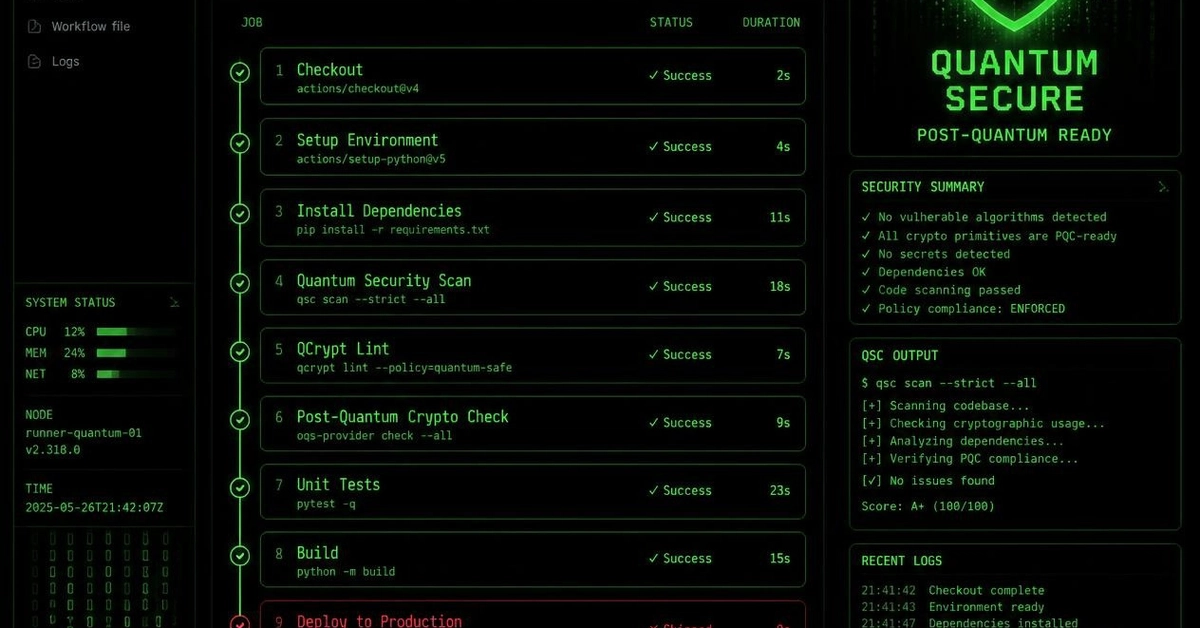
The race towards quantum computing presents a looming threat to current cryptographic standards. While the full impact of quantum computers on encryption is still some years away, the time to prepare is now. Developers need tools that can proactively identify and flag quantum-vulnerable cryptography within their codebases. The newly released quantum-audit tool aims to fill this gap by integrating directly into Continuous Integration and Continuous Deployment (CI/CD) pipelines, acting as a gatekeeper against deploying code with known quantum risks.
Traditional security scanning tools often report vulnerabilities but leave the remediation entirely to the developer. This can lead to findings being deprioritized or forgotten. quantum-audit takes a more assertive approach: when it detects critical quantum-vulnerable cryptography, it exits with a non-zero status code. This behavior is precisely what’s needed to make quantum vulnerability a hard stop in the development lifecycle, preventing potentially compromised code from reaching production.
This tool is the latest addition to a series exploring quantum-vulnerable cryptography, following investigations into blockchain NPM packages and the construction of an Abstract Syntax Tree (AST) scanner for JavaScript projects. The core principle is simple: if a vulnerability poses a critical risk, it should block the deployment process, forcing immediate attention and resolution.
How quantum-audit Works
quantum-audit operates by scanning a project's codebase for specific cryptographic algorithms and implementations known to be vulnerable to quantum attacks. These often include older versions of RSA, Diffie-Hellman, and Elliptic Curve Cryptography (ECC) that are susceptible to Shor's algorithm. The tool analyzes the Abstract Syntax Tree (AST) of the code to identify these cryptographic primitives and their configurations.
When quantum-audit identifies a critical instance of quantum-vulnerable cryptography, it does not merely log a warning. Instead, it terminates the build process with a non-zero exit code. This is a critical feature for CI/CD integration. Most CI/CD platforms are configured to treat a non-zero exit code from any script or tool as a build failure. This automatically halts the pipeline, preventing the problematic code from proceeding to testing, staging, or production environments.
To implement this, developers can add quantum-audit as a step in their CI configuration file (e.g., `.github/workflows/main.yml` for GitHub Actions, `.gitlab-ci.yml` for GitLab CI, or `Jenkinsfile` for Jenkins). The configuration is straightforward, typically involving installing the tool and then running it against the project's source files. The tool's output is then interpreted by the CI/CD system as a pass or fail signal based on the exit code.
Integrating into CI Pipelines
Integrating quantum-audit into a CI pipeline is designed to be a simple, declarative process. The exact implementation will vary slightly depending on the CI/CD platform used, but the core concept remains the same: execute the audit tool and treat its exit code as the build status.
For example, in a GitHub Actions workflow, a step could look like this:
- name: Run Quantum Audit
  run: npx quantum-audit .
  # quantum-audit will exit with non-zero code if vulnerabilities are found
The `npx quantum-audit .` command executes the tool in the current directory. If the tool finds any critical vulnerabilities, it will exit with a non-zero status, causing GitHub Actions to mark the job as failed. This immediate feedback loop is crucial for developers to address quantum risks before they become deeply embedded in the codebase.
Similarly, for GitLab CI, a job definition might include:
quantum_audit_job:
  stage: build
  script:
    - npm install -g quantum-audit
    - quantum-audit .
  allow_failure: false
The `allow_failure: false` ensures that any job failure, including one triggered by quantum-audit's non-zero exit code, will fail the entire pipeline. This strict gating mechanism is the most effective way to enforce security policies related to quantum-vulnerable cryptography.
The Quantum Threat Landscape
The development of powerful quantum computers poses a significant threat to public-key cryptography. Algorithms like Shor's algorithm can efficiently factor large numbers and compute discrete logarithms, breaking widely used cryptosystems such as RSA and ECC. While cryptographically relevant quantum computers are not yet a reality, the transition to quantum-resistant cryptography (also known as post-quantum cryptography or PQC) is a complex and lengthy process.
This transition involves standardizing new algorithms, updating software libraries, and migrating existing systems. The challenge is that many systems have long lifecycles, and the data they protect may need to remain secure for decades. Therefore, identifying and mitigating current cryptographic weaknesses that will be exploitable by future quantum computers is a critical proactive step.
quantum-audit addresses this by targeting the identification of these known quantum-vulnerable primitives in existing code. It doesn't aim to replace PQC migration efforts but rather to provide an immediate safety net, preventing the deployment of code that relies on algorithms that will soon be obsolete due to quantum advancements. The tool’s focus on critical vulnerabilities and its direct CI/CD integration make it a practical solution for developers looking to harden their applications against the eventual quantum threat.
What's Next for Quantum-Audit
The introduction of quantum-audit marks a significant step in making quantum-vulnerability assessment accessible and actionable for developers. By integrating directly into development workflows, it shifts the responsibility of identifying these risks from a post-hoc analysis to a continuous, automated process.
Future developments could include expanding the range of detectable vulnerabilities, supporting more programming languages and cryptographic libraries, and providing more granular reporting. The ultimate goal is to make the detection and remediation of quantum-vulnerable cryptography as routine as checking for other critical security flaws. As quantum computing technology progresses, tools like quantum-audit will become indispensable for maintaining the long-term security of software systems.
The surprising detail here is not the existence of the tool itself, but its direct, opinionated approach to failure. Many security tools offer warnings; quantum-audit forces action by breaking the build. This is a crucial differentiator for teams serious about future-proofing their cryptographic implementations.