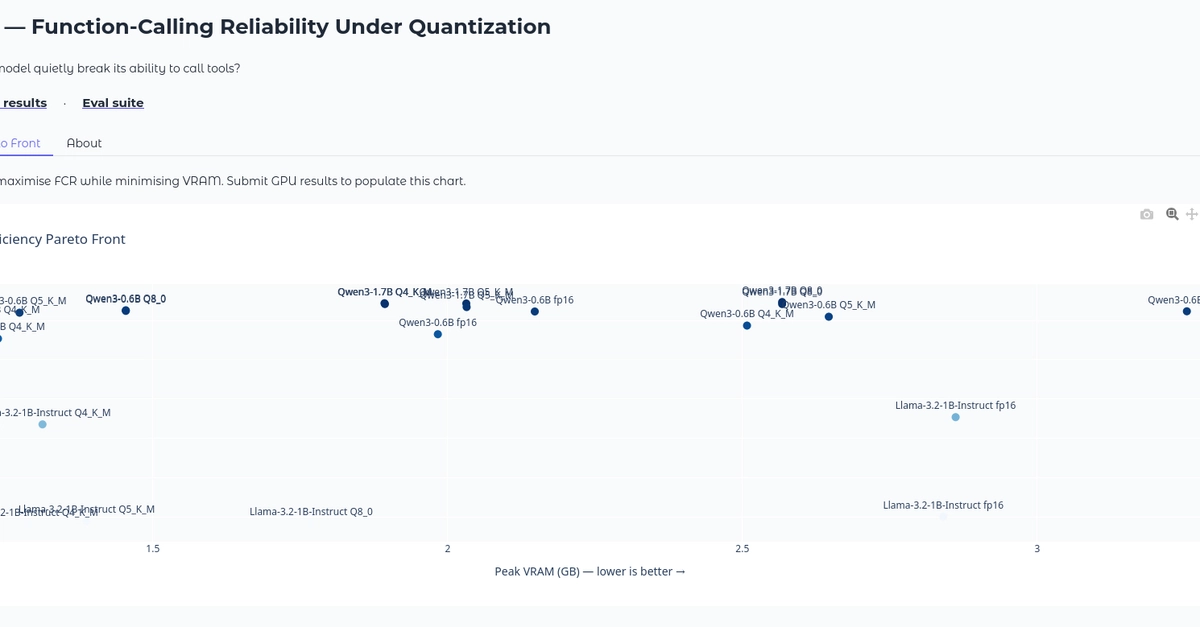
Quantization and Tool-Calling: The Anecdotal Problem
The local LLM community frequently debates the safety of 4-bit quantization (Q4) for models used in tool-calling applications. Historically, answers have been based on anecdotal evidence, extrapolating from limited testing on specific models. This approach lacks rigor, making it difficult for users to trust Q4 for critical tasks. To address this, a new benchmark, QuantCall, has been developed to provide a statistically sound evaluation of quantization’s impact on tool-calling capabilities.
QuantCall moves beyond subjective observations by employing a bootstrapping method to measure per-seed delta. This ensures that degradation claims are based on robust statistical analysis, not just visual inspection of overlapping confidence intervals. The goal is to provide a definitive, data-driven answer to the question: “Is Q4 safe for tool-calling?”
QuantCall Methodology and Hardware
The benchmark was designed and executed entirely on consumer-grade hardware, specifically an RTX 3050 Laptop GPU with 4096 MiB of VRAM. This constraint is deliberate; it reflects the reality for many users running LLMs locally on modest hardware. The models tested are therefore small, ranging from 0.6 billion to 1.7 billion parameters, representing the kind of models accessible to this hardware class.
The testing setup utilizes BFCL v4, a framework that includes specific test cases: T1 (simple and multiple tool calls) and T6 (irrelevance). Each test involves 200 examples per seed, with three seeds used for statistical robustness. Greedy decoding and a temperature of 0 were employed to ensure deterministic and repeatable results. Crucially, the evaluation focuses on several key metrics:
- Schema-Validity Rate (SVR): Measures how often the LLM’s output adheres to the expected JSON schema for tool calls.
- Tool-Selection Accuracy (TSA): Assesses whether the LLM correctly identifies and selects the appropriate tool for a given query.
- Argument Correctness (AC): Evaluates the accuracy of the arguments provided by the LLM for the selected tool.
- Abstention Accuracy: Measures how often the LLM correctly abstains from calling a tool when no relevant tool is available.
- Function-Calling Reliability: An overall metric combining the above to gauge the dependable performance of the tool-calling function.
Quantization's Measured Impact on Tool-Calling Metrics
The core of the QuantCall benchmark lies in comparing the performance of quantized models against their full-precision counterparts across these metrics. The results, derived from the bootstrapped per-seed delta, aim to provide statistically significant findings.
Initial findings suggest that for the tested models and hardware, 4-bit quantization does not catastrophically break tool-calling capabilities. The SVR remains high, indicating that the structural integrity of the tool call outputs is largely preserved. Similarly, TSA and AC show minimal degradation, implying that LLMs can still accurately select the correct tools and provide the necessary arguments even when quantized to Q4.
The Abstention Accuracy and Function-Calling Reliability metrics also hold up surprisingly well. This suggests that the LLM’s reasoning process, which underpins its ability to choose or refrain from choosing a tool, is not severely impaired by Q4 quantization on these smaller models. The surprise here is not that some degradation exists, but that it is often within acceptable margins for many practical applications, even on hardware as constrained as a 4GB laptop GPU.
Implications for Local LLM Deployment
The QuantCall benchmark provides critical data for developers and users operating LLMs on consumer hardware. It directly challenges the prevailing caution around Q4 for tool-calling tasks, offering empirical evidence that Q4 is indeed viable for many such applications. This has significant implications for resource-constrained environments.
By validating Q4, QuantCall enables users to run more powerful models or achieve faster inference speeds on the same hardware. This democratizes access to capable AI tools, allowing for sophisticated agentic workflows to be deployed on laptops, edge devices, and other low-resource platforms where full-precision models would be impractical or impossible to run.
The benchmark's methodology, focusing on rigorous statistical measurement rather than anecdotal observation, sets a new standard for evaluating LLM performance in specific tasks. As LLMs continue to be integrated into diverse applications, such detailed, hardware-specific benchmarks will become increasingly essential for making informed deployment decisions.
Future Directions and Unanswered Questions
While QuantCall offers a valuable snapshot, it also opens avenues for further research. The current benchmark focuses on a specific set of small models and a particular hardware configuration. What happens when larger models, or different quantization schemes (like Q5, Q8, or even mixed-precision), are tested? Do the findings hold across a wider variety of tool-calling frameworks and prompt engineering techniques?
Furthermore, the long-term stability and potential for subtle, emergent failures in quantized models over extended agentic sessions remain areas for exploration. The benchmark provides a strong starting point, but the journey toward fully understanding and trusting quantized LLMs for complex, real-world applications is ongoing. The question of whether these findings generalize to more complex reasoning tasks beyond direct tool-calling also looms large.