The Challenge of Distributed Data Processing
As datasets grow and computational demands increase, processing data efficiently becomes a critical bottleneck. Traditional approaches often involve centralizing data, which can lead to I/O limitations and single points of failure. For analytical workloads, especially those leveraging the power of in-process analytical databases like DuckDB, distributing queries across multiple nodes can offer significant performance gains. However, orchestrating these distributed queries, managing connections, and aggregating results presents a complex engineering challenge.
DuckDB, a fast, in-process analytical data management system, excels at handling large datasets directly within an application. Its columnar storage and vectorized query execution engine make it a compelling choice for local data analysis. The challenge arises when a single DuckDB instance becomes insufficient, either due to memory constraints or the desire to parallelize processing across multiple machines for speed. Running SQL queries concurrently across several independent DuckDB servers requires a robust mechanism for distributing the query, collecting intermediate results, and combining them into a final output.
Introducing Quack for Remote DuckDB Orchestration
Quack emerges as a solution to this problem, providing a straightforward method for executing SQL queries across multiple remote DuckDB instances simultaneously. This experimental tool aims to simplify the process of distributed data processing by abstracting away the complexities of network communication, query partitioning, and result aggregation.
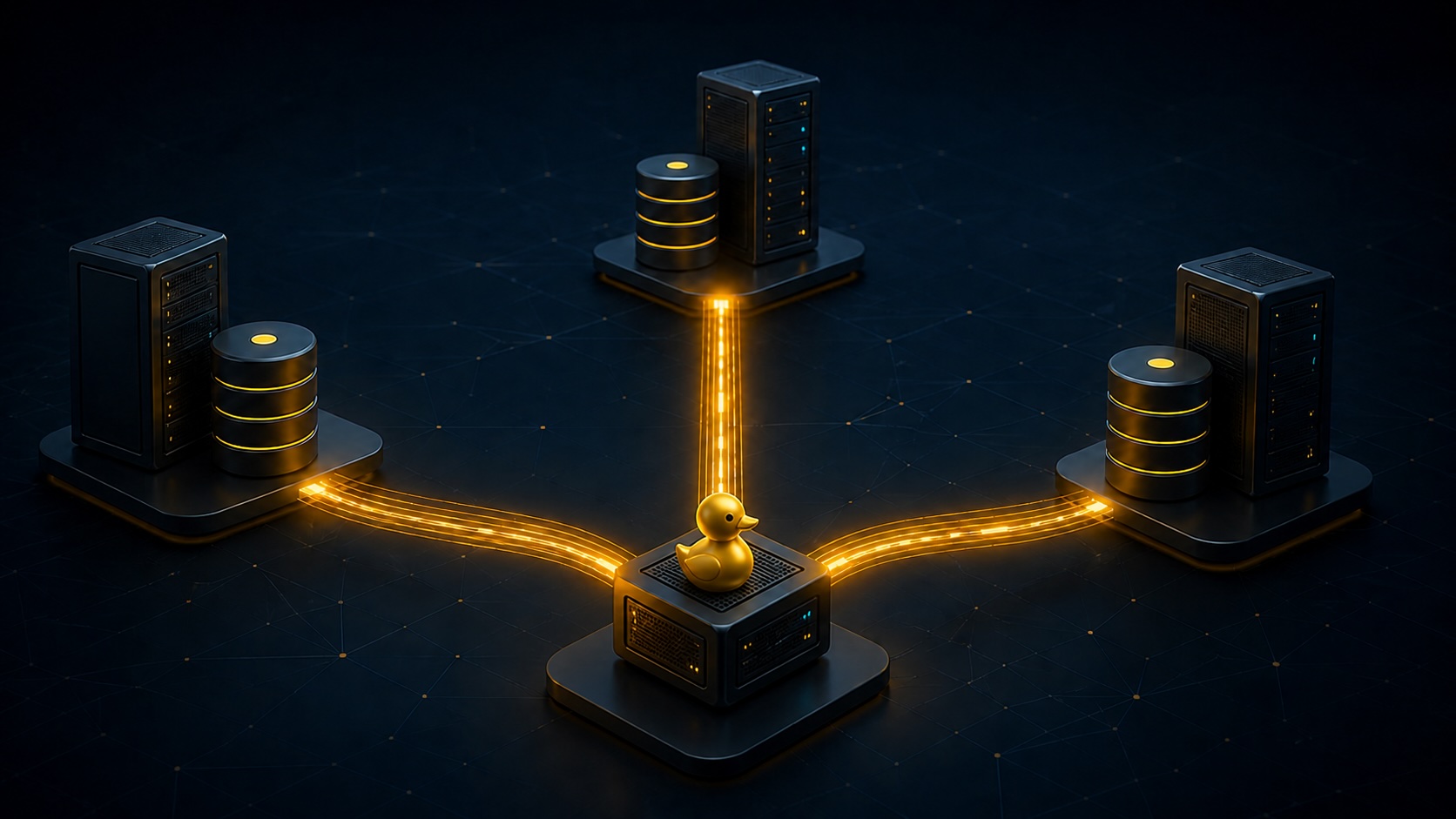
At its core, Quack operates by connecting to several DuckDB servers, which are assumed to be running remotely and accessible over the network. The user defines a SQL query and specifies the target DuckDB instances. Quack then distributes this query to each of the specified instances. Each instance processes its portion of the query independently. Once the individual instances complete their tasks, Quack collects the results from each server and merges them into a single, coherent result set. This aggregation step is crucial for presenting a unified view of the data, as if the query had been run against a single, larger database.
How Quack Works Under the Hood
The architecture of Quack is designed for simplicity and effectiveness. It leverages Python as the primary development language, making it accessible to a broad range of developers familiar with the data science ecosystem. The tool likely employs a client-server model, where the Quack client orchestrates the operations and the remote DuckDB instances serve as the execution engines.
When a query is submitted through Quack, the tool first establishes connections to each of the configured remote DuckDB servers. This often involves managing connection strings, authentication, and ensuring network accessibility. Once connections are active, Quack sends the identical SQL query to each server. The key to concurrency lies in the fact that these network requests and subsequent query executions happen in parallel. This is typically managed using asynchronous programming techniques or multithreading/multiprocessing within the Quack client.
Each remote DuckDB server then executes the SQL query against its local data. The efficiency of this step is dependent on the performance of the individual DuckDB instances and the data they hold. After a server finishes processing, it returns its results to the Quack client. The client is responsible for gathering these results from all participating servers. A critical component of Quack is its ability to handle potentially different result formats or sizes from each server and to merge them appropriately. This aggregation might involve simple concatenation if the queries are designed to return compatible schemas, or more complex operations if the distributed query requires intermediate joins or aggregations performed by Quack itself.
Use Cases and Potential Benefits
The primary benefit of using Quack is accelerated data processing. By distributing a single query across multiple machines, the total execution time can be significantly reduced, especially for read-heavy analytical tasks. This is particularly useful when dealing with large datasets that might overwhelm a single server or when leveraging existing distributed infrastructure.
Consider a scenario where a company has partitioned its data across several smaller, cost-effective servers, perhaps for regulatory reasons or to manage large files. With Quack, analysts can query this distributed dataset as if it were unified, without needing to move or merge the data beforehand. This approach can save considerable time and resources associated with data migration and management.
Another potential use case involves enhancing the resilience of data processing. If one of the remote DuckDB servers experiences an issue, Quack might be designed to either retry the query on that specific server or to continue processing with the remaining available instances, depending on its fault-tolerance capabilities. While the current iteration is described as an experiment, future developments could incorporate more sophisticated error handling and load balancing.
For developers and data scientists, Quack offers a way to scale their DuckDB-based analytics without migrating to more complex distributed database systems. It provides a familiar SQL interface while unlocking the potential for parallel computation. This can be especially valuable for prototyping and for applications where the scale of data does not warrant a full-fledged distributed database cluster.
Limitations and Future Directions
As an experimental tool, Quack likely has limitations. The current implementation focuses on running identical queries across all specified servers. This means that queries requiring fine-grained data partitioning or specific data placement on different servers might not be directly supported without pre-processing the data on each node. The effectiveness of Quack is also highly dependent on the network latency and bandwidth between the client and the remote servers, as well as the performance of the individual DuckDB instances.
Furthermore, the complexity of the aggregation step can become a bottleneck if not handled efficiently. For queries that produce very large result sets from each server, the overhead of collecting and merging these results could diminish the performance gains achieved through parallel execution. The tool's fault tolerance mechanisms, if any, would also need to be robust for production environments.
Future directions for Quack could include support for more complex query distribution strategies, such as sending different parts of a query to different servers based on data characteristics. Enhanced error handling, automatic server discovery, and more sophisticated result aggregation techniques would further solidify its utility. Exploring integration with data orchestration frameworks like Apache Airflow or Prefect could also make Quack a more powerful tool in production data pipelines.
Conclusion
Quack represents an intriguing step towards simplifying distributed SQL execution for DuckDB users. By enabling concurrent queries across multiple remote instances, it offers a path to faster data processing and more scalable analytics. While currently an experiment, it highlights the growing need for tools that bridge the gap between powerful in-process databases and the demands of distributed computing. Its success will depend on its ability to balance performance gains with ease of use and robustness.